
Toulouse Airport Guide: Where Airbus Meets the Airlines
Toulouse Airport shares its runways with the home of Airbus. Codes, halls, airlines, routes, transport links and the best spotting locations explained.
 By The Aviation Hub
6 min read
Updated October 20, 2026
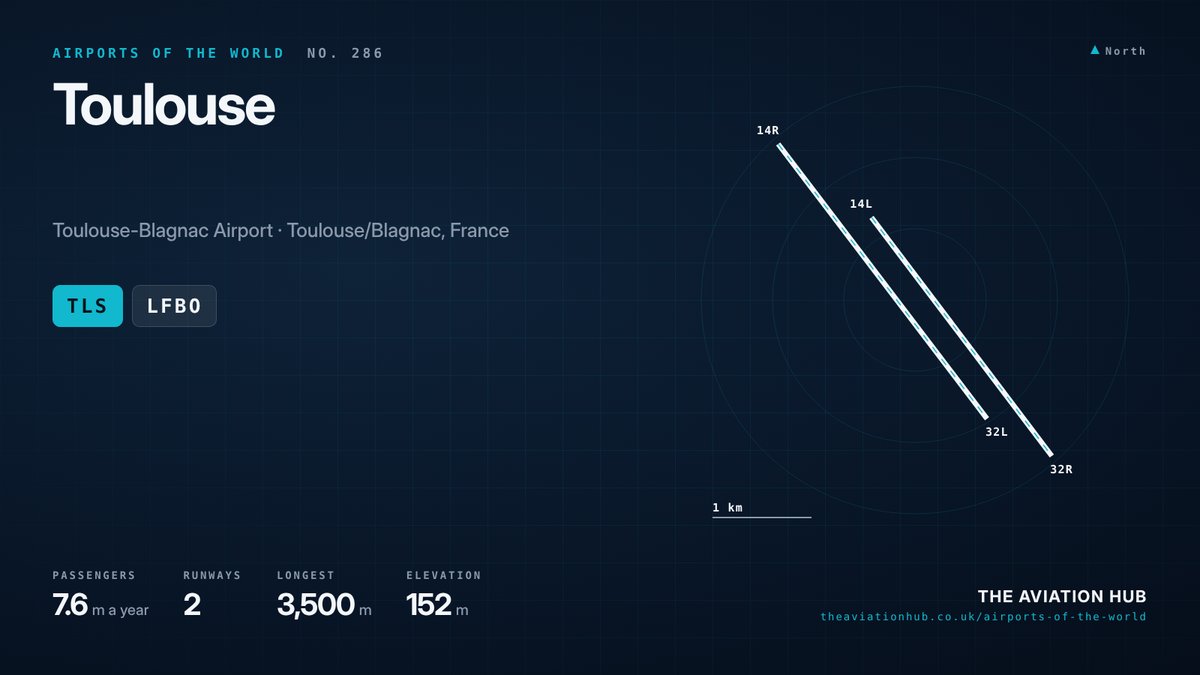
Toulouse Blagnac sits on the north west edge of the capital of Occitanie, and it shares its runways with the final assembly lines of Airbus. Toulouse Airport handles close to eight million passengers a year, which places it among the larger regional airports in France. Most of that traffic is domestic and European, built on a heavy Paris shuttle and a growing low cost network. For enthusiasts the field means something more. New Airbus jets make their first flights and delivery flights here, often with a Beluga in the circuit.
Toulouse Airport at a Glance
The IATA code is TLS and the ICAO code is LFBO. The airport lies about 4 miles (6.7 km) west north west of the city centre, mostly within the commune of Blagnac, at an elevation of 152 metres (499 ft). It covers around 780 hectares. There are two parallel runways and a single terminal divided into four halls, lettered A to D.
Traffic reached roughly 7.8 million passengers in 2024, still short of the pre pandemic peak of more than nine million. Air France and easyJet are the largest carriers, and easyJet bases aircraft at the airport. The operating company, Aéroport Toulouse Blagnac, holds a concession that runs to 2046. Flight times, parking rates and transport updates are on the airport’s official website.
How Toulouse Became an Aviation City
Toulouse has a long claim on French aviation. In the 1920s Latécoère and its successor Aéropostale flew mail to Africa and South America from Montaudran, on the south east side of the city, with pilots such as Jean Mermoz at the controls. Blagnac came into its own after the Second World War, when airline flying and aircraft manufacturing gathered on the flat land beside the Garonne. The airport takes its name from the commune that hosts most of it.
The manufacturers made the field famous. The Sud Aviation Caravelle first flew from Blagnac in May 1955, and Concorde 001 lifted off here on 2 March 1969. Airbus settled next door in the 1970s, and the A300B prototype flew in October 1972. The Airbus A380 followed on 27 April 2005, watched by tens of thousands of people. On the passenger side, Hall B opened in 1978 and Hall D in 2010. The state sold a 49.99 per cent stake in 2015 to a Chinese consortium, which passed it to the French group Eiffage in 2019.
Runways at Toulouse Airport
Toulouse Airport has two parallel asphalt runways, both 45 metres wide. Runway 14R/32L, on the western side, is 3,500 metres (11,483 ft) long. Runway 14L/32R, nearer the terminal, is 3,000 metres (9,843 ft) long. Airline traffic normally uses 14L/32R. The longer runway sits beside the Airbus delivery centre and carries most of the test, acceptance and delivery flying for Airbus and ATR, along with formation flights for publicity photographs.
The prevailing westerly and north westerly winds favour the 32 direction. When the Autan, a warm south easterly, sets in, operations swing to 14. The test flying carries real risk. In June 1994 an Airbus A330-300 crashed shortly after take off during a test simulating an engine failure, killing all seven on board. In November 2007 a brand new Airbus A340-600 for Etihad ran through a blast wall during a ground engine test and was written off.
Terminals and Airlines
The terminal at Toulouse Airport covers about 100,000 square metres, with 68 check in counters and 34 gates spread across four halls. Hall A serves domestic regional flights from eight stands. Hall B, the oldest of the four, has ten gates. Hall C handles European flights from six gates. Hall D, opened in 2010, has ten gates and takes international and long haul services.
Air France runs the heaviest schedule, with Paris at its core, and KLM connects SkyTeam passengers through Amsterdam. Lufthansa, Brussels Airlines, TAP Air Portugal and Turkish Airlines bring Star Alliance links via Munich, Brussels, Lisbon and Istanbul, while British Airways flies to Heathrow. easyJet, Ryanair and Volotea run the biggest low cost networks, with Transavia also present. North African carriers, including Air Algérie, Royal Air Maroc and Tunisair, serve the city’s large Maghreb community.
Routes and Destinations
Paris dominates the departure boards, with Air France flying to Charles de Gaulle and easyJet and Transavia flying to Orly. From Toulouse Airport the flight takes little more than an hour, while the rail journey to the capital still takes more than four hours, which keeps the air shuttle relevant. Other domestic routes run to Lille, Lyon, Nantes, Strasbourg, Nice and the four Corsican airports. Domestic flying has shrunk since the pandemic as business travel moved online and Air France trimmed its network.
The international map is broader. As of March 2024 the airport served 84 destinations, mostly in Europe and North Africa. London, Amsterdam, Brussels, Lisbon, Rome and Istanbul see regular service, and Algiers, Oran, Casablanca, Marrakesh and Tunis carry heavy family and leisure traffic. The longest route is the Corsair service to Saint Denis on Réunion, about 5,620 miles (9,050 km) away, and Montreal is served across the Atlantic. Summer adds Greek islands, the Balearics and other sun routes.
Getting to and from Toulouse Airport
For now the airport shuttle bus is the simplest public option. It leaves from outside Hall B every 15 minutes and reaches the city centre in around 20 minutes when traffic allows, stopping at Compans Caffarelli, Jeanne d’Arc, Jean Jaurès and Matabiau railway station. The T2 tram branch closed in 2023 to make way for metro works. A replacement service, the Aéroport Express, is due at the end of 2026 and will link the terminal with Blagnac in about seven minutes.
By road, the A621 links the terminal with the Toulouse ring road. A taxi to the centre takes 20 to 30 minutes and costs roughly €30 to €40 (about £26 to £35). Multi storey and surface car parks sit in front of the halls, with cheaper economy areas further out. Three daily coaches connect Toulouse Airport with Andorra, a useful option for skiers in winter.
Spotting and Photography
Toulouse Airport is one of the great European destinations for Airbus fans. The Aeroscopia museum, opened in 2015 on the north western edge of the field facing the A380 assembly halls, displays Concorde, a Super Guppy and other historic types, with an outdoor tarmac of larger jets. Airbus factory tours also start there. On a typical day the movements include A320neo family test flights, A350s on acceptance sorties and Beluga XL freighters bringing in sections from other European plants.
The lanes and roundabouts on the western side, around Cornebarrieu and Aussonne, offer the classic views of the Airbus runway and delivery ramps. That side keeps the sun behind the camera in the afternoon. The Airbus sites are high security zones. Stay on public land, never climb fences, do not stop on main roads and expect questions from the gendarmerie if you linger near the factory gates.
What Comes Next
Surface access is the immediate priority. The Aéroport Express will meet metro Line C at Blagnac, where an interchange is due by the end of 2028, giving a fast link across the city. Further out, the planned high speed line from Bordeaux should cut rail times to Paris to around three hours in the early 2030s. That will put the Paris air shuttle under real pressure.
Toulouse Airport is unlikely to grow fast, but its mix of airline traffic and aircraft manufacturing gives it a character few airports can match. Expect steady leisure and North African growth, a shrinking domestic share and Airbus flying for decades to come. See how it compares with other French fields on the Airports of the World map.
Continue to follow The Aviation Hub for more analysis and insight.
Advertise with us Your brand, in front of an aviation audience Home page and in-article placements, sold directly, one advertiser per slot. From £250 a year. See the rates

