
Trabzon Airport Guide: Black Sea Runway and Gulf Summers
Trabzon Airport sits on the Black Sea shore beside the city. Its runway, Pegasus base, Gulf summer flights, transport links and future plans.
 By The Aviation Hub
6 min read
Updated October 20, 2026
Trabzon Airport sits right on the Black Sea shore, a few miles east of the historic port city of Trabzon in north eastern Turkey. It is the main air gateway to the eastern Black Sea coast, its tea plantations and its green highland plateaus. Close to four million passengers used it in 2025, most of them flying to and from Istanbul. Each summer the field also fills with flights from the Gulf, carrying visitors in search of cool mountain air.
Trabzon Airport at a Glance
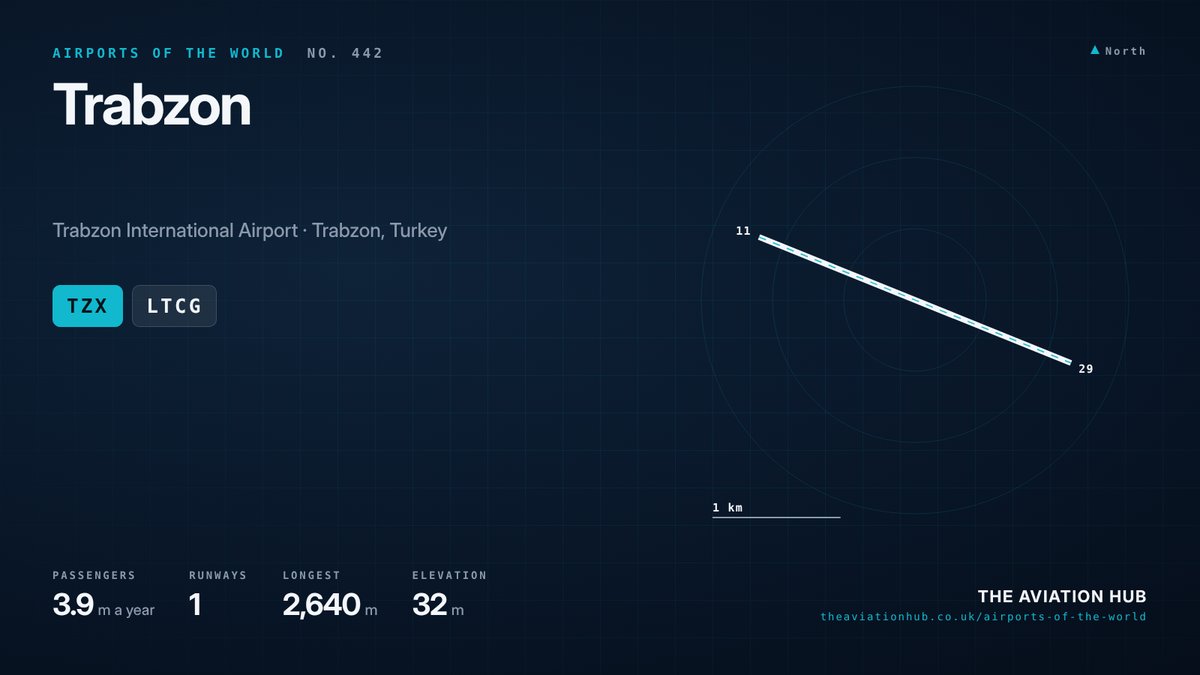
The IATA code is TZX and the ICAO code is LTCG. The airport lies about 3.5 miles (5.5 km) east of the city centre, squeezed between the coast road and the sea. It sits 104 feet (32 m) above sea level, with one runway. Trabzon Airport handled 3,874,640 passengers in 2025, up 6 per cent, of whom about 3.03 million flew domestically and around 845,000 internationally. Aircraft movements reached 26,507.
The airport is run by DHMI, the Turkish state airports authority. Pegasus Airlines has an operating base here, and Turkish Airlines, AJet and SunExpress are the other main domestic players. Annual capacity is put at four million passengers, so the field is running close to its limit. Flight information is on the airport’s official website.
A Short History of Trabzon’s Airfield
The airport opened in 1957, giving the isolated eastern Black Sea region a fast link to Ankara and Istanbul at a time when the coastal highway was slow and mountain roads were worse. The flat coastal strip east of the city offered one of the few level sites in a region where the Pontic Mountains rise almost straight from the shore.
Its Cold War location close to the Soviet border produced a famous episode. On 20 May 1989 Soviet pilot Alexander Zuyev landed a MiG-29 at Trabzon and defected. Turkey returned the jet to the USSR, while Zuyev was granted asylum in the United States. The airport has since grown on the back of domestic travel, diaspora flights to Germany and, from the 2010s, Gulf tourism.
Traffic peaked at about 4.15 million passengers in 2017. Trabzon Airport also faces competition from new airports at Ordu Giresun, opened in 2015, and Rize Artvin, opened in 2022, both built on land reclaimed from the sea. Even so, numbers recovered strongly after the pandemic.
Runways at Trabzon Airport
There is a single asphalt runway, 11/29, measuring 2,640 metres (8,661 feet) long and 45 metres wide. It runs parallel to the shoreline, with the sea on its northern side and the city and mountains to the south. The length comfortably suits the Boeing 737 and Airbus A320 families that dominate, and it accepts wide body aircraft on Gulf and charter services.
Approaches demand care. Steep terrain rises just inland, and fog and low cloud roll in off the Black Sea. On 26 May 2003 a Yak-42 chartered by the Spanish government crashed into a mountain about 14 miles (23 km) south west of the field during a night approach in fog, killing all 75 people aboard. On 13 January 2018 a Pegasus Boeing 737-800 veered off the left side of runway 11 on landing and came to rest on the slope above the sea. None of the 168 people aboard was seriously injured.
Terminals and Airlines
Domestic and international flights are handled in separate terminal areas on the southern side of the runway, close to the coast road. Facilities are compact. Summer peaks, when Gulf charters overlap with domestic holiday traffic, can make the halls crowded, which is one reason pressure for more capacity keeps building.
Turkish Airlines flies to Istanbul Airport, while Pegasus and AJet concentrate on Istanbul Sabiha Gokcen. Pegasus also links Trabzon Airport with Antalya, Izmir, Adana and Ercan in Northern Cyprus, plus seasonal routes to the Middle East and Europe. AJet adds Ankara, Bursa and Diyarbakir. SunExpress serves Antalya, Izmir, Dusseldorf and Muscat. In summer Gulf Air, Qatar Airways and flydubai join the mix, and flynas scheduled flights from Abha from 25 June 2026.
Routes and Destinations
Istanbul dominates. Between Turkish Airlines, Pegasus and AJet, flights to the city’s two airports run throughout the day and account for a large share of domestic traffic. Ankara, Izmir and Antalya follow. Germany matters too, because many families from the region live there, and SunExpress and charter airlines carry them home each summer.
The Gulf market is the seasonal story. From June to September, visitors from Saudi Arabia, Kuwait, Qatar, Bahrain and the United Arab Emirates arrive to escape the desert heat. Most head for Uzungol lake and the highland pastures. Trabzon Airport sees a sharp jump in international traffic during these months, and in March 2026 permits were reported for two weekly flights to Tashkent. Cargo is modest and mostly carried in passenger holds.
Getting to and from Trabzon Airport
The airport is close enough to the centre for a short ride. Shuttle buses and city buses run along the coast road to the central Meydan area in around 20 minutes, and shared dolmus minibuses pass the airport entrance. They are the cheapest sensible option. Taxis wait outside arrivals and reach the centre in about 15 minutes outside rush hour, at a modest fare.
The D010 coastal highway runs past the field, linking Trabzon with Rize and Hopa to the east and Giresun and Samsun to the west. Car hire makes sense for trips inland. Sumela Monastery is roughly an hour away by road and Uzungol about two hours. There is no rail link, since no railway reaches this part of the Black Sea coast. Parking is available beside the terminals.
Spotting and Photography
Trabzon Airport offers a classic coastal setting, with aircraft framed against the sea on one side and green mountains on the other. Boztepe, the hilltop park and tea garden above the city, gives a panoramic view across the coast towards the airport and suits long lenses. The seafront promenades west of the field also offer distant views of arrivals and departures.
Summer is the best season for variety, when Gulf Air, Qatar Airways, flydubai and Saudi charters mix with the Turkish fleets. The light is generally kinder from the southern side in the morning. Turkish police take airport security seriously, so keep cameras away from fences and checkpoints, carry identification and stop if officials ask.
What Comes Next
Capacity is the central problem. With traffic close to the four million mark, the terminals and apron are stretched at peak times. Turkish officials have discussed new runway and terminal capacity, including ideas for building out over the sea as at Ordu Giresun and Rize Artvin, but no firm timetable has been published.
Growth from the Gulf and Central Asia should continue, and new routes such as Abha and Tashkent point to a broader international role. The verdict: Trabzon Airport will remain the eastern Black Sea’s main gateway, but it needs more space soon to keep its summer boom running smoothly. Compare it with the region’s newer fields on the Airports of the World map.
Continue to follow The Aviation Hub for more analysis and insight.
Advertise with us Your brand, in front of an aviation audience Home page and in-article placements, sold directly, one advertiser per slot. From £250 a year. See the rates

