
Trondheim Airport Guide: Værnes, the Fjord and the Road to Hell
Trondheim Airport at Værnes links central Norway with Oslo and Europe. Our guide covers its runway, airlines, train link, military role and spotting tips.
 By The Aviation Hub
5 min read
Updated October 20, 2026
Værnes sits on the shore of the Trondheimsfjord in Stjørdal, east of Norway’s third largest city. Trondheim Airport handles around 4.2 million passengers a year and is the main gateway to central Norway. It combines a busy civil terminal with a long established military air station. The neighbouring village of Hell, with its famous railway sign, gives the area a quirk that visitors never forget.
Trondheim Airport at a Glance
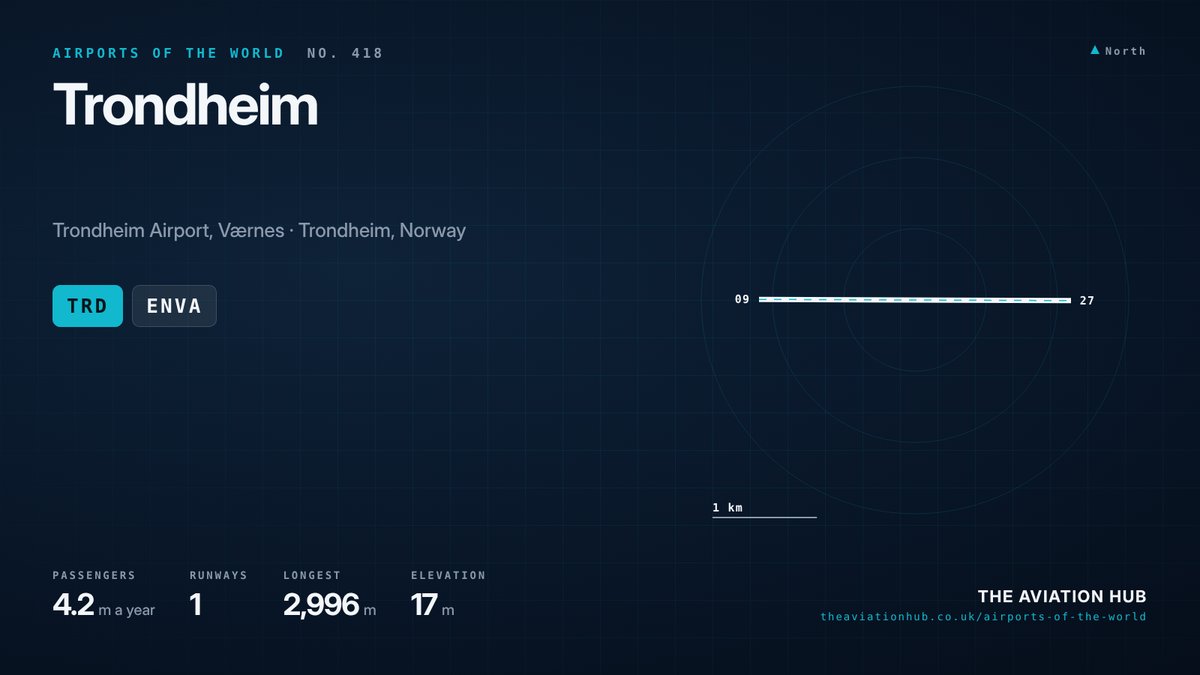
The IATA code is TRD and the ICAO code is ENVA. The airport lies roughly 20 miles (32 km) east of Trondheim city centre by road, at an elevation of 17 metres (56 feet). It has one runway and a single terminal complex that has been extended in stages. Trondheim Airport handles about 4.2 million passengers a year, ranking it among the busiest airports in Norway.
SAS, Norwegian and Widerøe carry most passengers, with the Oslo route at the heart of the network. Avinor, the state owned company that runs most Norwegian airports, operates the civil side. The Royal Norwegian Air Force runs Værnes Air Station alongside. Timetables and transport details are on the airport’s official website.
How Trondheim’s Airport Came to Be
Military flying at Værnes dates back to 1914, when the Norwegian Army’s air service began using the flat farmland by the fjord. That makes it one of the oldest airfields in the country. The site’s position at the mouth of the Stjørdal valley gave it open approaches over water and level ground for expansion.
German forces occupied the airfield in 1940 and expanded it heavily during the Second World War, adding hard runways for Luftwaffe operations over the Norwegian Sea. After liberation the Royal Norwegian Air Force took it back. Civil traffic grew steadily through the post war decades, and Værnes became the main airport for Trondheim and the wider Trøndelag region.
The modern era arrived in the 1990s. A new terminal complex and a railway station beside it transformed access to the city, putting central Trondheim under 40 minutes away by train. Domestic deregulation in the 1990s, followed by the arrival of Norwegian’s low cost jets in 2002, brought fierce competition, and traffic at Trondheim Airport climbed past 4 million passengers a year in the 2010s.
Runways at Trondheim Airport
A single runway, 09/27, handles all traffic. It measures 2,996 metres (9,829 feet) long and 45 metres wide, with an asphalt surface. Its west end points out over the Trondheimsfjord, while the east end faces the Stjørdal valley and rising hills.
The length comfortably handles the Boeing 737 and Airbus A320 family jets that dominate the schedule, as well as military transports. Winter weather is the main challenge. Snow, ice and strong winds funnelled along the fjord and valley test crews from autumn to spring, and snow clearing teams work hard to keep the runway open. Instrument approaches keep flights moving through the low cloud and drizzle that often settle over the fjord in autumn. Military flights share the same runway, and civil traffic at Trondheim Airport is sequenced around them.
Terminals and Airlines
The terminal complex handles both domestic and international flights under one roof. Jet bridges serve many of the stands, and the railway station sits a short walk from check in. Walking distances are short, and the layout is straightforward. Cafes and shops sit airside, and SAS runs a lounge for its frequent flyers, many of them business travellers commuting to Oslo.
SAS and Norwegian fly Boeing 737 and Airbus A320 family jets on trunk routes to Oslo, Bergen, Stavanger and northern Norway. Widerøe uses Dash 8 turboprops on regional links to smaller coastal towns across Trøndelag and beyond. International carriers include KLM, with flights to its Amsterdam hub, and low cost airlines serving eastern Europe. SAS, which moved from Star Alliance to SkyTeam in 2024, provides the widest range of onward connections.
Routes and Destinations
Oslo Gardermoen is by far the busiest route, with frequent flights throughout the day from SAS and Norwegian. Bergen, Bodø, Tromsø and Stavanger are other key domestic links. Widerøe adds shorter regional hops to communities along the coast, some of which have few other transport options.
Internationally, Amsterdam and Copenhagen give hub connections to the world. Summer brings direct leisure flights to Spain, Greece and other Mediterranean destinations, while winter adds routes to the Canary Islands. Eastern European links serve the region’s Polish and Baltic communities. Major events lift demand too. Trondheim hosted the 2025 Nordic World Ski Championships, and pilgrims bound for Nidaros Cathedral pass through Trondheim Airport every summer.
Getting to and from Trondheim Airport
Rail is the standout option. Trains from the airport station beside the terminal reach Trondheim Central Station in around 35 to 40 minutes, and the same line continues north towards Steinkjer. Regular commuter services make it the cheapest sensible choice for most travellers.
Airport coaches also run into the city, taking around 40 minutes and stopping at major hotels. By road, the E6 motorway passes close to the terminal, though tolls apply on the route into Trondheim. Taxis are expensive, as everywhere in Norway, but useful for late arrivals. Parking at Trondheim Airport sits directly beside the terminal.
Spotting and Photography
The fjord setting gives attractive backdrops of water, farmland and hills. Public roads around the perimeter offer views of arrivals and departures. The military side brings occasional transports and visiting aircraft, including allied forces training in the region, though military areas are strictly off limits.
Light changes dramatically with the seasons. Long summer evenings bring golden light late into the night, while winter offers only a few hours of low sun. Keep away from fences and follow Norwegian rules on drones near airports. A short drive east, Hell station’s sign makes a fun photo stop before returning to Trondheim Airport.
What Comes Next
Avinor has outlined further terminal development to cope with long term growth and changing security requirements. Norway’s push towards electric aviation could also reshape regional flying in Trøndelag, with short Widerøe routes seen as early candidates. Military investment at Værnes continues as allied cooperation in the north intensifies.
Traffic has largely recovered from the pandemic, and Trondheim’s universities and technology sector support strong business demand. Expect steady growth and a growing role as a link between southern Norway and the north. Compare it with other Norwegian airports on our Airports of the World map.
Continue to follow The Aviation Hub for more analysis and insight.
Advertise with us Your brand, in front of an aviation audience Home page and in-article placements, sold directly, one advertiser per slot. From £250 a year. See the rates

