
Tucson Airport Guide: Desert Runways, F-16s and Easy Access
Tucson Airport shares its desert runways with Air National Guard F-16s. Our guide covers its terminal, airlines, routes, new runway and spotting tips.
 By The Aviation Hub
5 min read
Updated October 20, 2026
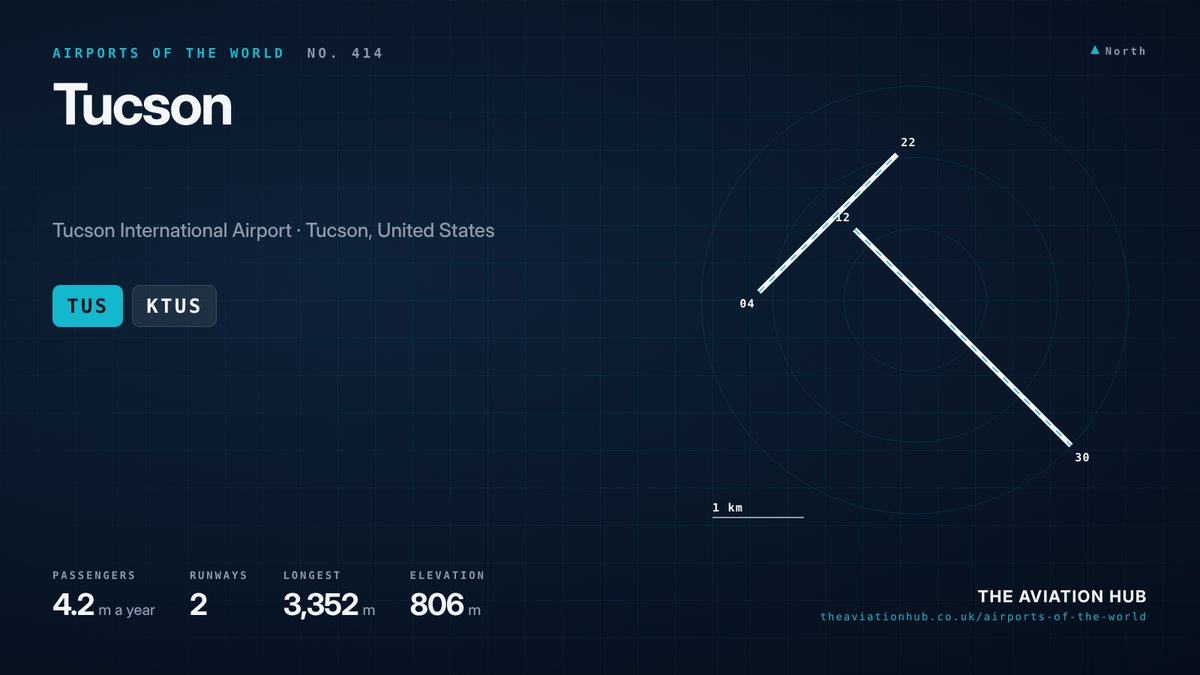
Tucson International Airport sits in the Sonoran Desert on the southern edge of Arizona’s second city. Tucson Airport handled close to 4 million passengers in its 2025 financial year and ranks as the second busiest airport in the state after Phoenix Sky Harbor. Its single terminal is relaxed and easy to use. Behind the airline gates, dozens of Air National Guard F-16s and a nearby aircraft boneyard make the area a magnet for enthusiasts.
Tucson Airport at a Glance
The IATA code is TUS and the ICAO code is KTUS. The airport lies roughly 8 miles (13 km) south of downtown Tucson, at an elevation of 806 metres (2,643 feet). It currently has two active runways, with a third under construction, and one terminal with three concourses. Tucson Airport recorded about 3.92 million passengers and more than 126,000 aircraft movements in the 2025 financial year.
Southwest is the largest carrier with just over a quarter of passengers, followed closely by SkyWest and American. No airline runs a hub here. The non profit Tucson Airport Authority, created in 1948, operates the site. Parking, flight and terminal details are on the airport’s official website.
How Tucson’s Airport Came to Be
Tucson has a strong claim to aviation history. In 1919 the city opened what is described as the first municipally owned airport in the United States, on a different site. Commercial flights began in 1928 with Standard Airlines, a forerunner of American Airlines, and regular airmail followed in 1930.
The airport later moved to its current location south of Valencia Road. In 1961 Aeronaves de Mexico began Douglas DC-6 flights to Hermosillo, justifying the international title, and a new terminal with an international inspection station opened in 1963. Military flying arrived in 1956 with what is now Morris Air National Guard Base, in the northwest corner of the field.
Growth continued through the jet age. In 1987 the main runway was extended by about half a mile to the southeast for noise abatement. The terminal interior even appeared in the 1974 film Death Wish. A renovation known as A Brighter TUS, completed in November 2017, refreshed the building and its passenger facilities at Tucson Airport.
Runways at Tucson Airport
Runway 12/30 is the main strip. It measures 3,352 metres (10,996 feet) long and 46 metres wide, with an asphalt surface and an instrument landing system. Runway 04/22 measures 2,134 metres (7,000 feet), also 46 metres wide and asphalt. Arresting barriers serve military jets that need them in an emergency. Summer heat regularly pushes past 40C, and at this elevation the thin, hot air lengthens take off runs and can restrict payloads on longer flights.
The airfield is in the middle of a major rebuild. The old parallel runway, 11R/29L, closed permanently on 30 November 2023. A new south parallel runway and a centre taxiway have been under construction, with opening planned for 2026. When it opens, the new strip will become 12R/30L and the existing runway will be redesignated 12L/30R. The project improves safety and gives Tucson Airport proper parallel runway capability again.
Terminals and Airlines
The single terminal has a distinctive X shaped layout, similar to Seattle Tacoma. Concourse A holds gates A1 to A9 and Concourse B holds gates B1 to B11. Concourse C has one gate in a separate building to the west. Walking distances are short, and security lines are usually manageable.
Southwest flies Boeing 737 jets on point to point routes. American, Delta and United, along with their regional partners, connect Tucson with their hubs. Alaska Airlines, Frontier and Sun Country add further options. SkyWest operates many of the regional jet flights for the major carriers. Every major US alliance is represented at Tucson Airport through its hub partners.
Routes and Destinations
Dallas Fort Worth is the busiest route, with about 321,000 passengers in the year to January 2026. Denver follows closely at around 298,000. Phoenix, Los Angeles and Las Vegas complete the top five. Together these hubs give one stop access to more than 400 destinations worldwide.
Nonstop service reaches roughly 20 destinations across the United States. Winter is the peak season, when snowbirds from the Midwest and Canada escape the cold for the Arizona sunshine. Chicago, Minneapolis and Seattle routes grow busier in those months. Atlanta and other eastern hubs are among the longest routes, at around four hours. International scheduled service to Mexico has come and gone over the years.
Getting to and from Tucson Airport
Road is the main option. Tucson Boulevard and Valencia Road link the terminal with Interstate 10 and Interstate 19, and downtown Tucson is around 15 to 20 minutes away by car. A rental car complex sits on the airport grounds, within walking distance of the terminal.
Sun Tran bus routes 11 and 25 serve the airport, the cheapest sensible option for travellers with light bags. Taxis, ride hailing and shuttle vans wait at the kerb, and hotel shuttles serve many properties near the airport. There is no rail link. Garage and surface parking at Tucson Airport are reasonably priced compared with larger hubs.
Spotting and Photography
The Tucson area offers exceptional aircraft variety. Morris Air National Guard Base hosts the 162nd Wing, described as the largest Air National Guard fighter unit in the country, with more than 70 F-16s. The wing has long trained pilots from allied air forces, so unusual markings sometimes appear. Winter also brings visiting military aircraft under the long running Snowbird programme.
Davis Monthan Air Force Base lies a few miles east, home to the famous boneyard where thousands of retired military aircraft are stored. The Pima Air and Space Museum sits next door and offers bus tours. Around the airport, public roads give views of approaches, but stay away from fences, military areas and the nearby RTX missile plant. The desert sun is fierce, so early morning and late afternoon give the best light at Tucson Airport.
What Comes Next
The new south parallel runway is the headline project, the biggest airfield change in decades. A new federally funded control tower, built under a 20 year no cost FAA lease, is replacing a tower from the 1950s. Together they modernise the airfield for the next generation of airline and military operations.
Passenger numbers have recovered strongly, and Tucson’s growing population and tourism appeal support further growth. The challenge is winning more nonstop routes from Phoenix, which dominates Arizona air travel. Expect steady expansion and a modernised airfield. Compare it with other desert airports on our Airports of the World map.
Continue to follow The Aviation Hub for more analysis and insight.
Advertise with us Your brand, in front of an aviation audience Home page and in-article placements, sold directly, one advertiser per slot. From £250 a year. See the rates

