
Tunis Airport Guide: Carthage, Tunisair and the Med
Tunis Airport is Tunisia's main gateway and home of Tunisair. Codes, runways, terminals, airlines, routes, transport and spotting advice explained.
 By The Aviation Hub
5 min read
Updated October 20, 2026
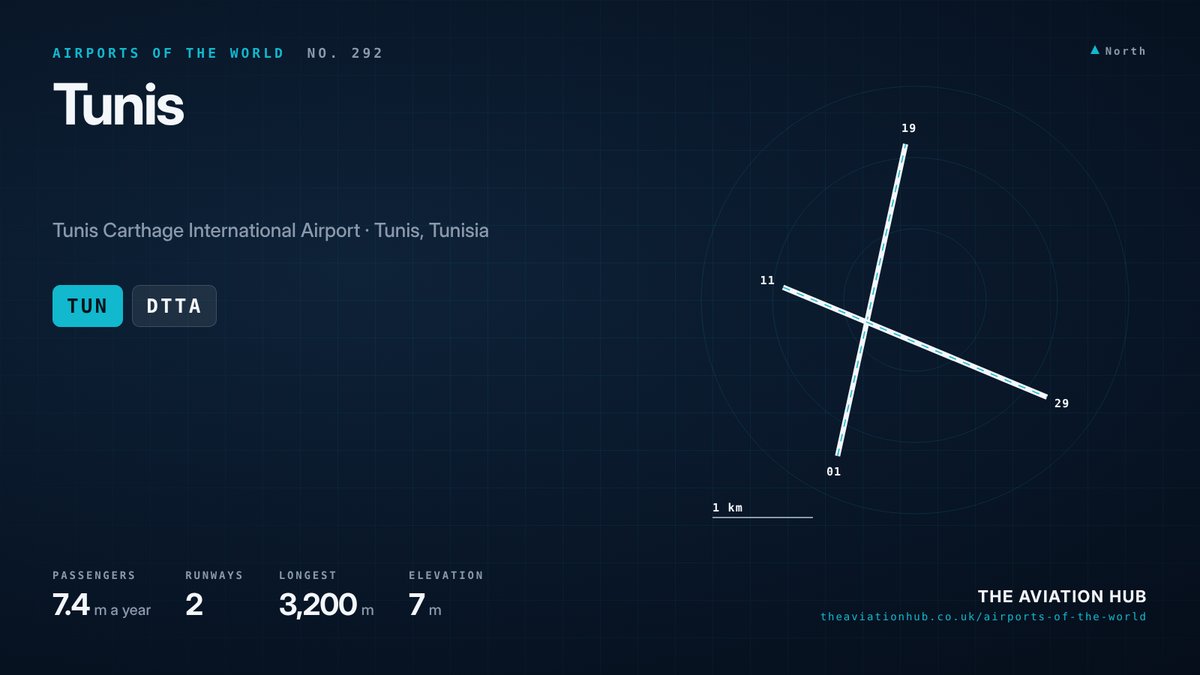
Tunis Carthage International Airport sits on the northern edge of the Tunisian capital, between the city and the ruins that give it its name. Tunis Airport handles more than seven million passengers a year and is home to Tunisair and most of the country’s airlines. Its traffic is built on the large Tunisian community in France and on links across the Mediterranean, the Gulf and Africa. The field is close enough to the centre that a taxi ride rarely takes more than 20 minutes.
Tunis Airport at a Glance
The IATA code is TUN and the ICAO code is DTTA. The airport lies about 5 miles (8 km) north east of central Tunis, beside the Lake of Tunis, at an elevation of 7 metres (22 ft). It has two crossing runways, a main passenger terminal and a second building added in 2006 for charter flights. The Tunisian Air Force shares the field from its own base.
Traffic reached about 7.2 million passengers in 2024, well above the terminal’s design capacity of around five million. Tunisair, Tunisair Express and Nouvelair are all based here. The state agency OACA, which runs most Tunisian airports, operates the field and has its head office on site. Flight information and passenger notices are posted on the airport’s official website.
A Short History of Flying in Tunis
Aviation in Tunis began on the water. A seaplane base opened on the Lake of Tunis in 1920 for the French company Compagnie Aéronavale. A land airfield followed in 1938, handling about 5,800 passengers a year, mostly on the route to Paris. The name came from Carthage, the ancient city whose remains lie just east of the airport.
During the Second World War the United States Twelfth Air Force used the airfield as a headquarters during the 1943 Italian campaign, and Air Transport Command later made it a major transshipment hub. Rebuilding, fully funded by France, began in 1944. In 1948 the field became the main base of the new Tunisair, which started out with Douglas DC-3s. By 1951 traffic had reached 56,400 passengers.
The modern shape came later. A major expansion in 1997 enlarged the terminal to about 57,000 square metres, with capacity for 4.4 million passengers a year. A further extension followed in 2005, and the charter terminal opened on 23 September 2006.
Runways at Tunis Airport
Tunis Airport has two asphalt runways, both 45 metres wide. Runway 01/19 is 3,200 metres (10,499 ft) long and is the longer of the two. Runway 11/29 is 2,840 metres (9,318 ft) long and crosses it. Both handle the Airbus A330s and other wide bodies that serve Tunis Airport from the Gulf.
Northerly winds off the Gulf of Tunis are common, which brings approaches over the lake and the city’s northern districts. Westerly winds bring 11/29 into play. The terrain around the city adds challenge in poor weather. On 7 May 2002 EgyptAir Flight 843, a Boeing 737 from Cairo, crashed into high ground about 4 miles from the airport in fog and sandstorm conditions. Fourteen of the 62 people on board were killed.
Terminals and Airlines
The main terminal handles scheduled flights, while the 2006 building takes most charters. Tunisair is the dominant carrier, flying Airbus A320 family jets and A330s across Europe, North Africa and West Africa, with a long haul link to Montreal. Tunisair Express covers domestic routes and short international hops with ATR 72 turboprops. Nouvelair, a privately owned airline, flies A320s on scheduled and leisure routes.
Foreign airlines include Air France, Transavia, Lufthansa, ITA Airways, Turkish Airlines, Royal Air Maroc, EgyptAir, Qatar Airways, Emirates and Etihad. All three global alliances are represented, although Tunisair itself belongs to none. Lounges are modest, and the terminal can feel crowded at summer peaks.
Routes and Destinations
France is the core market. Flights to Paris Orly and Charles de Gaulle run many times a day, with Marseille, Lyon, Nice, Toulouse and other French cities close behind. Italy, Germany, Belgium and Switzerland follow, carrying both tourists and the Tunisian diaspora. Istanbul, Algiers, Casablanca, Cairo and Tripoli are other key routes.
Tunis Airport also connects to the Gulf, with Doha, Dubai and Abu Dhabi all served, while Amman and Baghdad add links to the Middle East. Tunisair flies to Abidjan, Dakar, Bamako and other West African cities, and the transatlantic link to Montreal is the longest on the network. Domestic flights reach Djerba and Tozeur. Summer brings sharp peaks as families return home from Europe.
Getting to and from Tunis Airport
Road is the only option. Taxis are the simplest choice and are cheap by European standards, with a metered fare to the city centre usually well under 20 dinars (about £5). Agree on use of the meter before setting off. The drive to Avenue Habib Bourguiba takes 15 to 20 minutes outside rush hour.
City buses run between Tunis Airport and the centre for a small fare, but they are slow and crowded with luggage. Carthage, Sidi Bou Said and La Marsa are around 20 to 30 minutes away by taxi. Car hire desks sit in the arrivals hall, and parking is available in front of the terminals. Coastal resorts such as Hammamet are about an hour away by motorway.
Spotting and Photography
Spotters need to take care here. The military base on the airfield and tight security around official buildings mean that photography near the perimeter can quickly attract police attention. There is no public viewing terrace at Tunis Airport. Most visiting enthusiasts photograph from the terminal or from aircraft windows.
The mix is still rewarding. Tunisair A330s and older A320s, Nouvelair jets, Tunisair Express ATRs and a wide spread of African, Arab and European carriers all appear on a typical day. Never photograph military aircraft or installations, carry identification and follow every instruction from officials.
What Comes Next
Capacity is the main issue. The terminals were sized for a smaller airport, and traffic now regularly exceeds their design figures. Enfidha Hammamet, south of the capital, takes much of the charter traffic, but it does not solve the pressure on scheduled flights into Tunis. In 2026 the government shelved plans for a new airport and chose instead to expand Tunis Carthage for about 3 billion dinars, aiming for capacity of around 18.5 million passengers a year by 2031.
Tunisair’s fleet troubles have also held back growth, while Nouvelair and foreign carriers have filled the gaps. Tunis Airport will remain the country’s main gateway, but it needs investment to keep pace. Explore other North African airports on the Airports of the World map.
Continue to follow The Aviation Hub for more analysis and insight.
Advertise with us Your brand, in front of an aviation audience Home page and in-article placements, sold directly, one advertiser per slot. From £250 a year. See the rates

