
Turin Airport Guide: Alpine Views and Eurofighters
Turin Airport explained: the Caselle runway, the terminal, Ryanair and Wizz Air bases, ski charters, the Leonardo factories and how to reach the city.
 By The Aviation Hub
6 min read
Updated October 20, 2026
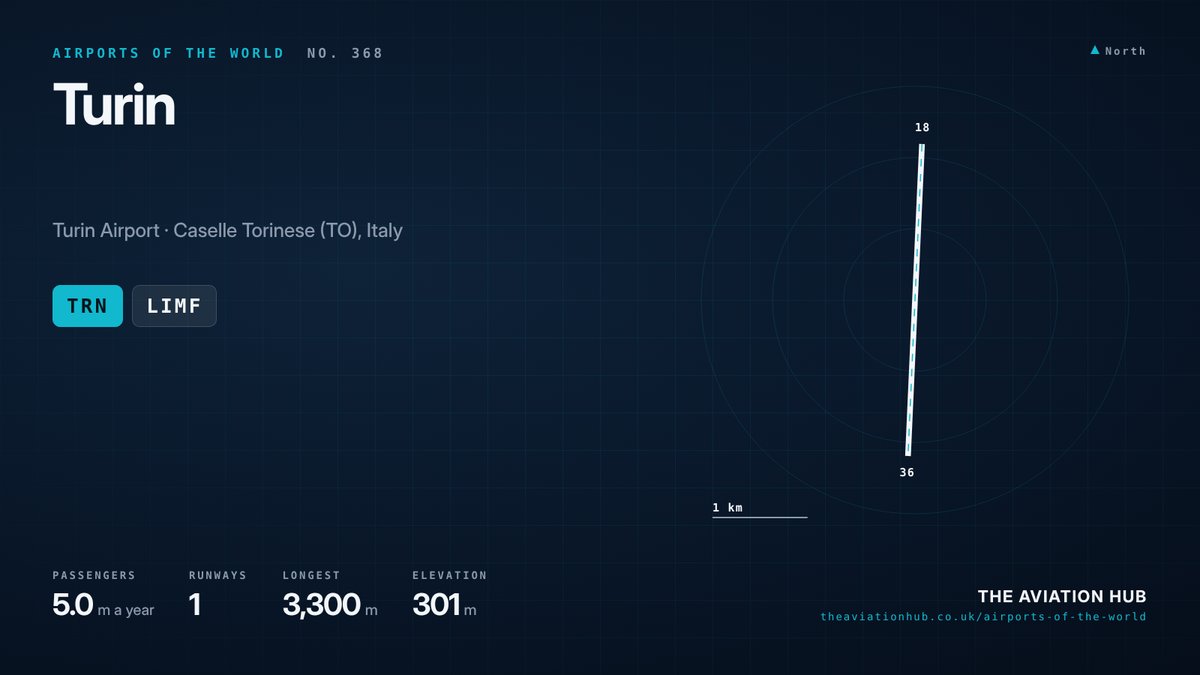
Turin Airport, known locally as Caselle, serves Piedmont’s capital and the ski resorts of the western Alps. It sits on a plain north of the city with the mountains close behind, giving it one of the more dramatic settings in Italy. Around five million passengers pass through each year. The site is also an aerospace factory, where Leonardo builds and tests military and civil aircraft beside the airline apron.
Turin Airport at a Glance
The airport carries the IATA code TRN and the ICAO code LIMF. It lies in Caselle Torinese, about 10 miles (16 km) north northwest of central Turin, at an elevation of 989 feet (301 m). There is one runway, one passenger terminal, a cargo terminal and a general aviation terminal. Its official name honours Sandro Pertini, the former Italian president.
SAGAT S.p.A. operates the airport, with ENAC as regulator and ENAV handling air traffic control. Traffic reached roughly 5.0 million passengers in the latest full year, with about 44,000 aircraft movements. Ryanair and Wizz Air both base aircraft at Turin Airport. Timetables and passenger services are listed on the airport’s official website.
How Turin’s Airport Came to Be
The modern airport was built in 1953 on the site of a Second World War air base. Turin’s industrial strength, built on Fiat and its suppliers, made a proper civil airport essential. Aircraft manufacturing grew up alongside, a link that survives in today’s Leonardo plants.
Two major events reshaped the passenger facilities. The airport was renovated in 1989 ahead of the 1990 FIFA World Cup, which Italy hosted. A second upgrade came in 2005, in preparation for the 2006 Winter Olympics staged in Turin and the nearby mountains.
Recognition followed. ACI Europe named Turin Airport the best in its one to five million passenger category in 2007, 2008 and again in 2022. The airport also has a famous mystery: on 20 November 1973 crowds reported a glowing object over the field, and a pilot in a Piper tried to chase it.
Runways at Turin Airport
A single runway, 18/36, handles all traffic. It measures 3,300 metres (10,827 feet) long and an unusually generous 60 metres wide, with an asphalt surface. That length suits everything from turboprops to wide body jets and fully loaded military types.
Runway 36 carries the instrument landing system and sees most arrivals, with aircraft approaching from the south over the northern suburbs of Turin. The Alps rise steeply to the north and west, so departure routes turn early to avoid high ground. Fog on the Po plain can disrupt winter operations, though the ILS keeps most flights moving.
The runway at Turin Airport also serves Leonardo’s test flying. Its two plants on the field, known as North and South, handle assembly, maintenance and flight testing. Products include Italy’s Eurofighter Typhoons, the C-27J Spartan transport and maritime patrol versions of the ATR 42 and ATR 72.
Terminals and Airlines
The single passenger terminal at Turin Airport handles all scheduled and charter flights, with Schengen and non Schengen areas separated inside. The building is easy to navigate, and the walk from check in to gate is short. General aviation and business jets use their own terminal.
Ryanair is the largest airline, using Boeing 737-800s and 737-8200s from its base, where it added a third based aircraft in 2025. Wizz Air also bases Airbus A321neos here. ITA Airways links the city with Rome, and Air Dolomiti flies to Frankfurt and Munich for Lufthansa. Air France, KLM, Iberia, Finnair and Turkish Airlines connect Turin with their hubs, while British Airways flies to London Gatwick. Volotea and Vueling add leisure and domestic flying.
Alliance coverage is broad. Star Alliance comes through Lufthansa, Turkish and ITA, which joined in April 2026. SkyTeam arrives through Air France and KLM, and Oneworld through British Airways, Iberia and Finnair.
Routes and Destinations
Domestic routes remain important, especially to southern Italy and the islands. Naples, Bari, Catania, Palermo, Cagliari and Rome are core markets, carrying students, workers and families with roots in the south.
Internationally, Turin Airport connects with Europe’s big hubs, giving onward links worldwide. London is a key market, served by several carriers. Ryanair and Wizz Air reach the UK, Spain, Eastern Europe and North Africa, while summer adds holiday routes to Greece and the Mediterranean islands.
Winter brings a distinctive peak. Ski charters, many from the UK, fly in on Saturdays and Sundays, carrying skiers to the Milky Way resorts such as Sestriere and Sauze d’Oulx. Cargo is a small part of the business.
Getting to and from Turin Airport
The airport has its own railway station on the Turin to Ceres line, a short walk from the terminal. Trains run into the city in around 20 to 30 minutes, depending on the service. It is usually the cheapest sensible option, though frequencies are lower in the evenings and on Sundays.
SADEM coaches link the terminal with Porta Susa and Porta Nuova stations, taking roughly 40 to 50 minutes. Flibco runs additional shuttles, and seasonal services head to the mountain resorts. Many ski holidaymakers travel on pre booked transfers.
Taxis wait outside arrivals and take around 25 to 30 minutes to the centre, with a fixed fare structure into the city. The airport is close to the Turin ring road and the motorways towards Milan, Aosta and the Frejus tunnel. Car hire desks sit in the arrivals hall.
Spotting and Photography
Turin Airport is one of the more rewarding Italian fields for enthusiasts. The Alps form a spectacular backdrop on clear days, especially in winter when the peaks are white. Fields and minor roads around the perimeter give views of the runway, with the east side best in the morning and the west side in the afternoon.
Leonardo activity adds real variety. Eurofighters, C-27Js and ATR patrol aircraft appear on test flights, and new build aircraft sometimes sit outside the hangars. Weekend ski charters bring a stream of UK registered jets in winter.
Respect the fences and the military and industrial areas, where photography rules are strict. Stay on public land, follow police instructions and never fly drones near the field.
What Comes Next
Growth now depends on the low cost carriers. Ryanair’s reported investment points to more based aircraft and new routes, and Wizz Air continues to expand. The terminal has spare capacity, so the airport can absorb more traffic without major building work.
The bigger challenge is competition from Milan Malpensa, under two hours away by road and rail. Turin Airport wins by offering convenience to Piedmont travellers and ski holidaymakers. Compare it with other northern Italian fields on the Airports of the World map. The verdict: a compact, well run regional airport with a growing low cost base and a strong aerospace heart.
Continue to follow The Aviation Hub for more analysis and insight.
Advertise with us Your brand, in front of an aviation audience Home page and in-article placements, sold directly, one advertiser per slot. From £250 a year. See the rates

