
Urumqi Airport Guide: China’s Gateway to Central Asia
Urumqi Airport is the hub of Xinjiang and China's bridge to Central Asia, with a new North Terminal and three runways. Read about its routes and spotting.
 By The Aviation Hub
6 min read
Updated October 20, 2026
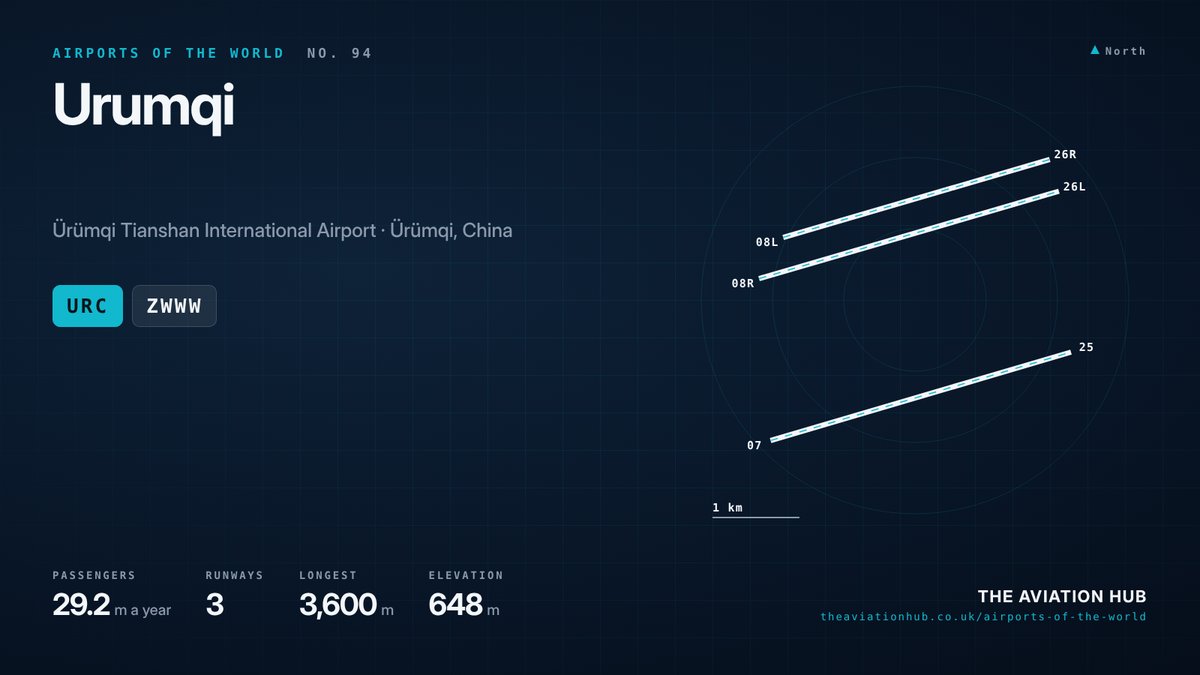
Urumqi Tianshan International Airport is the main airport of Xinjiang and the westernmost major hub in China. It lies in Diwopu, about 10 miles (16 km) north west of central Urumqi, on the dry plain beneath the Tianshan mountains. Around 29 million passengers used Urumqi Airport in 2025, and a vast new North Terminal opened in April that year with two extra runways. China Southern runs its western hub here, Urumqi Air is based on the field, and the route map reaches deep into Central Asia.
Urumqi Airport at a Glance
The codes are URC and ZWWW. The field sits at 2,125 ft (648 m) above sea level, 10 miles (16 km) from the city centre by metro or expressway. Urumqi is one of the most inland cities in the world, more than 1,500 miles (2,400 km) from the nearest coast, and the airport is correspondingly remote from the rest of the Chinese network.
Urumqi Airport now has three runways, two of them built for the North Terminal project, and one passenger terminal in use. Traffic in 2025 was around 29.2 million passengers, up 5 per cent and 18th in China, with about 195,000 movements and 332,000 tonnes of cargo. China Southern and Urumqi Air are the hub carriers and Hainan Airlines has a focus presence. Xinjiang Airport Group, a regional state owned company, operates the field. Flight information is on the airport’s official website.
How Urumqi’s Airport Came to Be
The civil airport at Diwopu opened to foreign passengers in 1973. The first terminal followed in 1974. Xinjiang’s isolation kept traffic small until the 1990s.
A new runway in 1994 and Terminal 2 in 2002 marked the start of real growth, as China Southern built up Urumqi as the base for its Xinjiang operation and the economy of the region opened. Terminal 3 arrived in 2009 as part of a further expansion. Terminal 1 closed in 2011 for renovation and reopened in 2014 for regional flights, while Terminal 2 was refurbished.
Urumqi Airport carried the name Urumqi Diwopu International Airport until March 2025, when it was renamed after the Tianshan range. The North Terminal, under construction since 2017, opened on 17 April 2025 and is the largest single project in the airport’s history.
Runways at Urumqi Airport
Runway 07/25 is the original 1994 strip, 3,600 m (11,811 ft) long and 45 m (148 ft) wide, with Category II precision approaches. Runway 08R/26L matches it at 3,600 m (11,811 ft) but is wider at 60 m (197 ft), and runway 08L/26R is 3,200 m (10,498 ft) long and 60 m (197 ft) wide. All three have concrete surfaces. The two newer runways are built to Code 4F standard and can take the Boeing 747 and Airbus A380.
The elevation of 648 m and the fierce summer heat, which can pass 35C, lengthen take off runs, so the long strips matter for heavy departures to Europe and the east coast. Winter brings the opposite problem. Urumqi is one of the coldest big cities in China and heavy snow and freezing fog close the airport for hours at a time.
Urumqi Airport is well known among long haul crews as an emergency diversion field for flights between Europe and East Asia, as it is often the only large airport within range over the deserts and mountains. Several wide bodies have landed here with medical emergencies or technical problems.
Terminals and Airlines
The North Terminal, sometimes called T4, is the new centre of operations. It covers close to 400,000 square metres with 177 gates and sits beside the new runways north of the old airfield. Every flight moved across on the opening day, and the three older terminals closed to passengers.
The three older terminals stand together on the south side. Until then, Terminal 1 mainly handled regional flights within Xinjiang and low cost carriers such as Spring Airlines, Tianjin Airlines, Okay Airways and China United Airlines. Terminal 2 took most domestic routes beyond Xinjiang other than those of China Southern, Xiamen Airlines and Chongqing Airlines, and Terminal 3 served China Southern and the international flights. The plan is to convert the older buildings into cargo relay facilities as part of the Belt and Road logistics push.
An automated airport transit line connects the metro station at the old terminals with the North Terminal, so transfers between the two sides take a few minutes.
Routes and Destinations
Domestic routes dominate. Beijing, Shanghai, Guangzhou, Chengdu, Xi’an, Lanzhou, Zhengzhou and Chongqing are the main trunk links, and most involve flights of three to five hours given the distances. Within Xinjiang the airport is the hub for a dense regional network to Kashgar, Hotan, Korla, Aksu, Yining and Altay, many of them operated by Urumqi Air and China Southern.
International service is what makes Urumqi Airport distinctive. China Southern flies to Dubai, Istanbul, Moscow, Frankfurt and Kuala Lumpur, and together with the Central Asian carriers it links the city with Almaty, Tashkent, Bishkek and Dushanbe. Islamabad and Tbilisi have also appeared on the map. Frankfurt, at around 3,550 miles (5,700 km), is the longest China Southern route. Cargo grew by more than 40 per cent in 2025 on the back of trade with Central Asia and Russia.
Getting to and from Urumqi Airport
Urumqi Metro Line 1 opened in October 2018 and runs from a station at the old terminal complex into the city centre for a few yuan. It is the cheapest sensible option. Passengers for the North Terminal change to the airport transit line.
Airport buses run to the main railway station, the South Railway Station and the city centre hotels. By road the airport expressway reaches downtown in 25 to 40 minutes, and a taxi costs around 40 to 60 yuan (£4 to £6). Ride hailing works from designated pick up zones.
Large car parks serve the North Terminal and the older buildings. Allow extra time for security checks at the airport entrance, which are more thorough in Xinjiang than elsewhere in China.
Spotting and Photography
Urumqi Airport is not an easy or advisable place to spot from outside the fence. Xinjiang is under tight security and anyone photographing infrastructure near the perimeter will be stopped. The practical advice is to shoot from inside the terminals. The North Terminal has long glass piers with views of the new runways and the China Southern wide bodies, and the older Terminal 3 looked across the southern apron.
The reward for the effort is variety that no other Chinese airport offers, from the Central Asian carriers such as Air Astana, Uzbekistan Airways and Somon Air to the occasional diverted European wide body. The dry air gives superb visibility outside the dust storm season in spring.
Do not photograph police, checkpoints or military aircraft under any circumstances. Carry your passport at all times, expect questions and answer them politely.
What Comes Next
The North Terminal project is designed to lift capacity far beyond current traffic, with two new runways and a terminal designed for about 48 million passengers a year. The next phase is converting the old terminals into cargo and logistics facilities aimed at the Central Asian and European trade routes of the Belt and Road Initiative.
Whether the passengers follow depends on Xinjiang’s economy and on how fast the international network expands. The 2025 growth in cargo and the return of Central Asian routes suggest the airport is already leaning into its role as a bridge.
Urumqi Airport is a frontier hub built for a future bigger than the present. Compare it with the other Chinese and Central Asian airports on the Airports of the World map.
Continue to follow The Aviation Hub for more analysis and insight.
Advertise with us Your brand, in front of an aviation audience Home page and in-article placements, sold directly, one advertiser per slot. From £250 a year. See the rates

