
Vancouver International Airport is the second busiest airport in Canada and the country’s main gateway to Asia and the Pacific. It occupies most of Sea Island in Richmond, British Columbia, about 7 miles (12 km) south west of downtown Vancouver, in the delta of the Fraser River. Vancouver Airport handled a little under 27 million passengers in 2025 and is a hub for Air Canada, WestJet, Pacific Coastal Airlines and Harbour Air. Mountains to the north, the sea to the west and a 22 km dyke system holding back both give the field a setting that few airports can match.
Vancouver Airport at a Glance
The codes are YVR and CYVR. The field sits at just 14 ft (4 m) above sea level, protected by dykes, and lies 7 miles (12 km) from the city centre by the Canada Line railway. Richmond is just across the Middle Arm of the Fraser to the south.
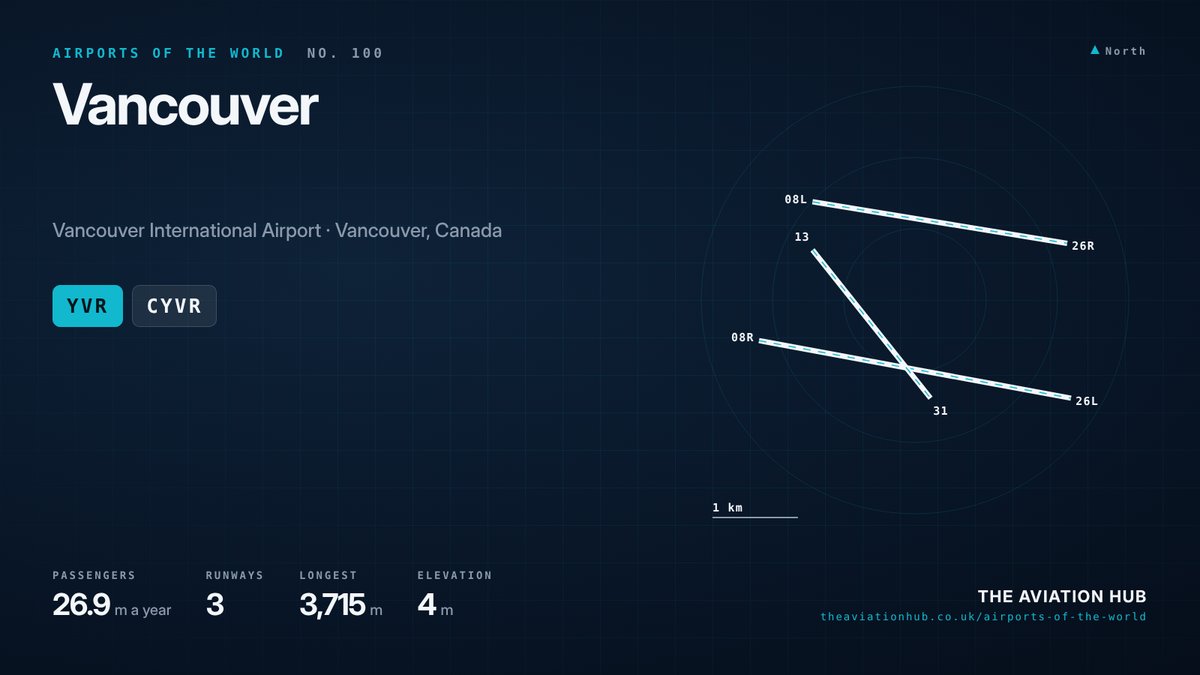
Vancouver Airport has three runways, a Main Terminal with domestic and international wings, and a separate South Terminal for regional and floatplane traffic. The 2025 figure was 26,913,561 passengers, a modest gain on the 26.2 million of 2024. Air Canada runs its Pacific hub here and WestJet has its second largest base, with Flair, Air Canada Rouge and Central Mountain Air also basing aircraft and Air North and Porter treating it as a focus city. The Vancouver Airport Authority, a community based not for profit, has run the field under a lease from Transport Canada since 1992. Flight and parking details are on the airport’s official website.
How Vancouver’s Airport Came to Be
Vancouver’s first flights used a grass strip at Minoru Park on Lulu Island. The City of Vancouver bought land on Sea Island in 1929 to replace it, and the new airport opened on 22 July 1931 with a single runway and a small terminal. The Royal Canadian Air Force took it over during the Second World War as RCAF Station Sea Island.
Trans Canada Air Lines, the forerunner of Air Canada, made Vancouver its western terminus, and the current Main Terminal opened in 1968. The federal government handed the field to the Vancouver Airport Authority in 1992, and the authority opened the International Terminal and the north runway in 1996.
The airport has known dark days. Luggage containing the bomb that destroyed Air India Flight 182 off Ireland in 1985, killing 329 people, was checked in at Vancouver. On 11 September 2001 the field took 34 diverted transpacific flights. The 2010 Winter Olympics brought the Canada Line rail link and the final push of the modern expansion.
Runways at Vancouver Airport
Runway 08R/26L on the south side is the main strip, 3,715 m (12,188 ft) long and 61 m (200 ft) wide on asphalt. Runway 08L/26R, the north parallel opened in 1996, is 3,030 m (9,940 ft) long and 61 m (200 ft) wide on concrete. The crosswind runway 13/31 runs 2,225 m (7,300 ft) by 61 m (200 ft), also concrete, and is used mainly by lighter aircraft and when strong south easterly winds blow in winter.
The parallels are far enough apart for simultaneous operations, with the north runway taking most arrivals and the south runway most departures in the usual flow. Westerly winds off the Strait of Georgia dominate in summer, so the 26s are busiest, with arrivals passing over Richmond and departures climbing out over the sea. Easterly flow on the 08s brings aircraft in over the water and out across the Fraser delta towards the mountains.
The north runway carries a night curfew to protect residents of Richmond, so heavy night operations use the south strip. At 4 m above the sea behind dykes, storm surge protection is a live question in the airport’s long term planning.
Terminals and Airlines
The Main Terminal at Vancouver Airport is divided into a Domestic Terminal with Piers A, B and C and an International Terminal with Piers D and E. Pier C belongs to Air Canada and Air Canada Express, Pier B is WestJet’s domestic hub shared with Air North, Air Transat, Flair and Porter, and Pier A handles WestJet Encore’s Dash 8 flights. Pier D takes all international departures, and Pier E is the United States preclearance area, where travellers clear US customs before boarding.
The international line up leans heavily towards Asia. Air Canada flies to Tokyo, Seoul, Hong Kong, Shanghai, Singapore, Bangkok and Sydney, joined by Cathay Pacific, Japan Airlines, ANA, Korean Air, EVA Air, Philippine Airlines, Air China and China Southern. Europe is served by Air Canada, British Airways, Lufthansa, KLM, Air France and Condor, and the US by Air Canada, WestJet, United, American, Delta and Alaska.
The South Terminal, on the opposite side of the field, handles Pacific Coastal Airlines, Central Mountain Air and Helijet, and the adjacent dock is Harbour Air’s floatplane base. The Main Terminal is known for its Pacific Northwest art, a 30,000 gallon saltwater aquarium, an indoor green wall and trilingual signs in English, French and Chinese.
Routes and Destinations
Toronto is the busiest route, with Air Canada, WestJet, Flair and Porter all competing, and Calgary, Montreal, Edmonton and Kelowna are also busy. Victoria is a short hop across the strait served by both jets and floatplanes. Los Angeles, Seattle, San Francisco and Las Vegas lead the US flows, and Mexico’s resorts fill the winter schedule.
Across the Pacific, Hong Kong, Tokyo, Seoul, Taipei and Shanghai carry the heaviest traffic, and the route network reaches Manila, Delhi and Singapore. The Air Canada service to Singapore, at around 8,000 miles (12,800 km), is among the longest from Vancouver Airport. Cargo is significant, with seafood, cherries and technology moving to Asia and e commerce freight returning. Summer brings the cruise ship crowds bound for Alaska and the heaviest transatlantic flying, while winter adds ski traffic for Whistler.
Getting to and from Vancouver Airport
The Canada Line SkyTrain runs from YVR Airport station, between the domestic and international terminals, to downtown Waterfront station in about 25 minutes. Trains run every six minutes or so at peak times and the fare is a few dollars plus a small airport surcharge, which makes it the cheapest sensible option by a wide margin. The line also serves Richmond via a change at Bridgeport.
Buses fill the gaps. The 412 serves the South Terminal, the N10 night bus covers the terminals when the trains stop, and YVR Skylynx coaches run to Squamish and Whistler. By road the Arthur Laing Bridge and Grant McConachie Way link Sea Island with the city, with downtown 25 to 40 minutes away. A taxi costs roughly $35 to $45 (£20 to £26) on a zone fare, and Uber and Lyft pick up from designated areas. Multi storey and long stay parking sit beside the terminal.
Spotting and Photography
Vancouver Airport is one of the great spotting locations in North America. The Larry Berg Flight Path Park at the eastern end of runway 08R/26L has a viewing area, parking and information boards, and aircraft on short final for 26L pass directly overhead. It is the obvious first stop. The dyke paths along the Fraser on the south side of the field give long views across the apron and the floatplane base.
Iona Beach Regional Park on the north west corner catches arrivals on the 08s and departures off the 26s against the sea, with the mountains behind on a clear day. The south side keeps the sun behind the camera for most of the day. Summer offers the heaviest wide body schedule and the longest days.
The viewing park is designed for enthusiasts, so use it. Stay off the dykes near the runway ends, respect the fences, and do not park on the airport service roads. The RCMP patrol the perimeter and are friendly to anyone behaving sensibly.
What Comes Next
The authority’s Flight Plan 2037 master plan sets out some 75 projects worth around $5.6 billion to carry 35 million passengers by 2037. The first phase added eight international gates to Pier D by early 2021, and later phases cover expanded domestic piers and a reworked road network. Some elements still await final federal approval.
Growth depends on the Asian market, where Chinese traffic has yet to return fully, and on Air Canada’s willingness to keep building its Pacific hub. Climate resilience at sea level will shape the capital programme as much as demand.
Vancouver Airport is a serene and handsome gateway with a serious long term plan. Compare it with the other Pacific hubs on the Airports of the World map.
Continue to follow The Aviation Hub for more analysis and insight.
Advertise with us Your brand, in front of an aviation audience Home page and in-article placements, sold directly, one advertiser per slot. From £250 a year. See the rates

