
Varanasi Airport Guide: Flying Into India’s Holy City
Varanasi Airport serves the spiritual heart of Hinduism and nearby Sarnath. Read about its runway, terminal, airlines, routes, road links and expansion plans.
 By The Aviation Hub
5 min read
Updated October 20, 2026
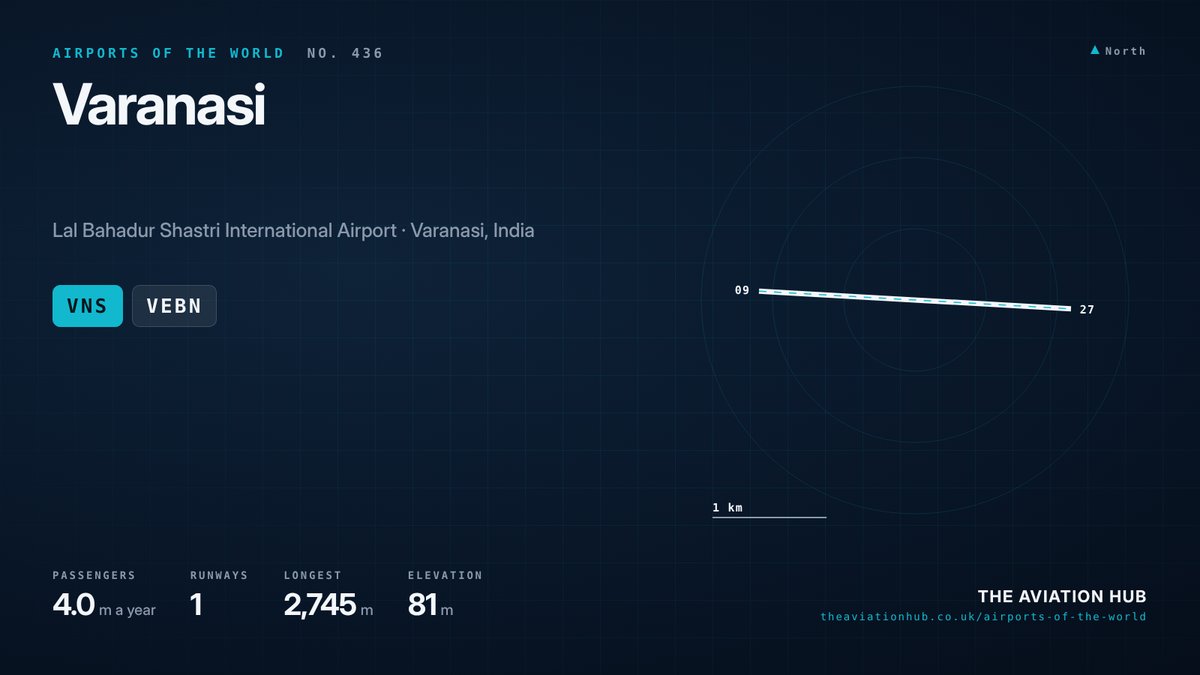
Varanasi is one of the oldest continuously inhabited cities in the world and the spiritual heart of Hinduism. Pilgrims, tourists and returning families now arrive in growing numbers by air. Varanasi Airport, officially Lal Bahadur Shastri International Airport, handled about 4.3 million passengers in the year to March 2026. It also serves Sarnath, where the Buddha preached his first sermon, which gives the field a strong role in Buddhist pilgrimage from across Asia.
Varanasi Airport at a Glance
The IATA code is VNS and the ICAO code is VEBN. Varanasi Airport sits at Babatpur, about 16 miles (26 km) northwest of the city and its ghats along the Ganges. The elevation is 266 feet (81 metres). There is one runway and one integrated terminal handling both domestic and international flights.
Traffic reached roughly 4.34 million passengers between April 2025 and March 2026, up 7.8 per cent, with about 27,800 aircraft movements. IndiGo is the dominant carrier, flying to around 14 destinations. Air India, Air India Express, Akasa Air and SpiceJet also operate here. The Airports Authority of India runs the field. Flight details are on the airport’s official website.
How Varanasi’s Airport Came to Be
The Babatpur airfield served the city for decades as a modest domestic stop with flights to Delhi and Kolkata. For years it was simply Varanasi Airport. In October 2005 it was renamed after Lal Bahadur Shastri, India’s second Prime Minister, who was born nearby.
Growth accelerated in the 2010s. Varanasi became the parliamentary constituency of Prime Minister Narendra Modi, bringing political attention and investment. The Kashi Vishwanath temple corridor, opened in 2021, drew millions of extra visitors. The airport won an Airports Council International award in 2020 as the best airport in the Asia Pacific region in the two to five million passenger category.
Varanasi Airport also made a cultural mark. It became the first airport in India to make announcements in Sanskrit. In the 2024 to 2025 financial year it passed four million passengers, joining the ranks of India’s major airports.
Runways at Varanasi Airport
A single asphalt runway, 09/27, measures 2,745 metres (9,006 feet) long and 45 metres (148 feet) wide. It handles narrow body jets such as the Airbus A320neo and Boeing 737-800 comfortably. Larger wide body flights face payload limits.
Seasonal winds decide the runway direction. Westerly winds in winter and the hot pre monsoon months favour runway 27, while monsoon easterlies bring runway 09 into use. Winter fog across the Gangetic plain is the main operational headache. It can delay or divert flights for days at a time in December and January.
A planned extension to 4,075 metres (13,369 feet) would allow long haul wide body aircraft to operate fully loaded. National Highway 31 crosses the line of the extension, so an underpass is planned to carry the road beneath the new runway.
Terminals and Airlines
The single integrated terminal is compact for current demand. It has 16 check in counters, four counters that handle both immigration and emigration, and two baggage belts. The apron can park five narrow body aircraft at once, which constrains the schedule at busy times.
IndiGo flies to Delhi, Mumbai, Bengaluru, Kolkata, Hyderabad and other cities with Airbus A320neo and A321neo jets. Air India serves Delhi and Mumbai. Air India Express links Varanasi Airport with Bangkok, Sharjah, Bengaluru, Delhi and Mumbai. Akasa Air flies Boeing 737 MAX jets to Bengaluru, Hyderabad, Mumbai and Navi Mumbai. Buddha Air connects with Kathmandu, and SpiceJet serves Delhi and Mumbai.
Routes and Destinations
Delhi and Mumbai are the core routes, served by several airlines many times a day. Bengaluru, Hyderabad and Kolkata follow, linking the city with India’s technology hubs and the east. Navi Mumbai, the newest airport in the Mumbai region, adds fresh competition.
International flights serve two distinct markets. Bangkok and Kathmandu carry Buddhist pilgrims heading for Sarnath, along with tourists. Sharjah serves workers from eastern Uttar Pradesh and Bihar employed in the Gulf. At around 1,700 miles (2,700 km), Sharjah is typically the longest regular route.
Demand peaks during festivals such as Dev Deepawali and Mahashivratri, and during the winter tourist season. Cargo is small but growing, at about 6,800 tonnes a year.
Getting to and from Varanasi Airport
Most visitors take a taxi or app based ride. The trip to the old city and the ghats takes around 45 minutes to an hour, longer during festivals or rush hour. Prepaid taxi counters in arrivals offer fixed fares and are the simplest choice. Sarnath is a similar distance away, so many Buddhist pilgrims head there straight from the terminal.
Varanasi Junction railway station, also known as Varanasi Cantt, lies about 14 miles (22 km) away and connects with trains across India. City buses run on the main road but are crowded and slow with luggage, so a shared or app based ride is the cheapest sensible option for most visitors. Car parking sits in front of the terminal.
Spotting and Photography
Varanasi Airport offers steady traffic from IndiGo, Air India Express, Akasa and the occasional Nepalese visitor from Buddha Air. Public roads near the perimeter give some views of approaches, especially for runway 27 arrivals from the east.
The sun stays in the southern sky for most of the year, so the southern side of the runway generally offers the best light. Winter mornings are often lost to fog, while the post monsoon months bring the clearest skies.
Indian airports take security very seriously, and photography near the perimeter can attract attention. Stay on public land, keep away from fences, carry identification and follow any instruction from police or CISF personnel.
What Comes Next
On 20 October 2024, Narendra Modi laid foundation stones for a major expansion worth about ₹2,870 crore, including the runway extension and a new terminal. An earlier plan, announced in 2019, proposed a terminal of about 58,700 square metres with capacity for 4.5 million passengers a year. Traffic is already close to that level, so the new building cannot come soon enough.
The longer runway would allow direct long haul flights, including potential Hajj and Gulf services on wide body jets. Compare Varanasi Airport with other Indian airports on our Airports of the World map. The verdict: the field is outgrowing its facilities fast, and the expansion now under way will define its next decade.
Continue to follow The Aviation Hub for more analysis and insight.
Advertise with us Your brand, in front of an aviation audience Home page and in-article placements, sold directly, one advertiser per slot. From £250 a year. See the rates

