
Venice Airport Guide: Flying Into the Lagoon at Marco Polo
Venice Airport sits on the edge of the lagoon with water buses to St Mark's Square. Read about its runways, airlines, long haul routes and the coming rail link.
 By The Aviation Hub
7 min read
Updated October 20, 2026
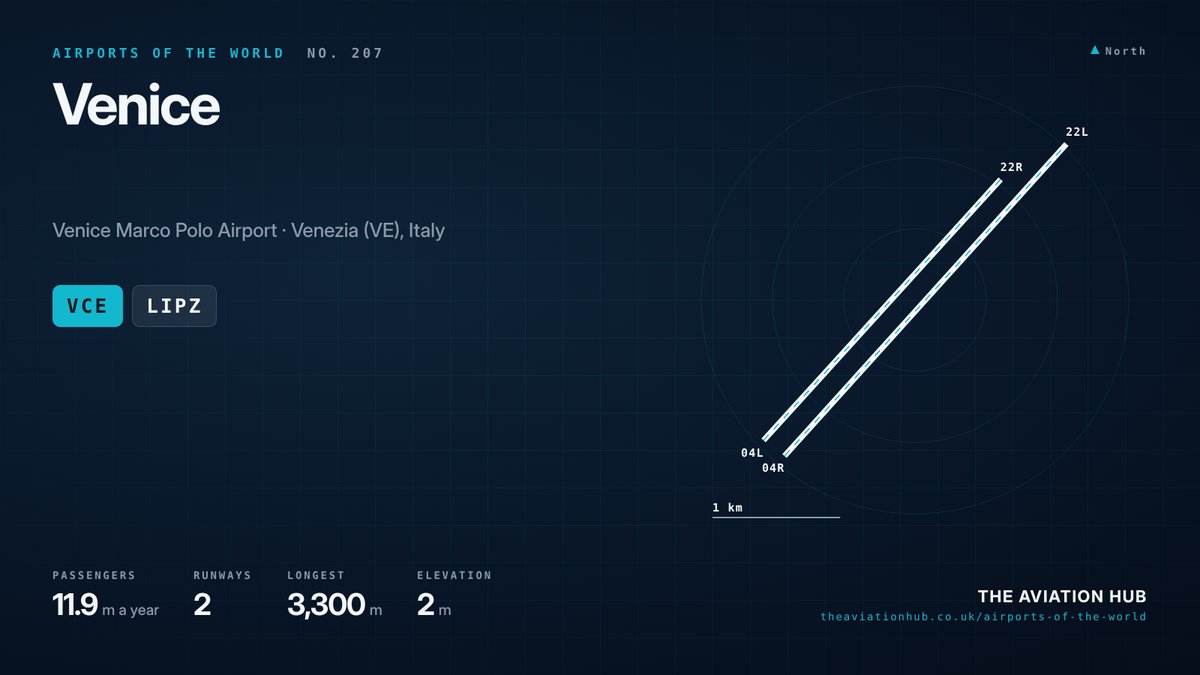
Venice Marco Polo Airport stands at Tessera on the mainland shore of the Venetian lagoon, so close to the water that arriving passengers can step from the terminal onto a boat. It serves Venice, Padua and the Veneto, one of the richest regions in Italy, and it ranks among the busiest airports in the country. Venice Airport handled around 11.85 million passengers in 2025 on a mix of low cost carriers, European flag carriers and a growing long haul roster from North America and the Gulf. A rail link due in 2027 will change how people reach it.
Venice Airport at a Glance
The codes are VCE and LIPZ. The field lies about 5 miles (8 km) north east of the historic centre as the crow flies, although the city is across water and the road route runs round the lagoon to Piazzale Roma. Elevation is 7 ft (2 m), and acqua alta flooding is a real concern for the airfield as well as the city.
Venice Airport has two parallel runways and one terminal, extended in several stages since 2002. The 2025 total of 11.85 million passengers came with about 87,600 aircraft movements and roughly 62,000 tonnes of cargo. easyJet, Ryanair, Volotea and Wizz Air all base aircraft here, and ITA Airways, Delta and Emirates provide the premium traffic. SAVE, a company part owned by the local authorities, operates the field and also runs Treviso and Verona. Timetables and boat connections are on the airport’s official website.
How Venice’s Airport Came to Be
Venice flew from the Lido for decades, where the Nicelli airfield served the city from the 1920s and still hosts light aircraft. The Lido was too small for jets, so a new airport opened at Tessera on reclaimed marsh in the early 1960s and took the name of the city’s most famous traveller, Marco Polo. The first terminal was a modest building that served through the 1970s and 1980s.
The turning point came with privatisation. SAVE took the concession and opened the present terminal in 2002, a long, low building faced in brick and glass that could absorb the tourist boom of the following two decades. Low cost carriers arrived in strength after 2005, and Delta’s New York service established Venice as a long haul destination in its own right.
Growth has not been smooth. Treviso, about 12 miles (20 km) to the north west and also run by SAVE, took much of the Ryanair traffic for years and still markets itself as Venice Treviso. Two accidents stand out, a Skyvan that ditched in the lagoon in 1967 with no deaths and an Air Force Piaggio PD.808 that crashed on landing in 1993, killing three.
Runways at Venice Airport
Runway 04R/22L is the main strip at 3,300 m (10,827 ft) long and 45 m wide, asphalt surfaced. Runway 04L/22R runs parallel at 2,780 m (9,121 ft) and the same width. In practice the shorter runway serves as a taxiway and as a relief strip for general aviation and for periods of maintenance, so the airport operates for most purposes as a single runway field.
The prevailing wind from the north east, the famous bora, puts most operations on the 04 runways in winter. Arrivals on 04R come in low over the lagoon from the south west with the city off the right wing, which is one of the better approaches in Europe. Summer sea breezes bring landings onto 22L over the mainland and departures out across the water.
Capacity at Venice Airport is bound up with the apron and the terminal rather than the runway. The long main strip takes any aircraft in service, and wide bodies from Emirates, Delta and Air Canada use it daily in summer. Fog in late autumn and winter is the main operational hazard on the flat lagoon edge.
Terminals and Airlines
The single terminal has arrivals on the ground floor, departures above and airline offices on the top level. Seventy check in desks line the departures hall, which splits airside into Schengen and non Schengen zones. A pier extension and a new boarding area opened in the late 2010s with air bridges for wide body aircraft.
ITA Airways, Air France, KLM, Lufthansa, Swiss, Austrian, British Airways, Iberia and Turkish Airlines fly the European trunk routes. The low cost side is bigger, with easyJet, Ryanair, Volotea, Wizz Air, Vueling and Transavia holding most of the gates. Delta, United and American fly to the United States in summer, Air Canada serves Montreal and Toronto, Emirates flies daily from Dubai and China Eastern from Shanghai.
Two lounges operate airside, the Tintoretto Lounge for SkyTeam passengers and the Marco Polo Room for everyone else. Cargo passes through a dedicated terminal on the north side of the apron.
Routes and Destinations
London is the busiest international market, with British Airways to Heathrow, easyJet to Gatwick and Ryanair to Stansted. Paris, Amsterdam, Frankfurt, Munich, Madrid, Barcelona and Istanbul follow. Domestic traffic centres on Rome Fiumicino with ITA Airways, with Catania, Palermo, Naples and Bari served by the low cost carriers.
Long haul sets Venice Airport apart from most Italian regional fields. Delta flies New York JFK year round and Atlanta in summer, United serves Newark and Washington, American flies to Philadelphia and Dallas Fort Worth, and Air Canada links Montreal and Toronto. Emirates operates a daily Boeing 777 from Dubai, and Air China began flying to Beijing in July 2026. The longest route is China Eastern’s Shanghai Pudong service at roughly 5,550 miles (8,900 km), just ahead of Dallas Fort Worth.
The season is sharp. July and August run far ahead of January, and the transatlantic routes mostly pause from November to March. Cargo of 62,000 tonnes a year is respectable, driven by the region’s fashion and eyewear exporters.
Getting to and from Venice Airport
The boat is the Venetian way. Alilaguna water buses run from the airport dock, a ten minute walk from the terminal, on the Blue, Red and Orange lines to Murano, the Lido, Rialto and San Marco. The crossing to St Mark’s takes about 75 minutes and costs around 15 euro (£13). Water taxis make the same journey in 30 minutes for upwards of 120 euro (£100).
On land, the ATVO express coach and the ACTV route 5 Aerobus reach Piazzale Roma in 20 to 30 minutes for around 10 euro (£8.50), which is the cheapest sensible option. ACTV routes 15 and 45 serve Mestre station for regional trains. A taxi to Piazzale Roma costs about 40 euro (£34). Multi storey car parks sit opposite the terminal, and the airport lies beside the SS14 and the A4 motorway junction.
A rail link is under construction. A loop off the Venice to Trieste line will bring trains into a station beneath the terminal, with work due to finish in late 2026 and services from early 2027.
Spotting and Photography
Venice Airport rewards photographers more for its setting than its access. Arrivals on 04R cross the lagoon from the south west with the islands behind them, and the water bus dock and the shoreline path near the terminal give angles on short final. The northern perimeter road beyond the threshold of 22L is reachable by car and offers departure shots in the afternoon.
Light is best in the morning from the lagoon side and in the afternoon from the northern road. Winter brings clear, cold days after the bora, and the summer haze flattens everything by midday. The terminal windows on the departures level cover the main apron and the wide body stands.
The lagoon edge is a nature reserve and parts of the perimeter are military. Stay on public paths, respect the fences and expect the Polizia di Frontiera to ask questions near the gates.
What Comes Next
The rail station is the headline project, and SAVE has paired it with a programme to extend the terminal and the apron towards 20 million passengers a year. Long haul will keep growing with Air China and the North American carriers, and Ryanair and Wizz Air added routes for 2026. The question is whether Venice, which already struggles with tourism, wants the growth.
Environmental limits on the lagoon and the city’s own visitor caps weigh on every expansion plan. The field will grow, but not fast.
Venice Airport is heading for a decade of steady growth, a rail link and a long haul network that most cities of its size would envy. See how it compares with Milan and Rome on the Airports of the World map.
Continue to follow The Aviation Hub for more analysis and insight.
Advertise with us Your brand, in front of an aviation audience Home page and in-article placements, sold directly, one advertiser per slot. From £250 a year. See the rates

