
Vilnius Airport Guide: Lithuania’s Capital on the Wing
Vilnius Airport explained: its 1932 origins, the single runway, old and new terminals, airlines, routes, the fast rail link and the best spotting views.
 By The Aviation Hub
6 min read
Updated October 20, 2026
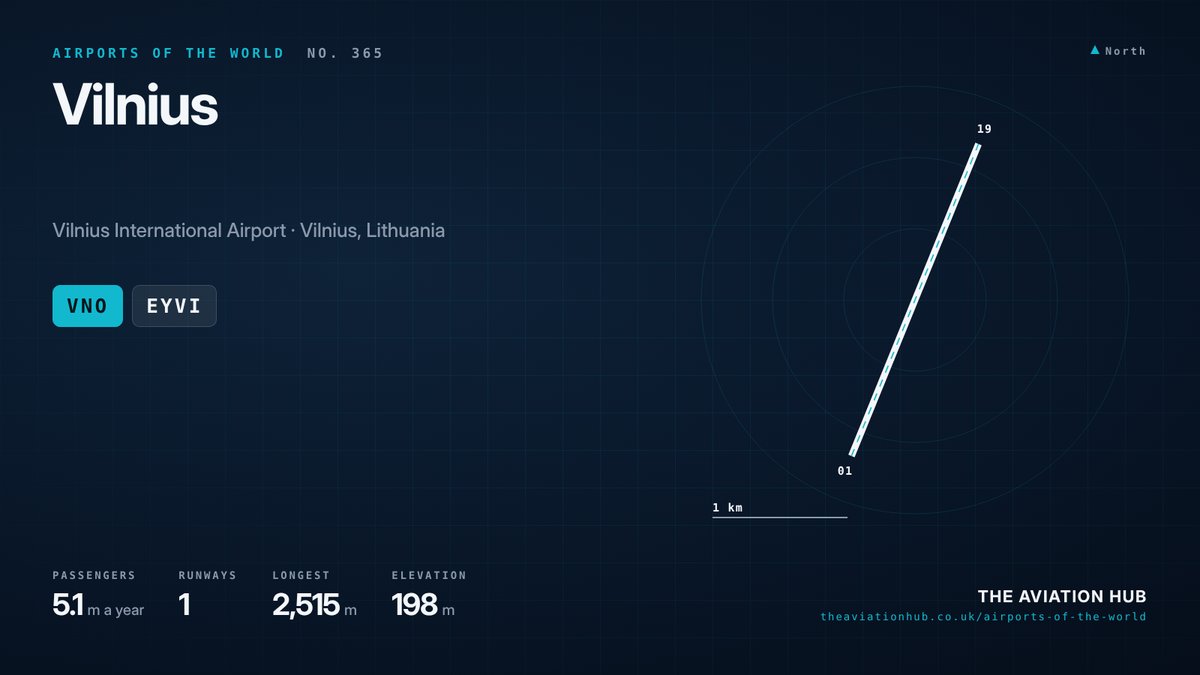
Vilnius Airport is the main international gateway to Lithuania and the busiest of the country’s three commercial airports. It sits on the southern edge of the capital, close enough that the train into town takes minutes. Around five million passengers use it each year. A new departure terminal opened in 2025, giving the Baltic hub its biggest upgrade in nearly two decades.
Vilnius Airport at a Glance
The airport carries the IATA code VNO and the ICAO code EYVI. It lies about 3.7 miles (5.9 km) south of the city centre, at an elevation of 648 feet (198 m). There is a single runway and a cluster of linked terminal buildings. The operator is Lithuanian Airports, a state company under the Ministry of Transport and Communications.
Traffic stood at roughly 4.8 million in 2024 and rose to a record of just over 5.1 million in 2025, passing the 2019 peak of about five million. Ryanair, Wizz Air and airBaltic all base aircraft at Vilnius Airport, while GetJet Airlines uses it as a focus for seasonal charters. Flight information and passenger guidance are on the airport’s official website. Between 2025 and 2029 the airport also carries the name of the painter Mikalojus Konstantinas Ciurlionis.
How Vilnius Got Its Airport
The airport opened on 17 August 1932, when Vilnius belonged to the Second Polish Republic and was known as Wilno. It took the name Porubanek from a neighbouring village, now part of the city’s Kirtimai district. After the Second World War, the Soviet Union rebuilt the field as part of its Aeroflot network.
The Soviet terminal, a grand 1950s building, still stands and now handles arrivals. Lithuanian independence in 1990 opened the airport to Western airlines. A separate departure terminal followed in 1993, and a larger terminal opened in November 2007 as Lithuania joined the Schengen area.
Home carriers have come and gone. flyLAL, the former national airline, collapsed in 2009, and Air Lituanica lasted only a few years. Low cost carriers filled the gap, and they now provide most of the seats at Vilnius Airport.
Runways at Vilnius Airport
A single runway, 01/19, handles every movement. It is 2,515 metres (8,251 feet) long and 50 metres wide, with an asphalt surface. That suits the Airbus A320 and Boeing 737 families comfortably but limits heavier long haul operations.
The runway runs roughly north to south. Southwesterly winds favour runway 19, with arrivals descending over the southern districts of the city. Northerly winds swing traffic onto runway 01, with approaches from the open country to the south.
Relying on one runway creates real vulnerability. In 2017 the airport closed for 35 days for runway reconstruction, with flights diverted to Kaunas. In November 2024 a Swiftair Boeing 737-400 freighter crashed into a house on approach, killing one crew member. During 2025, helium balloons drifting from Belarus, used to smuggle cigarettes, forced repeated airspace closures.
Terminals and Airlines
The new departure terminal opened on 4 February 2025 at a projected cost of about €50.2 million (roughly £42 million). It doubles throughput to around 2,400 departing passengers an hour, with more security lanes and a larger airside area. Arrivals still flow through the older buildings, including the restored Soviet era hall.
Ryanair, Wizz Air and airBaltic carry the largest shares of passengers. Ryanair and Wizz Air fly Boeing 737-800s and Airbus A321neos to leisure and visiting friends markets, while airBaltic, based in Riga, keeps a base here with its Airbus A220 fleet. Network carriers include LOT, Lufthansa, Austrian, Swiss, Brussels Airlines, Turkish Airlines, Finnair and SAS, covering all three alliances.
GetJet Airlines, Avion Express and Heston Airlines fly charters for tour operators. Summer brings these flights from Vilnius Airport to the Mediterranean, the Canary Islands and beyond.
Routes and Destinations
Hub links connect Vilnius Airport with the wider world. Warsaw, Frankfurt, Munich, Helsinki, Copenhagen, Amsterdam and Istanbul all feature, alongside airBaltic flights to Riga. Istanbul is the gateway for much of the long haul traffic, while Riga and Warsaw offer quick regional connections.
Low cost routes reach the UK, Ireland, Norway and Germany, reflecting large Lithuanian communities abroad. London is the biggest of these markets, served from several airports. Holiday flights head south to Spain, Italy, Greece, Turkey and Egypt, and Antalya was the busiest route of all in 2024.
The summer schedule is noticeably busier, though winter traffic holds up thanks to diaspora travel around Christmas. Cargo is modest, and the airport handled roughly 14,000 tonnes in 2019.
Getting to and from Vilnius Airport
The train is the quickest option. A direct rail link has run since 2008, reaching Vilnius station in around eight minutes. The airport stop sits a short walk from the terminal, and fares are cheap. Trains are not frequent, so check the timetable first.
City buses run to the centre and the old town, taking roughly 15 to 25 minutes and offering the cheapest sensible option for most visitors. Flybus coaches connect the terminal with Riga. Taxis and ride hailing services are plentiful, and the drive to the old town takes about 15 minutes outside rush hour.
Drivers reach the terminal from the Rodunios road, and short and long stay car parks sit close to the terminal. Intercity trains from the main station continue to Klaipeda and other Lithuanian cities.
Spotting and Photography
Vilnius Airport is an easy field to photograph because the city wraps around its northern end. Arrivals on runway 19 pass low over residential streets, and side roads near the threshold offer good angles. Open ground near the southern end works well when traffic switches to runway 01.
Traffic is light, so the timetable matters. Morning departure waves and evening arrival banks bring Ryanair, Wizz Air and airBaltic in quick succession. Occasional NATO and government aircraft add interest, reflecting Lithuania’s position on the alliance’s eastern flank.
Stay on public land and away from fences. Lithuanian police take security around the airport seriously, especially given recent airspace incidents. Do not fly drones anywhere near the field.
What Comes Next
The 2025 departure terminal solves the most pressing capacity problem, but the single runway remains a weak point. Lithuanian Airports has continued to modernise the older terminal buildings and aprons. Security has also moved up the agenda after the balloon incidents, with new detection measures at the border.
Demand should keep growing as Lithuania’s economy expands and new routes open. Vilnius Airport passed its 2019 record in 2025 and looks set to keep climbing. See how it compares with Riga, Tallinn and Warsaw on the Airports of the World map. The verdict: a compact, efficient capital city airport now with the terminal space to match its ambitions.
Continue to follow The Aviation Hub for more analysis and insight.
Advertise with us Your brand, in front of an aviation audience Home page and in-article placements, sold directly, one advertiser per slot. From £250 a year. See the rates

