
Washington Dulles Airport Guide: Saarinen’s Capital Gateway
Washington Dulles Airport is the long haul gateway to the US capital, a United hub with four runways and a famous terminal. Read about its routes and spotting.
 By The Aviation Hub
7 min read
Updated October 20, 2026
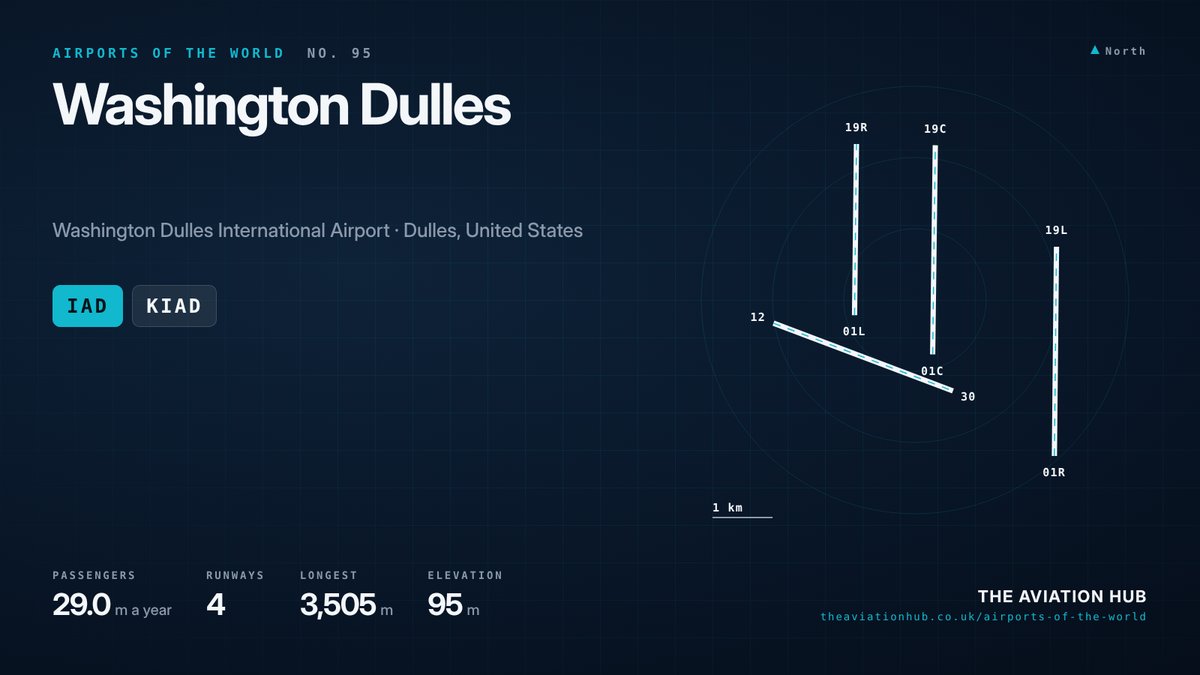
Washington Dulles International Airport is the main long haul gateway to the United States capital and the largest of the three airports serving the region. It sits in Loudoun and Fairfax counties, Virginia, about 26 miles (42 km) west of downtown Washington. Washington Dulles Airport handled a record 29 million passengers in 2025 and is a major transatlantic hub of United Airlines. The Eero Saarinen terminal, the vast site and the four runways make it a field built for a future that took decades to arrive.
Washington Dulles Airport at a Glance
The codes are IAD and KIAD. The field sits at 312 ft (95 m) above sea level on former farmland that has become the data centre belt of Northern Virginia. The site covers around 13,000 acres, the third largest airport footprint in the United States, and the terminal is roughly 26 miles (42 km) from the National Mall.
Washington Dulles Airport has four runways and a single main terminal with two pairs of midfield concourses. The 2025 figure was 29,008,839 passengers, up 6.4 per cent on 2024 and the best year in the airport’s history. United Airlines is the hub carrier, with United Express partners Mesa, GoJet and CommuteAir basing aircraft here, and more than 50 airlines served the field in early 2025. The Metropolitan Washington Airports Authority operates both Dulles and Reagan National. Live flight information is on the airport’s official website.
A Short History of Dulles
Washington needed a second airport as soon as National ran out of room after the war. Congress passed the Washington Airport Act in 1950, President Eisenhower picked the Chantilly site in 1958, and the small community of Willard was demolished to make way for it. The airport opened on 17 November 1962 and took the name of John Foster Dulles, Eisenhower’s Secretary of State, at the suggestion of aviation adviser Pete Quesada.
Saarinen’s terminal, with its swooping concrete roof slung between leaning columns, was designed for jets from the outset. Passengers rode mobile lounges from the terminal straight to aircraft parked on the apron. For years the airport was mocked as a white elephant, and in 1973 President Nixon pointedly flew a commercial United service from here during the fuel crisis. Concorde arrived from London and Paris in 1976.
The code changed from DIA to IAD because handwritten DIA kept being misread as DCA. The midfield C and D concourses opened as temporary buildings in 1983 and Washington Dulles Airport took its current full name in 1984. The AeroTrain people mover replaced most of the mobile lounges in 2010, and Dulles overtook Reagan National in total passengers in 2019.
Runways at Washington Dulles Airport
The three parallel north south runways are the backbone of the operation. Runway 01C/19C is 3,505 m (11,500 ft) long and 46 m (150 ft) wide with a grooved concrete surface, and runway 01R/19L matches it at 3,505 m (11,500 ft) on concrete. Runway 01L/19R, the newest, opened in 2008 at 2,865 m (9,400 ft) and 46 m (150 ft) wide, also concrete. The crosswind runway 12/30 runs 3,201 m (10,501 ft) by 46 m (150 ft) in concrete.
Three parallels allow simultaneous independent approaches. The centre runway 01C/19C mostly takes arrivals, 01R/19L handles both arrivals and departures, and 01L/19R is busiest at peak times. The field switches between north and south flow with the wind. Runway 12/30 is mainly a departure runway, and runway 30 takes most morning departures. It takes arrivals only on a few days of strong north westerly wind.
The long strips let fully loaded Boeing 777-300ER and Airbus A350-900 services to the Gulf and Asia depart without penalty. A planned fifth runway, parallel to 12/30, would add capacity that Washington Dulles Airport does not yet need.
Terminals and Airlines
The Main Terminal houses check in, baggage reclaim and customs, plus four Z gates used by Air Canada and some United Express flights. Everyone else heads underground to the AeroTrain or to one of the surviving mobile lounges, which still serve Concourse D and a few hardstands. In total there are 139 gates, 123 of them with jet bridges.
Concourses A and B form the north midfield building. Concourse A has 47 gates and most of the international traffic, including Emirates, Qatar Airways, Etihad, Air France, KLM and Virgin Atlantic. Concourse B has 28 gates and takes British Airways, Lufthansa and Turkish Airlines along with almost all the domestic and Canadian flights outside United. Southwest arrived in 2006 but pulled out in June 2026.
Concourses C and D belong to United, with 22 gates each for mainline and United Express flights. Built as temporary buildings more than 40 years ago, they are tired, and the Polaris lounge in C is the one bright spot.
Routes and Destinations
More than 139 destinations are served and about 60,000 passengers pass through each day. United’s domestic bank links the hub with every major city in its network, including San Francisco, Denver, Chicago, Los Angeles and Houston. Delta, American and the other domestic carriers add their own hubs.
The international network is where Washington Dulles Airport earns its keep. London Heathrow is the busiest overseas route, served by United, British Airways and Virgin Atlantic, with Frankfurt, Paris and Munich also busy. United flies to Tokyo and Tel Aviv, Air China links Beijing, while Emirates, Qatar Airways and Etihad connect the Gulf. Rome, Lisbon, Cairo and a long list of Latin American and Caribbean points complete the map. Summer brings seasonal European additions and a busy Caribbean programme in winter.
Getting to and from Washington Dulles Airport
The Metro Silver Line station opened on 15 November 2022 and sits a short walk from the terminal. Trains reach downtown Washington in around 55 minutes for a few dollars, which makes the Silver Line the cheapest sensible option. Fairfax Connector buses on routes 952 and 983 serve a Kiss and Fly stop beside the station for local journeys.
The Dulles Access Road is toll free for airport traffic and funnels cars onto Interstate 66 for the city. Allow 45 minutes at quiet times and far longer in the rush hour. Washington Flyer holds the taxi concession and a cab to downtown costs roughly $70 to $80 (£55 to £65). Uber and Lyft pick up from designated zones and tend to be cheaper. Parking ranges from the hourly garage beside the terminal to economy lots served by shuttle buses.
Spotting and Photography
Washington Dulles Airport is one of the better spotting airports on the US east coast because the site is so open. The Smithsonian’s Udvar Hazy Center, the air and space annex on the southern boundary, has an observation tower with views across runway 01R/19L and the approaches. It costs nothing to enter and the museum holds Concorde, the Space Shuttle Discovery and the Enola Gay.
The roads on the eastern side give views of arrivals on the 01s in north flow, with the morning light behind the camera. Spots off Old Ox Road (VA 606) on the north west side work for 19R arrivals in the afternoon. The Fairfield Inn car park in Sterling, on the north side, suits morning 19L arrivals.
Airport police patrol the perimeter and the garages. Stay on public roads, keep away from the fence line and do not loiter near the cargo gates. Photography is legal from public land, and a polite explanation usually satisfies anyone who asks.
What Comes Next
Concourse E is the big change, adding 14 gates and the first new concourse space in decades from its opening in 2026. A 100 MW solar and battery facility on airport land, started in 2023, will supply a large share of the field’s power. The authority has long term plans to replace the temporary C and D concourses with a permanent building and to build the fifth runway when demand justifies it.
Growth is driven by United’s transatlantic and Pacific expansion and the prosperity of Northern Virginia. With four runways and 13,000 acres to play with, Washington Dulles Airport is heading for 35 million passengers without breaking a sweat.
Washington Dulles Airport has grown into the role Saarinen imagined for it. Compare it with the other US hubs on the Airports of the World map.
Continue to follow The Aviation Hub for more analysis and insight.
Advertise with us Your brand, in front of an aviation audience Home page and in-article placements, sold directly, one advertiser per slot. From £250 a year. See the rates

