
Washington Reagan Airport Guide: The Capital’s Closest Field
Washington Reagan Airport sits on the Potomac minutes from the Capitol. Read about the River Visual approach, the perimeter rule and American's hub.
 By The Aviation Hub
7 min read
Updated October 20, 2026
Ronald Reagan Washington National Airport is the closest airport to the centre of the American capital and one of the most tightly regulated in the world. It sits on landfill in the Potomac River in Arlington, Virginia, barely 3 miles (5 km) from the National Mall. Washington Reagan Airport handled around 25 million passengers in 2025 on a short main runway, under slot controls and a perimeter rule that limits how far its flights can go. It is the hub of American Airlines and the airport of choice for Congress, which has shaped its rules for decades.
Washington Reagan Airport at a Glance
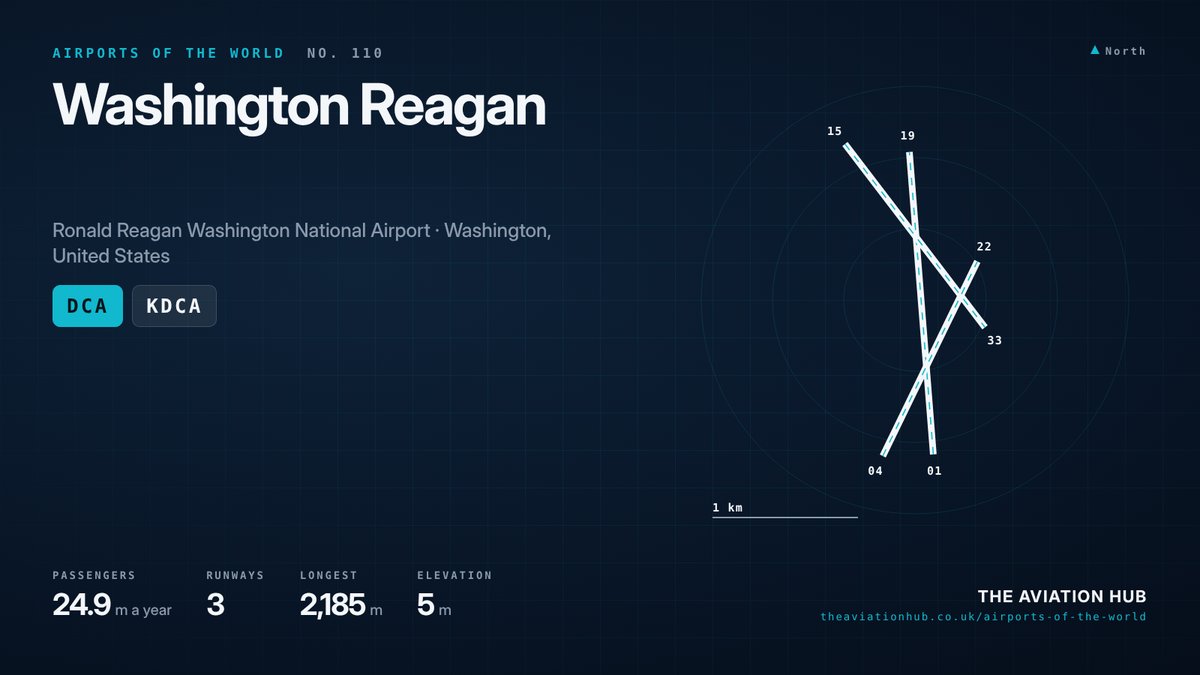
The codes are DCA and KDCA. The airport lies directly across the river from Washington at an elevation of 5 m (15 ft), between the George Washington Memorial Parkway and the Potomac. Three asphalt runways serve two terminals. Terminal 1 is the original 1941 building and Terminal 2 is the 1997 complex with concourses B to E.
In 2025 Washington Reagan Airport handled around 24.9 million passengers, down from a record of about 26.3 million in 2024. American Airlines carries about 54 per cent of them, with Southwest and Delta each holding around 14 per cent. The Metropolitan Washington Airports Authority operates the field under a lease from the federal government, which still owns it. Flight information, parking rates and Metro details are on the airport’s official website.
How Washington’s Airport Came to Be
Washington’s early airports were a mess. Hoover Field opened in 1926 and Washington Airport in 1927 on adjoining sites in Arlington, separated by a road that had to be closed for landings. They merged in 1930 but remained cramped and dangerous. Congress had banned federal spending on airports, and only in 1938 did it relent. President Franklin Roosevelt pushed through a USD 15 million appropriation and chose a site at Gravelly Point, built on fill dredged from the river.
Washington National Airport opened on 16 June 1941, months before Pearl Harbor. Its terminal, with its curved facade facing the river, became a landmark of the art deco era and survives as Terminal 1. In 1966 the airlines agreed a voluntary perimeter to protect the new Dulles airport, and in 1986 Congress wrote it into law at 1,250 statute miles, with a growing list of exemptions since.
Terminal 2, designed by Cesar Pelli with its distinctive row of domes, opened in 1997. In February 1998 President Bill Clinton signed a bill renaming the airport after Ronald Reagan, over objections that a federal building already bore his name and that the field already honoured George Washington. Project Journey added Concourse E for regional jets in April 2021 and new security halls that November.
Runways at Washington Reagan Airport
Washington Reagan Airport has three asphalt runways, all 46 m wide. The main runway 01/19 is just 2,185 m (7,169 ft) long, yet it is one of the busiest single runways in the United States. Runway 15/33 is 1,586 m (5,204 ft) and is used by regional jets and in crosswinds. Runway 04/22 is 1,524 m (5,000 ft) and is too short for commercial arrivals.
The famous River Visual approach to runway 19 follows the Potomac from the north, with aircraft weaving around the restricted airspace over the National Mall and the Naval Observatory before a late turn onto final. It needs a cloud base of at least 3,500 ft and 3 miles of visibility. Passengers on the left see the Lincoln Memorial and the Washington Monument slide past the window. Departures off runway 01 must turn sharply left to follow the river away from the prohibited zone.
On 29 January 2025 PSA Airlines Flight 5342, a Bombardier CRJ700 operating as American Eagle, collided with a US Army Black Hawk helicopter on approach over the river. All 67 people on both aircraft died. The Federal Aviation Administration restricted helicopter traffic along the Potomac in response, and a series of further incidents that year, including a tower altercation and ramp collisions, kept safety at the field under intense scrutiny.
Terminals and Airlines
Terminal 1, with gates A1 to A9, is the historic building. It handles Southwest, which has the largest presence there, along with Frontier and Air Canada Express. The main hall has been restored and is worth a look even for passengers using the other terminal.
Terminal 2 is the modern heart of Washington Reagan Airport. Concourse B, gates B10 to B22, is used by Alaska, Delta and United. Concourse C, gates C23 to C34, hosts American and JetBlue. Concourse D, gates D35 to D45, is entirely American, and Concourse E, gates E46 to E59, handles American and American Eagle regional flights. American operates Admirals Clubs across its concourses and Delta and United each have a lounge. Since 2021 Terminal 2 passengers clear security in two large checkpoints and then walk airside between its concourses, while Terminal 1 has no airside link to them.
Routes and Destinations
The perimeter rule keeps most flights within 1,250 miles, so Washington Reagan Airport is a short and medium haul field. Boston, Atlanta, Chicago O’Hare, Orlando and Miami were the busiest routes in the year to May 2026, with New York LaGuardia, Dallas Fort Worth, Charlotte, Nashville and Fort Lauderdale also busy. The shuttle corridor to New York and Boston is one of the busiest in the country.
Exemptions allow a handful of longer flights to Los Angeles, San Francisco, Seattle, Denver, Phoenix, Las Vegas, Salt Lake City, Austin and San Antonio. A 2024 law added five more round trip slot pairs beyond the perimeter, which were fought over by every major airline. International service is limited to Canada and the Caribbean because the airport has no customs facility for arriving passengers from elsewhere. Toronto is the busiest foreign route, followed by Montreal and Nassau. Slots are valuable, and JetBlue once paid USD 40 million for eight pairs.
Getting to and from Washington Reagan Airport
The Metro is the obvious answer and the cheapest sensible option. The airport station on the Blue and Yellow lines sits beside Terminal 2, with elevated walkways into the concourses and an underground passage and shuttle to Terminal 1. Trains reach L’Enfant Plaza in around ten minutes and Metro Center in about 15, for a fare of a few dollars. Several Metrobus routes also stop at the terminals.
By road the airport sits on the George Washington Memorial Parkway, with the Airport Viaduct connecting to US Route 1 and Interstate 395 a short distance north. Downtown is 10 to 15 minutes away outside the rush hours. A taxi to the Capitol costs around USD 20 to 25 (about £15 to £19). Parking garages face the terminals, and a planned pedestrian bridge would link the airport to Crystal City in National Landing, home of Amazon’s second headquarters.
Spotting and Photography
Gravelly Point Park, at the northern end of runway 01/19, is one of the most famous spotting locations in the world. Aircraft landing on runway 19 pass a few dozen feet above the grass, close enough to feel the wake. It is a public park with parking, reached from the parkway northbound, and it fills with families and photographers on summer evenings. The Mount Vernon Trail runs through it for cyclists and walkers.
Afternoon and evening light is ideal at Gravelly Point, with the sun behind the photographer for arrivals from the north. Departures off runway 01, which turn hard left over the river, climb straight over the park and give equally dramatic views. Across the river, Hains Point in East Potomac Park offers a long lens view of the River Visual with the city behind. Security is tight, and the US Park Police and airport police respond quickly to anyone near the fence or flying a drone, which is banned throughout the district.
What Comes Next
There is no room to expand and no political will to lift the constraints. The slot and perimeter rules are revisited every time Congress reauthorises the Federal Aviation Administration, and each round produces a few more long haul exemptions and a lot of lobbying. The airports authority is focused on refurbishing Terminal 1 and improving the airside connections built under Project Journey.
Safety is the pressing question after the 2025 collision, with helicopter routes, controller staffing and runway 15/33 operations all under review. The verdict is that Washington Reagan Airport will remain small, busy, convenient and controversial, exactly as it has been for more than 80 years. Compare it with Dulles and Baltimore on the Airports of the World map.
Continue to follow The Aviation Hub for more analysis and insight.
Advertise with us Your brand, in front of an aviation audience Home page and in-article placements, sold directly, one advertiser per slot. From £250 a year. See the rates

