
Wenzhou Airport Guide: Gateway to China’s Merchant City
Wenzhou Airport set a record of 13 million passengers in 2025. Explore its history, runway, terminals, Europe links, metro access and growth plans.
 By The Aviation Hub
6 min read
Updated October 20, 2026
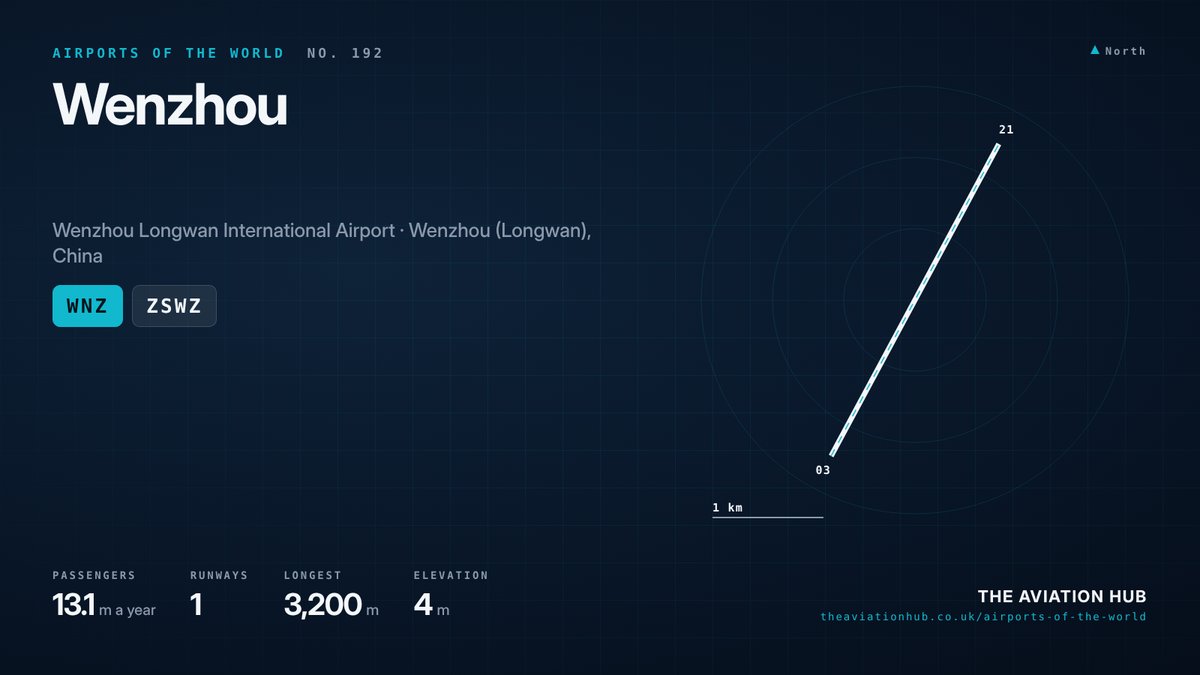
Wenzhou Airport, officially Wenzhou Longwan International Airport, serves one of the most commercially minded cities in Zhejiang province. It sits on flat coastal land at the mouth of the Ou River, southeast of the city, facing the East China Sea. A record 13.06 million passengers used it in 2025. That traffic owes much to Wenzhou’s famous traders and to a large diaspora spread across Italy, Spain and France.
Wenzhou Airport at a Glance
The IATA code is WNZ and the ICAO code is ZSWZ. The airport lies about 15 miles (24 km) southeast of central Wenzhou, in Longwan District. Elevation is just 4 metres (13 feet), reflecting its reclaimed coastal site. There is a single runway and two terminals, with a third terminal and second runway approved.
Wenzhou Airport handled 13,058,523 passengers in 2025, which ranked it 35th among mainland Chinese airports. It also moved about 128,700 tonnes of cargo and mail and recorded 93,735 aircraft movements, all record highs. No single airline runs a hub here, though China United Airlines lists the most destinations. Timetables and services are listed on the airport’s official website.
How Wenzhou’s Airport Came to Be
Wenzhou spent the early reform era without a proper airport, despite its reputation for private enterprise. Construction began in 1987, funded by the Wenzhou municipal government at a cost of RMB 132.5 million. The airport opened on 12 July 1990 as Wenzhou Yongqiang Airport, named after the local Yongqiang area. On its first day it offered four routes, to Shanghai, Wuhan, Chengdu and Ningbo.
Growth was steady through the 1990s and 2000s as the city’s shoe, clothing and electrical factories prospered. The name changed to Civil Aviation Wenzhou Yongqiang Airport in 2002. A dedicated international terminal of 10,500 square metres opened in June 2011. On 25 April 2013 the airport took its present name, after Longwan District.
The next big step came in June 2018, when Terminal 2 began opening and dual terminal operations started. Passenger numbers passed 10 million in November 2018. A year later, in September 2019, the S1 metro line reached the terminal. The pandemic hit hard, but traffic recovered strongly and set new records in 2025.
Runways at Wenzhou Airport
Wenzhou Airport has one concrete runway, 03/21, which is 3,200 metres (10,499 feet) long and 45 metres wide. It runs roughly northeast to southwest along the coast. The length handles the Airbus A330 and Boeing 787 comfortably, and the runway was rated for Boeing 747 operations when upgraded. A parallel taxiway serves the terminal aprons.
Wind decides the direction. In winter, northerly monsoon winds tend to favour runway 03, while summer southerlies bring more use of runway 21. Typhoons can close the airport for a day or more between July and September. Sea fog is another seasonal hazard on this low lying site.
The single runway is now the main constraint on growth. A second runway of 3,600 metres is planned on the east side of the existing one, as part of the Phase III expansion. On 20 March 2011 a China Eastern Airbus A320 arriving from Shanghai Hongqiao clipped trees on approach, a reminder of the obstacles around the field.
Terminals and Airlines
Terminal 2 is the main building and handles domestic flights, which make up most of the traffic. Terminal 1, the older building, is set aside for international and regional flights. Once Terminal 3 opens, the current buildings will be reorganised again. Facilities are functional rather than lavish, and queues at peak times can be long.
China United Airlines, Air China, Loong Air and China Eastern Airlines run the widest networks at Wenzhou Airport, flying mainly narrow body jets. Hainan Airlines and China Southern are also present, joined by Sichuan Airlines, Shandong Airlines, Xiamen Airlines and Spring Airlines on selected routes. Cargo carriers include Central Airlines, My Freighter Airlines and YTO Cargo Airlines.
Routes and Destinations
The network covered 102 destinations in 2025. Beijing, Guangzhou, Shenzhen, Chengdu and Chongqing are among the main domestic routes, alongside Xi’an, Kunming and Wuhan. Shanghai is only a few hours away by high speed rail, which limits demand for flights on that route. Flights to Hainan, Sanya in particular, peak in winter.
The international story is shaped by emigration. Wenzhou families built trading networks across Europe, from the textile workshops of Prato to wholesale districts in Madrid and Paris. China Eastern serves Rome and Madrid, and a Milan service completes the three intercontinental routes that ran through 2025. These are the longest from the airport. Regional international flights reach Hong Kong, Macau, Seoul, Jeju, Singapore and Vientiane.
Cargo is growing quickly. E commerce parcels and small manufactured goods dominate the outbound flow, and express freighters operate at night. Planned cargo facilities will raise annual capacity to around 320,000 tonnes.
Getting to and from Wenzhou Airport
Metro Line S1 has served Wenzhou Airport since September 2019, giving a direct rail link without transfers. Trains run west through Longwan towards Wenzhou South railway station, where high speed services connect with Shanghai, Hangzhou and Fuzhou. The ride to Wenzhou South takes around 40 minutes, and fares are a few yuan. It is the cheapest sensible option.
Airport coaches link the terminals with the city centre and neighbouring districts such as Rui’an and Yueqing. Taxis wait outside arrivals and take around 30 to 45 minutes to the centre, depending on traffic. Ride hailing apps work well and are widely used. Parking is available beside both terminals for those driving themselves.
Spotting and Photography
The flat coastal setting around Wenzhou Airport offers open views. Roads and sea walls around the perimeter give sightlines to the runway, and aircraft on approach pass low over farmland and fish ponds. Inside the terminals, the departure areas look over the aprons and the parallel taxiway.
The traffic is mostly A320 family and 737 types, with occasional wide bodies on European services and freighters at night. Morning light favours the southeast side of the field, while afternoon sun suits positions to the northwest. Chinese airports treat perimeter photography cautiously, so stay on public roads, keep away from fences and stop if security staff ask. Respect local rules at all times.
What Comes Next
China’s National Development and Reform Commission approved Phase III in September 2023. It includes the second 3,600 metre runway, a new Terminal 3 of 132,000 square metres, about 50 new aircraft stands and a 67,000 square metre cargo facility. Total investment is about RMB 10.97 billion. The airport also plans to connect more closely with the Wenzhou East railway station.
The targets for 2030 are 30 million passengers and 285,000 tonnes of cargo and mail. Those numbers would more than double today’s traffic. Wenzhou Airport is heading for a decade of building, with a second runway that should finally match the ambitions of its merchant city. Explore other Chinese gateways on the Airports of the World map.
Continue to follow The Aviation Hub for more analysis and insight.
Advertise with us Your brand, in front of an aviation audience Home page and in-article placements, sold directly, one advertiser per slot. From £250 a year. See the rates

