
Winnipeg Airport Guide: Prairie Hub for the Canadian North
Winnipeg Airport links the Prairies with the Canadian North, the US and the sun. Our guide covers its runways, terminal, airlines, cargo role and access.
 By The Aviation Hub
5 min read
Updated October 20, 2026
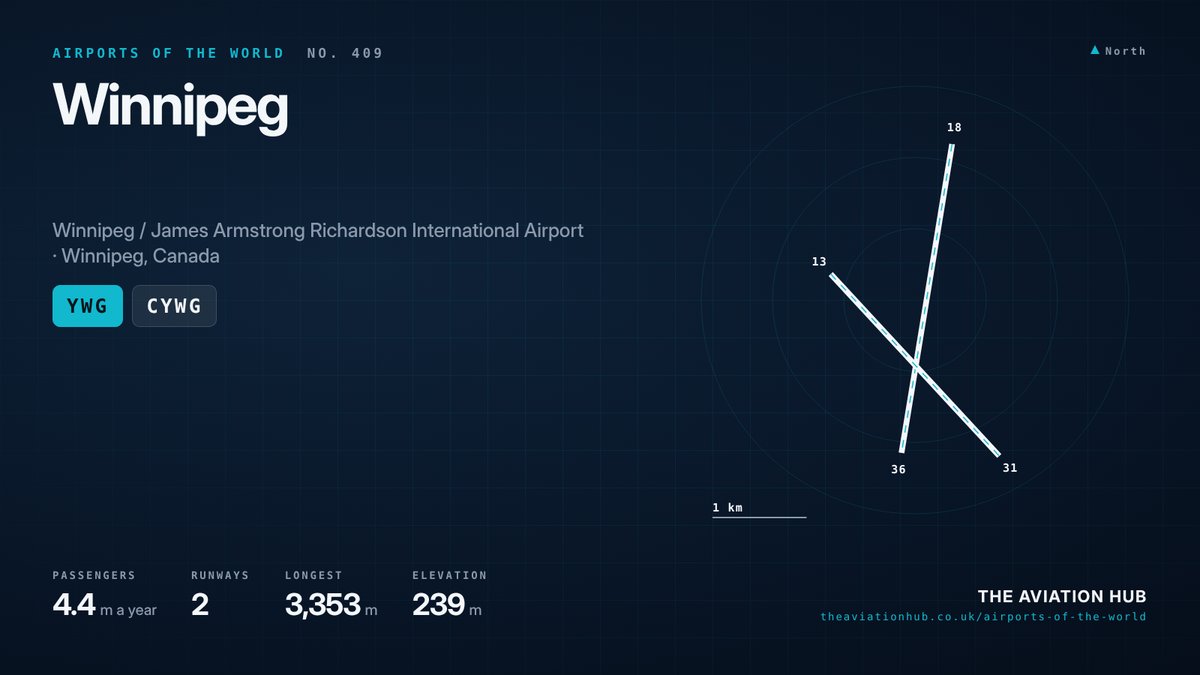
James Armstrong Richardson International Airport sits on the western edge of Manitoba’s capital, at the geographic heart of Canada. Winnipeg Airport handled about 4.4 million passengers in 2025 and ranks as the seventh busiest airport in the country. It is far more than a regional terminal. Northern airlines, a major cargo operation and an air force wing all work from the same field, giving it a role well beyond its passenger numbers.
Winnipeg Airport at a Glance
The IATA code is YWG and the ICAO code is CYWG. The airport lies roughly 5 miles (8 km) west of downtown Winnipeg, at an elevation of 239 metres (783 feet). It has two runways and one main terminal, plus a separate building for Perimeter Aviation. Winnipeg Airport recorded about 4.41 million passengers in 2025, up 2.7 per cent, with more than 115,000 aircraft movements.
WestJet treats the city as a focus city, Flair Airlines keeps a base, and Calm Air, Perimeter, Bearskin and Cargojet all run hubs. The not for profit Winnipeg Airports Authority operates the site. Flight times and parking rates are on the airport’s official website.
How Winnipeg’s Airport Came to Be
The field opened in 1928 as Stevenson Aerodrome, named for bush pilot Fred J. Stevenson. In 1931 Northwest Airways began flights to Pembina, North Dakota, and the airport describes itself as Canada’s first international airport. The Royal Canadian Air Force and the federal government controlled the site from 1940 until 1997. In the mid 1950s, Scandinavian Airlines briefly called here on its polar route between Copenhagen and Los Angeles.
The name Winnipeg International Airport arrived in 1962, and a new terminal followed in 1964. In December 2006 the federal government renamed the field for James Armstrong Richardson, the businessman who founded Western Canada Airways in the 1920s. Bush flying and northern freight made his company a giant of early Canadian aviation. A replacement terminal designed by Cesar Pelli and Stantec opened on 30 October 2011. It was Canada’s first LEED certified airport terminal, and the old building was demolished soon after.
Runways at Winnipeg Airport
Runway 18/36 is the longest strip. It measures 3,353 metres (11,000 feet) long and an unusually wide 61 metres, with an asphalt surface. Runway 13/31 measures 2,695 metres (8,841 feet), also 61 metres wide and asphalt. The two intersect, giving controllers a choice of directions as prairie winds swing around.
Winter is the defining challenge. Temperatures regularly fall below minus 30C, and snow clearing crews work around the clock to keep both runways open. The field operates 24 hours a day, which suits overnight cargo flights. The Royal Canadian Air Force still uses Winnipeg Airport through 17 Wing at CFB Winnipeg, which shares the site.
Terminals and Airlines
Nearly all airlines use the main terminal, a bright glass building that handles domestic, transborder and international flights. Winnipeg is one of nine Canadian airports with US border preclearance, so passengers clear American immigration before departure. Air Canada operates a Maple Leaf Lounge, and Plaza Premium runs a pay in lounge airside.
WestJet is the largest operator, flying Boeing 737 jets across Canada, to the United States and to sun destinations. Air Canada links Winnipeg with Toronto, Montreal and Vancouver, while Delta connects to Minneapolis. Calm Air serves northern Manitoba and Nunavut with ATR turboprops, and Bearskin Airlines adds links into northwestern Ontario. Perimeter Aviation flies to remote communities from its own terminal about 1.6 miles (2.6 km) south of the main building at Winnipeg Airport.
Routes and Destinations
Toronto Pearson is the busiest route, with around 93 weekly flights in mid 2025. Calgary follows with 77, then Vancouver with 65 and Edmonton with 38. Rankin Inlet, a key gateway to Nunavut, ranks fifth with about 24 weekly departures, a reminder of the airport’s northern role.
Minneapolis was the busiest international route in 2024 with about 157,000 passengers, followed by Atlanta and Los Angeles on WestJet. Winter brings flights to Mexico and the Caribbean, and Air Canada Rouge returns to Montego Bay from December 2026. WestJet launched a transatlantic link to Reykjavik in June 2026, now among the longest routes from Winnipeg Airport. Cargo is a major business, with Cargojet’s hub and a large Canada Post processing centre.
Getting to and from Winnipeg Airport
Winnipeg Transit runs three routes to the terminal, including the D12 and D13, the cheapest sensible option into downtown. The bus takes around 25 to 30 minutes. Taxis and ride hailing take about 15 to 20 minutes outside rush hour, and a multi level parkade with more than 1,500 spaces sits beside the terminal.
CentrePort Canada Way, a four lane expressway opened with federal and provincial funding, links the airport area with the Perimeter Highway. There is no rail link. The Brandon Air Shuttle connects with Brandon, about two and a half hours west. Kerbside valet parking is also available at Winnipeg Airport for travellers in a hurry, a welcome option in deep winter.
Spotting and Photography
The variety is excellent. WestJet and Air Canada jets mix with Calm Air ATRs, Perimeter Dash 8s and Metro turboprops, Cargojet Boeing 767 freighters and RCAF aircraft from 17 Wing. Maintenance and engine shops such as StandardAero add test flights and unusual visitors. The flat prairie landscape keeps sightlines long and clear, and big skies make for dramatic backdrops during summer storms.
The Royal Aviation Museum of Western Canada opened its new home on the airport grounds in 2022, and it makes a natural first stop. Public roads around the perimeter give views of approaches, though the shared military area is off limits. Dress for extreme cold in winter, keep clear of fences and respect every sign. Long summer evenings give the best light at Winnipeg Airport.
What Comes Next
The airport sits inside CentrePort Canada, an inland port of around 8,000 hectares built for warehousing, distribution and manufacturing. That gives Winnipeg a strong platform for cargo growth, especially overnight express flights. New passenger routes, including the Reykjavik link and returning sun services, should help traffic pass the 2019 peak of about 4.48 million passengers.
The two long runways offer plenty of airside capacity, and the 2011 terminal remains modern by Canadian standards. Expect steady passenger growth, a bigger cargo role and a continued lifeline to the Canadian North. Compare it with other Canadian gateways on our Airports of the World map.
Continue to follow The Aviation Hub for more analysis and insight.
Advertise with us Your brand, in front of an aviation audience Home page and in-article placements, sold directly, one advertiser per slot. From £250 a year. See the rates

