
Wroclaw Airport Guide: Copernicus and Lower Silesia’s Gateway
Wroclaw Airport explained: its 1938 origins, the single runway, the 2012 terminal, Ryanair, Wizz Air and LOT routes, city transport and expansion plans.
 By The Aviation Hub
5 min read
Updated October 20, 2026
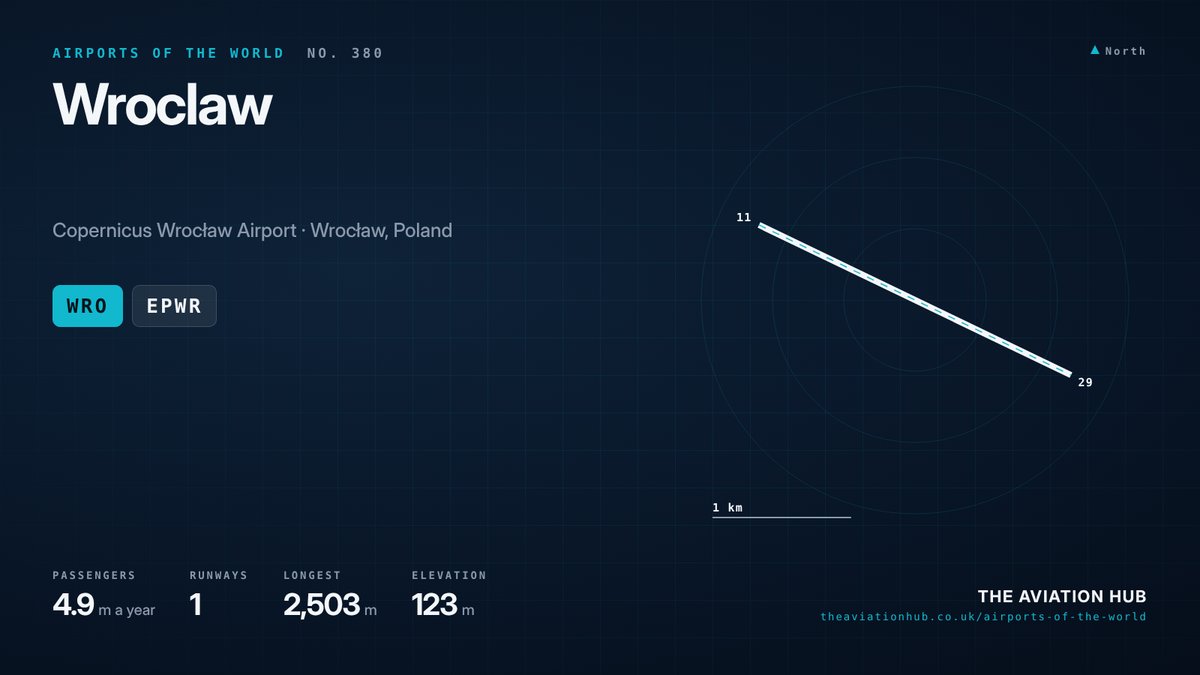
Wroclaw Airport, officially Copernicus Airport Wroclaw, serves one of Poland’s largest and fastest growing cities. It sits in the Strachowice district on the western edge of the city and handles close to five million passengers a year. Low cost carriers dominate, linking Lower Silesia with the UK, Ireland, Scandinavia and the Mediterranean. Network airlines provide the hub connections that business travellers need.
Wroclaw Airport at a Glance
The airport carries the IATA code WRO and the ICAO code EPWR. It lies about 6 miles (10 km) west of the city centre, at an elevation of 404 feet (123 m). There is one runway, a main passenger terminal opened in 2012 and a separate cargo terminal. Port Lotniczy Wroclaw S.A., founded in 1992, runs the airport.
Traffic has grown strongly in recent years, reaching roughly 4.9 million passengers in the latest full year. Ryanair and Wizz Air carry the largest share, while LOT, Lufthansa, KLM, Swiss and SAS connect Wroclaw Airport with their hubs. Charter specialist Enter Air runs a busy summer programme. Timetables and travel information are on the airport’s official website.
How Wroclaw’s Airport Came to Be
The airfield was built in 1938 for the German military, when the city was Breslau. Soviet forces briefly ran it after the Second World War, and it opened for civilian use in 1945 as the city became Polish. For decades it was a small airport with domestic flights only.
The fall of communism changed that. The airport company was formed in 1992, and the first international flights began in January 1993 with a service to Frankfurt. On 6 December 2005 the field was renamed after Nicolaus Copernicus, the astronomer who studied in the city.
Poland’s EU membership in 2004 brought a wave of low cost routes, especially to the UK and Ireland. A new terminal opened in March 2012, ahead of the Euro 2012 football championship, for which Wroclaw was a host city. Ryanair later chose Wroclaw Airport for an aircraft maintenance base in 2015.
Runways at Wroclaw Airport
The single runway, 11/29, is 2,503 metres (8,212 feet) long and 45 metres wide, with a mixed concrete and asphalt surface. It handles the Boeing 737 and Airbus A320 families easily, along with occasional wide body charters.
Westerly winds prevail across Lower Silesia, so runway 29 is the more common choice, with arrivals approaching from the east over the city’s western districts. Easterly flow switches operations to runway 11. Fog can disrupt winter mornings, and the instrument landing system was upgraded from Category I to Category II to help.
A single runway limits resilience. The airport closed to passengers from 26 October to 4 December 2025 while contractors worked on new aprons and taxiways. For now, the length is adequate for the narrow body fleets that make up almost all traffic at Wroclaw Airport.
Terminals and Airlines
The 2012 terminal handles all scheduled passengers, with Schengen and non Schengen areas inside. It was built to raise capacity to about 3.5 million passengers a year, a figure traffic has since overtaken. Duty free shopping sits in the international area.
Ryanair, flying Boeing 737-800s and 737-8200s, has the largest network, and Wizz Air operates Airbus A321neos. LOT connects with Warsaw, part of Star Alliance alongside Lufthansa, which serves Frankfurt and Munich. KLM flies to Amsterdam, Swiss to Zurich and SAS to Copenhagen.
Enter Air, the Polish charter airline, flies seasonal holiday programmes for tour operators. Summer weekends at Wroclaw Airport see a steady stream of departures to sun destinations.
Routes and Destinations
The UK is one of the biggest international markets, reflecting large Polish communities in Britain. London is served from several airports, with further links to regional UK cities. Ireland, Germany and the Netherlands also feature strongly. Inbound tourism is growing too, as visitors discover the Market Square, Ostrow Tumski and the bronze dwarf statues scattered around the old town.
Hub routes to Warsaw, Frankfurt, Munich, Amsterdam, Zurich and Copenhagen give business travellers onward connections worldwide. Leisure routes cover Spain, Italy, Greece, Portugal and the Canary Islands, plus charters to Turkey and Egypt. LOT’s weekly flight to Seoul Incheon is by far the longest route, while Enter Air charters reach Dubai, Salalah and Mombasa.
Summer is the clear peak, though Christmas and Easter bring strong demand from Poles abroad. Cargo is a smaller part of the business, handled through the dedicated terminal.
Getting to and from Wroclaw Airport
There is no rail link, although one has been discussed for years. MPK bus 106, or 206 at night, connects the terminal with the main railway station in about 45 minutes. At a few zloty, the bus is the cheapest sensible option. Long distance coaches leave from the central bus station beside the main railway station.
Taxis and ride hailing apps such as Uber and Bolt operate from outside arrivals. The drive to the Old Town and the Market Square takes around 20 to 25 minutes, depending on traffic.
Drivers benefit from the A8 motorway, the city’s ring road, which runs close to the airport. The S8 expressway continues towards Warsaw, about 220 miles (350 km) away. Car hire desks sit in the arrivals hall, with parking beside the terminal.
Spotting and Photography
Wroclaw Airport offers relaxed spotting. Roads and open land around the perimeter in Strachowice give views of the runway, particularly near the ends. With runway 29 in use, arrivals cross the eastern approach, where afternoon light works well.
Ryanair and Wizz Air dominate, but the maintenance base brings extra Ryanair visitors. Enter Air 737s, network carrier jets and occasional wide body charters add variety in summer.
Stay on public land and away from fences. Polish authorities take airport security seriously, so follow any instructions from police or Border Guard officers and never fly drones near the field.
What Comes Next
The airport has outgrown its 2012 design capacity, so terminal expansion is the priority. The first stage of works, adding a 12 stand passenger apron, a deicing apron and a 2.5 kilometre taxiway, is due for completion in December 2026. A temporary terminal for non Schengen passengers, due by April 2027, will add space while the main building is enlarged. A rail connection to the city centre would also ease pressure on the roads.
Wroclaw’s booming economy should keep demand rising, and Wroclaw Airport is well placed to win new routes from the low cost carriers. Compare it with Krakow, Katowice and Poznan on the Airports of the World map. The verdict: a busy, efficient regional airport that now needs more space to keep up.
Continue to follow The Aviation Hub for more analysis and insight.
Advertise with us Your brand, in front of an aviation audience Home page and in-article placements, sold directly, one advertiser per slot. From £250 a year. See the rates

