
Wuhan Airport Guide: Three Runways in Central China
Wuhan Airport at Tianhe is the main hub of central China, with three runways and a vast Terminal 3. Read about its history, routes and spotting.
 By The Aviation Hub
6 min read
Updated October 20, 2026
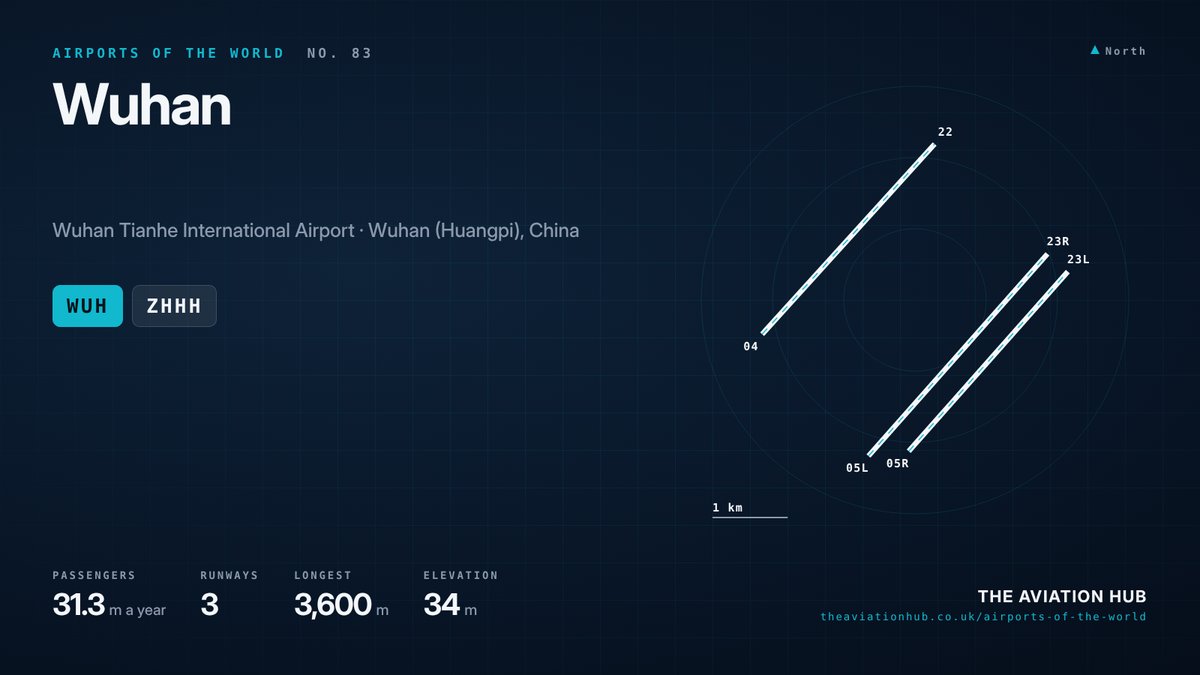
Wuhan Tianhe International Airport is the main air gateway to central China and the largest airport in Hubei Province. It lies in Huangpi District, about 16 miles (26 km) north of the city centre, on the plain between the Yangtze and its tributaries. Around 31 million passengers passed through Wuhan Airport in 2025, enough to rank it 14th in China. China Eastern and China Southern both run hubs here, a third runway opened in 2025, and Terminal 3 is one of the biggest single buildings in the region.
Wuhan Airport at a Glance
The codes are WUH and ZHHH. The field sits at 113 ft (34 m) above sea level, 16 miles (26 km) north of the Hankou district and a little further from Wuchang on the far bank of the Yangtze. Metro Line 2 connects the terminal with the city in about 50 minutes.
Wuhan Airport has three runways and two terminals in passenger use. The 2025 total was around 31.3 million passengers, almost flat on 2024, alongside roughly 180,000 tonnes of cargo and 219,000 aircraft movements. China Southern and China Eastern are the hub carriers, with Air China treating the city as a focus point. Hubei Airport Group, a provincial state owned company, operates the field. Flight and parking information is on the airport’s official website.
How Wuhan’s Airport Came to Be
Wuhan flew from two old military fields, Nanhu and Wangjiadun, until the mid 1990s. Both were deep inside the city and both had run out of room. The provincial government built a replacement on open land at Tianhe, a name that translates as Sky River and is an ancient Chinese term for the Milky Way. The airport opened on 15 April 1995 with domestic flights only and gained international status in 2000.
Growth came in waves. Terminal 2 opened in 2008 for domestic flights, and a separate International Terminal followed in December 2010. Air France started the first long haul route, to Paris, in 2012, and China Southern followed with San Francisco in 2014. Terminal 3 opened on 31 August 2017 with a stated capacity of 35 million passengers and took over all flights. The original Terminal 1 had closed in 2010.
Wuhan Airport became known worldwide for the wrong reason in 2020. It closed on 23 January as the city went into lockdown and did not reopen until 8 April. Traffic recovered faster than anyone predicted. A third expansion ran from 2022 to early 2025 and brought the third runway and a reopened Terminal 2.
Runways at Wuhan Airport
Runway 04/22 is the original, 3,400 m (11,155 ft) long and 45 m (148 ft) wide, with an asphalt surface. Runway 05L/23R arrived with the second expansion and is the main strip at 3,600 m (11,811 ft) long and 60 m (197 ft) wide, surfaced in concrete. The third, 05R/23L, opened with the 2025 expansion at 3,200 m (10,498 ft) long and 45 m (148 ft) wide, also in concrete.
Terminal 3 sits between Runway 04/22 and Runway 05L/23R, and the newest strip, 05R/23L, runs close alongside 05L/23R. With three runways at slightly different angles and spacings, they cannot all be used fully independently. Even so, the three runway layout gives Wuhan Airport plenty of spare capacity.
Summer heat and heavy rain shape operations. Wuhan is one of China’s hottest cities, and the long runways help heavy departures in July and August. Winter fog is less severe than in the Yangtze delta, but thunderstorms in the wet season cause regular diversions.
Terminals and Airlines
Terminal 3 is the heart of the airport. The building stretches across the centre of the field, with a vast curved roof and piers for both domestic and international gates. China Southern, China Eastern and Air China all fly from here, along with every foreign carrier. The international pier handles the Hong Kong, Macau, Taiwan and overseas flights with their own immigration hall.
Terminal 2 reopened on 15 April 2024, the airport’s anniversary, after seven years in mothballs. It now takes domestic flights only, which eases pressure on Terminal 3. The old International Terminal, opened in 2010 and closed to scheduled flights in 2017, has served charter and VIP flights since 2019.
The original Terminal 1 no longer handles passengers.
Routes and Destinations
Domestic routes dominate, with Beijing, Shanghai, Guangzhou, Shenzhen, Chengdu, Kunming, Xi’an and Hangzhou at the top. Wuhan’s position in the middle of the country makes it a natural transfer point for travellers between the coast and the west, and the two hub carriers run connecting banks through the day.
International service covers Hong Kong, Macau, Taipei, Tokyo, Seoul, Bangkok, Singapore and Kuala Lumpur. Longer routes include London Heathrow, Moscow, San Francisco and Dubai with China Southern, and Sydney with China Eastern. Air France’s Paris route, the first long haul link, is no longer listed. San Francisco, at around 6,450 miles (10,400 km), is the longest. Since 2019 citizens of more than 50 countries have been able to transit through the airport without a Chinese visa, now for up to 240 hours, which has helped the international network.
Getting to and from Wuhan Airport
Metro Line 2 is the cheapest sensible option. It reached the airport on 28 December 2016 and runs from a station beneath the ground transport centre through Hankou and across the river to Wuchang. The ride to the Hankou business district takes about 50 minutes and costs a few yuan.
The Wuhan to Xiaogan intercity railway, which also opened in December 2016, calls at the airport and links it with Hankou railway station in around 20 minutes. Airport buses serve several city stops and nearby towns. By road the S18 and S19 tolled expressways lead to downtown Hankou in about 40 minutes, and a taxi costs roughly 80 to 100 yuan (£9 to £11).
Multi storey car parks sit beside Terminal 3 and the reopened Terminal 2. Ride hailing cars use a dedicated pick up zone on the lower level.
Spotting and Photography
Terminal 3’s long glass gate piers give the best views at Wuhan Airport. The domestic piers look across the apron to both parallel runways, and the international pier catches the China Southern wide bodies on the London, San Francisco and Dubai routes. The departure hall windows upstairs face the main apron.
Outside the airport, the roads beyond the runway ends in Huangpi give open views of arrivals and departures, though there is no official viewing area. Morning light suits the east side and afternoon light the west. Haze is heavy in summer, so spring and autumn offer the clearest air.
Photography near the fence attracts attention from security at Chinese airports. Stay on public roads, carry identification and be ready to show what you have shot. Airside photography from the terminal is normally fine.
What Comes Next
The third runway was only the start. The master plan includes a fourth terminal, a satellite building for Terminal 3 and possibly a fourth runway, though no completion dates have been set. Timing depends on traffic, which has been slow to grow since the 2023 rebound.
Cargo is the other front. Hubei already has a dedicated freight airport at Ezhou Huahu, opened in 2022 for SF Express, and there is talk of converting the Shanpo military field into a second cargo airport for Wuhan itself. That competition means Tianhe will stay focused on passengers.
Wuhan Airport is a well equipped hub with more capacity than it currently needs, which is a good problem to have. Compare it with the other Chinese hubs on the Airports of the World map.
Continue to follow The Aviation Hub for more analysis and insight.
Advertise with us Your brand, in front of an aviation audience Home page and in-article placements, sold directly, one advertiser per slot. From £250 a year. See the rates

