
Wuxi Airport Guide: Jiangsu’s Quiet Ten Million Club Member
Wuxi Airport, also called Sunan Shuofang, serves Wuxi and Suzhou in the Yangtze Delta. Runway, terminals, airlines, metro access and the second runway plan.
 By The Aviation Hub
6 min read
Updated October 20, 2026
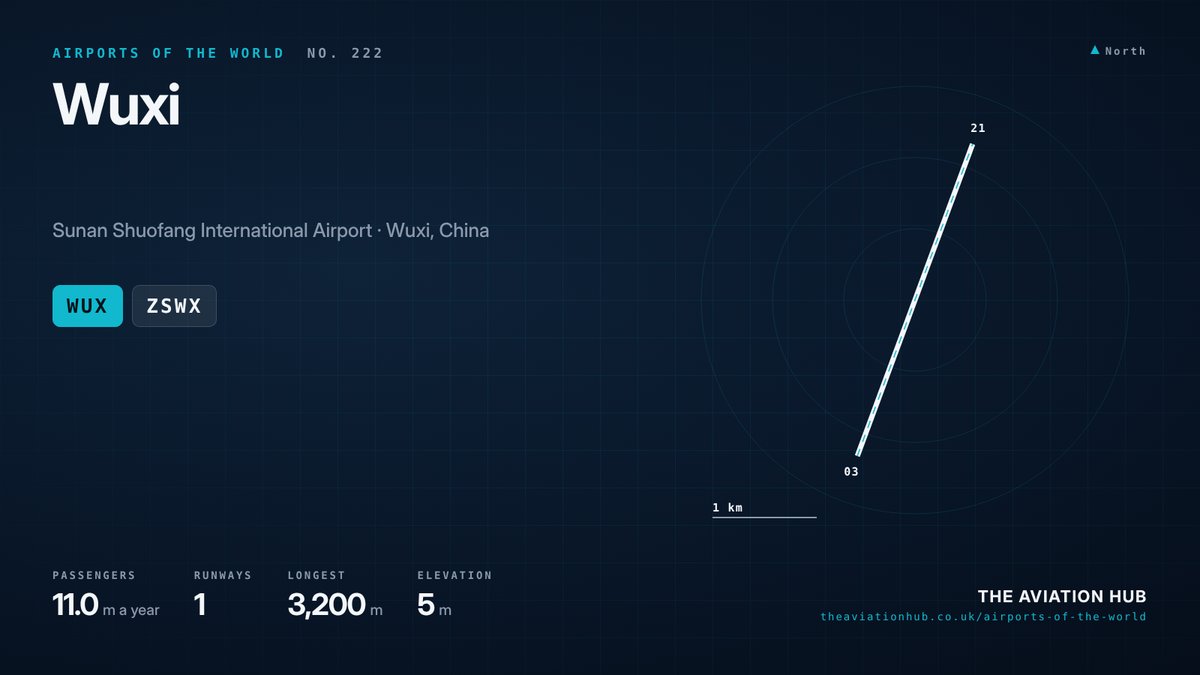
Sunan Shuofang International Airport sits in the Xinwu district of Wuxi, in Jiangsu province, roughly halfway between Shanghai and Nanjing. Most people outside China have never heard of it, yet it handles around 11 million passengers a year and is the second largest airport in Jiangsu. Wuxi Airport serves not just its home city but the much larger neighbour Suzhou, which has no major airport of its own. That shared catchment, one of the richest manufacturing regions on earth, explains why a former military field now outgrows its single runway.
Wuxi Airport at a Glance
The IATA code is WUX and the ICAO code is ZSWX. The field sits at just 17 feet (5 m) above sea level on the flat delta plain, about 10 miles (16 km) south east of central Wuxi and roughly 20 miles (32 km) north west of Suzhou. There is one runway and two passenger terminals with 23 boarding gates between them. In 2025 the airport handled about 10.97 million passengers, close to 197,000 tonnes of cargo and nearly 83,000 aircraft movements.
Ruili Airlines runs a hub here, and both China Eastern Airlines and Shenzhen Airlines maintain operating bases. The operator is Sunan Shuofang International Airport Ltd. Flight information and transport details are available on the airport’s official website, though the English pages are thin.
How Wuxi’s Airport Came to Be
The airfield was built in 1955 for the People’s Liberation Army Air Force and remained a purely military base for almost half a century. Commercial flights began on 18 February 2004, less than two years after the nearby Suzhou Guangfu airfield stopped handling airline traffic. The timing was deliberate. Suzhou needed a civil airport and Wuxi had the runway, so the two cities agreed to share one.
The name reflects that arrangement. Sunan means southern Jiangsu, the region both cities belong to, and Shuofang is the local township. In March 2023 the name Wuxi Suzhou Airport began to appear on booking platforms, a nod to the dual role, though officials said no formal rename had taken place. The military still shares the field, which shapes how airspace and expansion are managed.
Growth has been fast. A second terminal and international status followed, and the airport first passed 10 million annual passengers in December 2024. It is reported to be the only profitable airport in Jiangsu outside Nanjing, which is unusual for a Chinese regional field. That profitability has given Wuxi Airport the political cover to plan a much bigger future.
Runways at Wuxi Airport
The single runway is 03/21, an asphalt strip of 3,200 metres (10,499 feet) and 50 metres wide. It is long enough for the wide body freighters that use the field, though almost all passenger traffic is narrow body. Seasonal winds across the delta decide the runway direction, and both ends see regular use.
One runway shared with the air force imposes real limits. Military exercises can close the field or restrict slots at short notice, and the civil operator has to schedule around them. Approach paths run over the water and farmland of the delta, so noise is less of a constraint than airspace. Nearly 83,000 movements a year put growing pressure on a single runway shared with the military.
Terminals and Airlines
Wuxi Airport has two terminals. Terminal 1 holds gates 1 to 12 and Terminal 2 holds gates 13 to 23. The two buildings sit side by side, and Terminal 2 is the newer of the pair.
China Eastern is one of the largest carriers, operating a dense domestic network with Airbus A320 family jets. Shenzhen Airlines flies a similar pattern from its base here. Ruili Airlines, a private carrier from Yunnan, uses Wuxi as its eastern hub with Boeing 737-800 aircraft. Other regular operators include China Southern, Xiamen Airlines, Sichuan Airlines, Juneyao Air, Loong Air, Lucky Air and 9 Air.
International service is modest and concentrated on north east and south east Asia. China Eastern and Shenzhen Airlines fly to Seoul Incheon, while Hong Kong, Macau, Singapore, Osaka Kansai, Bangkok Suvarnabhumi and Kuala Lumpur appear in the timetable. Alliances mean little here. Skyteam and Star Alliance members fly in, but passengers overwhelmingly travel point to point.
Routes and Destinations
Domestic trunk routes dominate at Wuxi Airport. Beijing, Guangzhou, Shenzhen, Chengdu, Chongqing, Xi’an, Kunming and Xiamen are all served several times a day. Flights to Shanghai do not exist because the city is less than an hour away by high speed rail, so Wuxi concentrates on destinations beyond rail reach. Hainan resorts such as Sanya and Haikou do well in winter.
International routes come and go with demand. Seoul and Bangkok have proved the most durable, and Japan is served with flights to Osaka. Cargo is the real story. The region’s electronics and machinery exporters fill freighters bound for Europe and Asia, with DHL linking Wuxi to Leipzig and East Midlands, and the 197,000 tonnes handled in 2025 puts Wuxi Airport among the more significant cargo fields in eastern China. A dedicated cargo hub station is under construction.
Getting to and from Wuxi Airport
Line 3 of the Wuxi Metro runs to a station beneath the terminal area. Trains reach the city centre in roughly 30 to 40 minutes and connect to Wuxi railway station, where high speed trains leave for Shanghai, Nanjing and beyond. The metro is cheap and reliable, and it is the sensible choice for anyone without heavy luggage.
Airport buses run to Suzhou, Changzhou, Jiangyin and other nearby cities, with the Suzhou run taking about an hour. Taxis are plentiful and fares into Wuxi are modest, typically around 60 to 80 yuan (roughly £7 to £9). Ride hailing through Didi works well. Drivers use the Shanghai to Nanjing expressway and local link roads, and car parks sit in front of both terminals.
Passengers bound for Suzhou face a choice. The bus is direct, but the metro to Wuxi station followed by a fifteen minute high speed train is often faster at busy times.
Spotting and Photography
Spotting at Wuxi Airport, a shared military airfield, demands caution. Photography of the airport perimeter is sensitive and police may ask questions of anyone with a long lens near the fence. The practical approach is to shoot from inside the terminal, where the gate windows face the apron and give acceptable views of China Eastern and Shenzhen Airlines traffic.
The runway runs north east to south west, so morning light favours aircraft on the eastern side and afternoon light the western side. Operations on runway 21 bring arrivals in over the northern suburbs. The variety is limited to Chinese carriers and a handful of Asian visitors, but the freighters add interest, with wide body cargo movements fairly common at night.
Do not photograph military aircraft, hangars or anything on the far side of the field. Keep cameras away from security staff, avoid tripods and leave immediately if asked. The rules are stricter than at a purely civil airport and the consequences of ignoring them are serious.
What Comes Next
The Civil Aviation Administration of China has approved a master plan that transforms the field. It includes a second runway, an extension of the existing one, a new Terminal 3 and an integrated transport hub. Work on the cargo hub station and part of the second runway’s taxiway system began in May 2023. Forecasts call for 21.5 million passengers by 2035 and 25 million by 2050.
The constraint is the military. Any second runway must fit around air force operations, and that negotiation moves slowly. The Yangtze Delta also has fierce competition, with Shanghai’s two airports, Nanjing and Hangzhou all expanding at the same time. Wuxi Airport is heading for a bigger, two runway future, but the timetable depends on decisions made far from Jiangsu. See where it fits among its neighbours on the Airports of the World map.
Continue to follow The Aviation Hub for more analysis and insight.
Advertise with us Your brand, in front of an aviation audience Home page and in-article placements, sold directly, one advertiser per slot. From £250 a year. See the rates

