
Xining Airport Guide: Gateway to the Qinghai Plateau
Xining Airport sits 2,170 metres up on the edge of the Tibetan Plateau. Codes, runway, airlines, routes, transport and spotting for Caojiabao explained.
 By The Aviation Hub
7 min read
Updated October 20, 2026
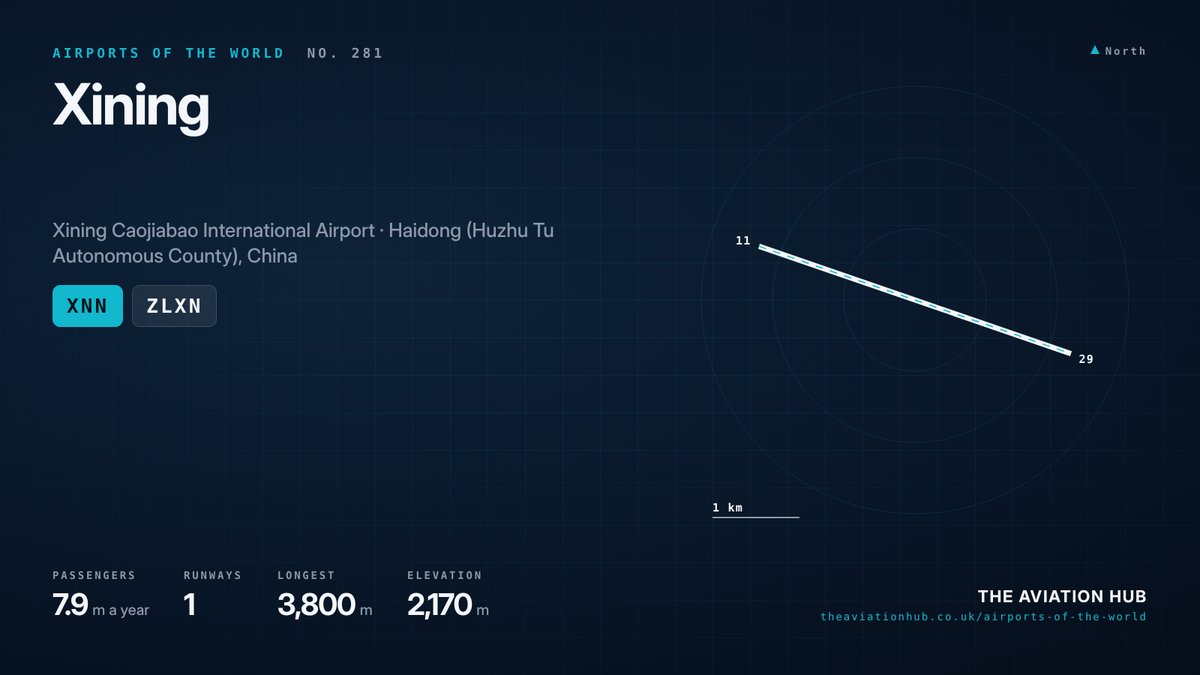
Xining Caojiabao International Airport serves the capital of Qinghai Province in western China, one of the highest provincial capitals in the country. Xining Airport handles close to eight million passengers a year, which makes it the main air gateway to the Qinghai Lake region and a staging point for flights onward to Tibet. It sits in Huzhu County in the neighbouring prefecture of Haidong, around 18 miles (30 km) east of downtown Xining. Its position at 2,170 metres above sea level shapes everything from runway length to aircraft performance.
Xining Airport at a Glance
The IATA code is XNN and the ICAO code is ZLXN. The field lies east of the city along the Huangshui valley, roughly 18 miles (30 km) from the centre, and its reference elevation is 2,170 metres (7,119 ft). That altitude places it among the higher commercial airports in China outside Tibet and western Sichuan. Hot summer afternoons at this height cut aircraft payloads noticeably, which is why the runway is so long.
There is one active runway, and the large new T3 terminal has handled passengers since August 2025. Traffic in 2025 reached roughly 7.9 million passengers, up almost 12 per cent on the year before, with about 63,000 aircraft movements and around 40,000 tonnes of cargo. China Eastern’s Qinghai branch, Air China, China Southern and Tibet Airlines are the main operators. The airport is run by Qinghai Airport Company, part of the Western Airport Group. Operational notices and flight information are published on the airport’s official website.
How Xining’s Airport Came to Be
Flying in Xining began in 1931, when the regional military governor Ma Bufang ordered an airfield built at Lejiawan, around 10 miles (17 km) west of the current site. It saw limited commercial use from 1933 and was shared with the military. The single gravel runway, extended to 2,600 metres in 1957, could only be used in one direction, and that limitation drove the decision in 1975 to look for a new site.
The State Council approved the Caojiabao project in 1985. Construction started in 1989 and the airport opened in December 1991, taking over all civil flying from Lejiawan, which became a military base. For two decades the new field relied on a single runway of modest length, until a second phase of expansion delivered a 3,800 metre runway in October 2011 and more terminal space. The original runway was downgraded to a taxiway. Growth since then has been rapid.
Runways at Xining Airport
Xining Airport operates a single runway, 11/29, which is 3,800 metres (12,467 ft) long and 45 metres wide with an asphalt surface. The length is not a luxury. At 2,170 metres elevation the air is thin enough that a Boeing 737-800 or Airbus A320 needs far more ground roll than it would at sea level, and summer temperatures make the effect worse. Airlines use performance tables specific to the field, and on the hottest days some flights still leave with weight restrictions.
The former runway, which dates from the 1991 opening, now serves as a full length parallel taxiway. That layout gives the field a single runway with good taxi capacity, so movements are not held up by backtracking. The valley runs roughly east to west, and the runway follows it, which keeps the approaches clear of the hills on either side. The third phase of expansion added a second parallel taxiway rather than a second runway.
Terminals and Airlines
Passengers have used the T3 terminal since it opened on 7 August 2025. It covers about 158,000 square metres, roughly double the older terminals combined, and is designed for 16 million passengers a year. Its W shaped layout adds stands, including some for wide bodies, and the departures level has 80 check in counters and 30 security lanes. Domestic traffic dominates and the international area is small, handling a few seasonal services to Southeast Asia.
China Eastern is the largest operator through its Qinghai branch, flying to Shanghai, Beijing, Xi’an and Kunming among others. Air China links the city to Beijing and Chengdu, and China Southern serves Guangzhou and Shenzhen. Tibet Airlines uses Xining as a stepping stone to Lhasa. Smaller players such as Lucky Air, Sichuan Airlines and West Air fill out the schedule.
Routes and Destinations
Almost all of the traffic at Xining Airport is domestic. Xi’an and Chengdu are the thickest routes, each served many times a day, with Beijing, Shanghai, Guangzhou and Shenzhen close behind. Lanzhou is near enough that most people take the high speed train instead, so that pairing barely registers. Within Qinghai there are short hops to Golmud, Yushu, Delingha and Huatugou, routes that cross some of the emptiest terrain in China.
The link to Lhasa is strategically important. Xining sits at an intermediate altitude, and the Qinghai Tibet railway starts here, so the city has long acted as an acclimatisation stop for travellers heading onto the plateau. International flying is thin. Charter and seasonal services have run to Bangkok, Hong Kong and a handful of other Asian points, and the airport has an open customs channel ready for more. Cargo volumes of around 40,000 tonnes a year are mostly belly freight on domestic trunk routes.
Getting to and from Xining Airport
The airport is linked to the city by the Xining Airport Expressway, which joins the G6 Beijing to Lhasa motorway. A taxi to the centre takes around 40 minutes in normal traffic and costs roughly CNY 80 to 100 (about £9 to £11). Ride hailing apps work from the dedicated pick up zone outside arrivals. Airport buses run between the terminal and the city centre, stopping near Xining railway station, and are the cheapest sensible option at around CNY 20 for a journey of about an hour.
There is no rail connection directly into the terminal. The Lanzhou to Xining high speed line passes through the Haidong area, and Haidong West station is a short taxi ride away, which gives an alternative route for anyone arriving from Lanzhou or further east. Parking is plentiful in the surface car parks in front of the terminal and in a multi storey block beside it. Hire car desks are inside the arrivals hall, though driving on the plateau roads is best left to those with experience of altitude and long distances.
Spotting and Photography
Spotting in China is tolerated at some airports and discouraged at others, and Xining falls somewhere in between. The terminal windows on the departures level give a view of the apron, so a cheap ticket to a nearby city is one way to spend a morning with a camera. Outside the fence the ground to the north rises gently and offers views across the field, though it is farmland and local people will take an interest in anyone with a long lens.
The wind decides which end of the runway is in use, so check before setting out. The light at this altitude is strong and clear, and the dry climate means haze is rarely a problem. Tibet Airlines A319s, China Eastern 737s and A320neos and the occasional wide body charter make up the mix. Stay well back from the fence, carry identification and move on if asked. Uniformed security have broad powers here and arguing never ends well.
What Comes Next
Xining Airport has just completed its third expansion phase, the largest in its history. Approved in 2020 at a cost of about 10.5 billion yuan, it delivered the 158,000 square metre T3 terminal and a second parallel taxiway. The aim is capacity for about 21 million passengers and 120,000 tonnes of cargo a year, so the airport now has ample room to grow.
The driver is tourism. Qinghai Lake, the Chaka salt flats and the road into Tibet have become fixtures on Chinese travel itineraries, and the airport’s growth curve tracks that boom. Altitude will always impose a cost on operators, but the long runway and the new terminal mean Xining Airport is set to remain the key gateway to the northeastern plateau for years to come. Find it alongside every other field in this series on the Airports of the World map.
Continue to follow The Aviation Hub for more analysis and insight.
Advertise with us Your brand, in front of an aviation audience Home page and in-article placements, sold directly, one advertiser per slot. From £250 a year. See the rates

