
Xishuangbanna Airport Guide: Yunnan’s Tropical Gateway
Xishuangbanna Airport serves Jinghong in tropical southern Yunnan near the Laos border. Codes, runway, airlines, routes, transport and spotting explained.
 By The Aviation Hub
6 min read
Updated October 20, 2026
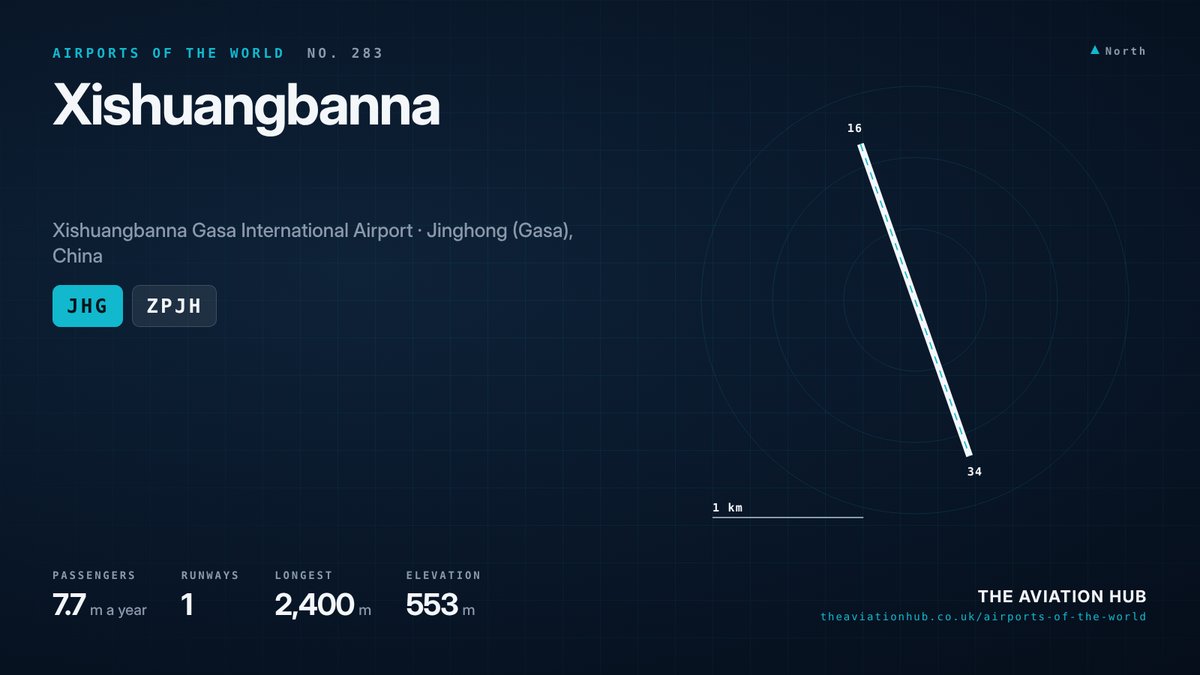
Xishuangbanna Gasa International Airport serves Jinghong, the capital of the Dai autonomous prefecture in the far south of Yunnan Province, close to the borders with Laos and Myanmar. Xishuangbanna Airport handles around 7.7 million passengers a year, remarkable for a region of around 1.3 million residents, and nearly all of them are tourists drawn by the tropical climate, the rainforest and the Dai culture. The field lies only about 4 miles (6 km) from the city centre. It is one of the busiest airports in China that does not serve a provincial capital.
Xishuangbanna Airport at a Glance
The IATA code is JHG and the ICAO code is ZPJH. The airport sits in Gasa town on the southwestern edge of Jinghong, about 4 miles (6 km) from the centre, at an elevation of 553 metres (1,815 ft). That is low by Yunnan standards, more than 1,300 metres below Kunming, and it gives the field a hot and humid climate that feels closer to Thailand than to the rest of China.
There is one runway and one main terminal. Traffic in 2025 reached about 7.7 million passengers, up almost 8 per cent on the previous year, with roughly 55,000 aircraft movements and 26,000 tonnes of cargo. That ranked it around 47th among Chinese airports. The field is publicly owned, run by the Yunnan Airport Group. China Eastern, Lucky Air, Sichuan Airlines and Qingdao Airlines run some of the widest networks. Timetables and terminal maps are on the airport’s official website.
How Jinghong’s Airport Came to Be
Xishuangbanna was one of the most isolated corners of China for most of the twentieth century. Reaching Jinghong from Kunming meant a long and often dangerous road journey through the mountains, and the region’s tea, rubber and tourism potential went largely untapped. Plans for an airport took shape in the 1980s as the government opened the border regions to domestic travel, and the field at Gasa opened on 7 April 1990 with flights to Kunming.
The airport is named after Gasa, the town that hosts it, rather than after Jinghong itself, which is a quirk that still confuses first time visitors. Early traffic was light, but the growth of domestic tourism in the 2000s changed everything. The airport became a national port of entry in 1997. Today a newer terminal handles domestic flights while the original building serves international and regional services. Passenger numbers passed four million in 2016 and have since climbed well beyond that level.
Runways at Xishuangbanna Airport
Xishuangbanna Airport has a single asphalt runway, 16/34, which is 2,400 metres (7,874 ft) long and 45 metres wide. By the standards of a field handling nearly eight million passengers that is on the short side, and it shapes the fleet mix. Airbus A320 family and Boeing 737 aircraft dominate, and heat and humidity add to the challenge on long flights.
The runway runs roughly north to south on the flat land of the Mekong valley, with hills rising on either side. The river itself, known in China as the Lancang, passes a short distance to the east. The main apron lies between the runway and the terminals. The current expansion centres on a new terminal rather than the runway, so the 2,400 metre strip remains the only one in operation.
Terminals and Airlines
The main domestic terminal at Xishuangbanna Airport is a two storey building. It handles the overwhelming majority of flights, with a waiting area on the ground floor for remote stands. The older single storey building beside it serves international and regional flights. Facilities are straightforward, with places to eat, a few shops and premium lounges.
China Eastern and its Yunnan subsidiary are the largest operators, with Lucky Air, the Kunming based low cost arm of Hainan Airlines, not far behind. Air China, China Southern, Sichuan Airlines, Shanghai Airlines and Qingdao Airlines fly trunk routes from the major cities. Smaller carriers including Ruili Airlines, 9 Air, Air Guilin and Donghai Airlines fill in secondary routes. China Eastern and Shanghai Airlines are in SkyTeam, Air China in Star Alliance and China Southern is independent, but alliances mean little here since nearly all traffic is domestic point to point.
Routes and Destinations
Kunming is the lifeline route from Xishuangbanna Airport, flown many times a day and feeding the provincial capital’s network. Beyond Yunnan, several airlines compete on Chengdu Tianfu, Shanghai Pudong, Beijing Daxing and Hangzhou, with Chongqing, Guangzhou, Shenzhen, Xi’an and Nanjing also served. The pattern is strongly seasonal. Winter is the peak, when northern Chinese escape the cold for the warmth of the south, and the Spring Festival holiday brings the heaviest loads of the year.
International flying is modest but growing. Qingdao Airlines flies to Vientiane in Laos and Ruili Airlines flies to Ho Chi Minh City in Vietnam. The Mekong region is the natural market and new routes come and go with demand and visa rules. The longest route on the map is Harbin, flown by Sichuan Airlines, at roughly 2,170 miles (3,500 km). Cargo reached around 26,000 tonnes in 2025, up 15 per cent.
Getting to and from Xishuangbanna Airport
The airport is close enough to the city that a taxi takes around 10 minutes on the airport expressway and the metered fare is low. Taxis wait outside the ground floor arrivals exit, and ride hailing apps also work. City bus routes link the terminal with Jinghong for a few yuan. Some hotels in Jinghong offer transfers for guests.
The opening of the China to Laos railway in December 2021 transformed access to the region. Xishuangbanna station is in Gasa, less than 2 km from the terminal, and offers trains to Kunming in around three hours and cross border services to Vientiane. For anyone comparing options, the train now competes directly with the Kunming flight. Hire cars are available at the terminal, and the roads to the tea mountains and the tropical botanical garden at Menglun are good.
Spotting and Photography
Spotting at Xishuangbanna Airport is informal. The terminal windows give a clear view of the apron and the runway beyond, and because the field is small the action is easy to follow. Outside the perimeter, local roads around Gasa pass close to the field, but the fence is well patrolled and there is no official viewing area.
Winds are generally light, and the wind on the day decides whether aircraft use runway 16 or runway 34. The early morning is the best time for photography before the heat haze builds, and the winter dry season brings weeks of clear sky. Airbus A320 family jets and Boeing 737s from China Eastern, Lucky Air, Sichuan Airlines and Qingdao Airlines make up most of the traffic. Carry identification, stay away from the fence line and leave promptly if security asks. The rules in border regions are enforced more firmly than elsewhere.
What Comes Next
The prefecture and the Yunnan Airport Group are building a fourth phase of expansion at Xishuangbanna Airport, centred on a new Terminal 3 with a parking building and an elevated road, at a cost of about CNY 1.8 billion. It is designed for 12.5 million passengers a year by 2030 and is due for completion in October 2027. T3 sits about 300 metres from Xishuangbanna railway station, creating the first integrated air and rail hub in Yunnan. Growth of 8 per cent a year means the current facilities will reach their limits before long, and the winter peaks already stretch the apron.
The railway is both a competitor and a complement. It takes some Kunming traffic but also brings more tourists into the region, many of whom fly home. With tourism still rising and the Mekong border trade opening up, Xishuangbanna Airport is on course to remain one of the fastest growing non capital airports in China. See how it compares across the region on the Airports of the World map.
Continue to follow The Aviation Hub for more analysis and insight.
Advertise with us Your brand, in front of an aviation audience Home page and in-article placements, sold directly, one advertiser per slot. From £250 a year. See the rates

