
Xuzhou Airport Guide: Northern Jiangsu’s Growing Gateway
Xuzhou Airport serves northern Jiangsu from a long runway and a modern terminal. Read its history, airlines, routes, rail links and expansion plans.
 By The Aviation Hub
6 min read
Updated October 20, 2026
Xuzhou has been a crossroads for more than two thousand years, and it still is. The city sits where the Beijing to Shanghai and Xuzhou to Lanzhou high speed lines meet, and its air link is catching up fast. Xuzhou Airport, officially Xuzhou Guanyin International Airport, handled about 4.1 million passengers in 2025. It is the main gateway for northern Jiangsu and a busy regional field for neighbouring parts of Shandong, Anhui and Henan.
Xuzhou Airport at a Glance
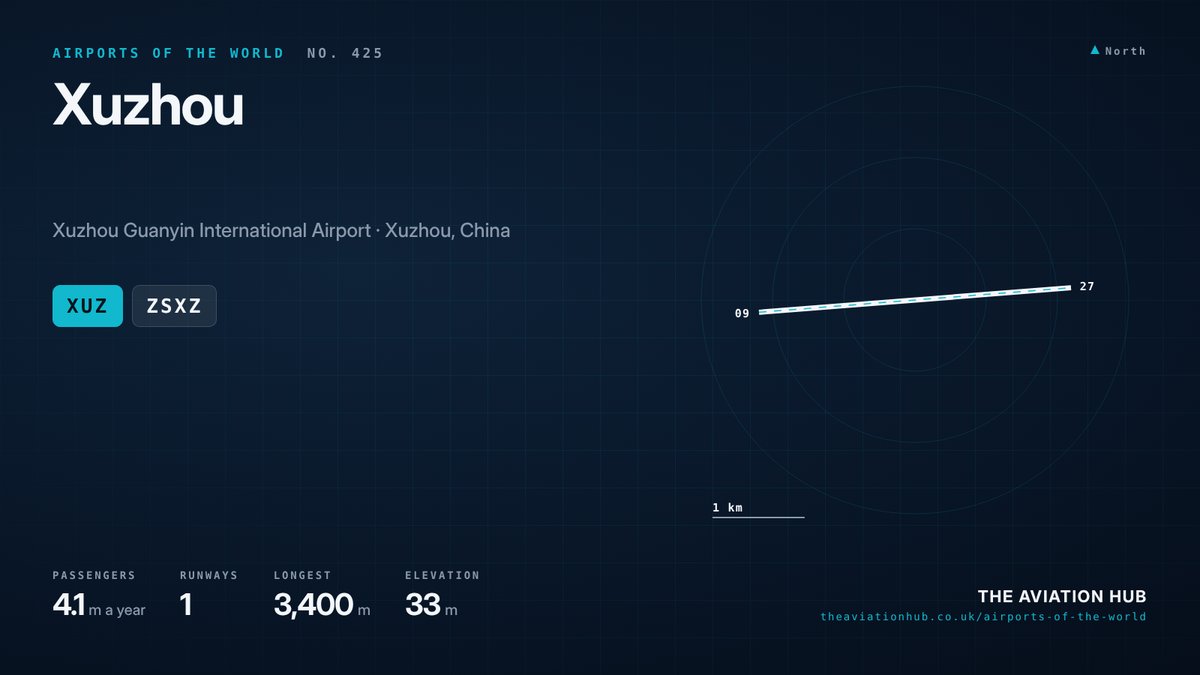
The IATA code is XUZ and the ICAO code is ZSXZ. Xuzhou Airport lies about 28 miles (45 km) southeast of downtown Xuzhou, in open farmland near Guanyin town. The field sits 108 feet (33 metres) above sea level. It has one runway and two passenger terminals, known simply as Terminal 1 and Terminal 2.
Traffic reached roughly 4.1 million passengers in 2025, which placed the field around 54th in China. The same year brought almost 35,000 aircraft movements and about 18,000 tonnes of cargo. Shanghai Airlines and other Chinese carriers serve the field, but no airline runs a dominant hub here. Services and flight information are on the airport’s official website.
How Xuzhou’s Airport Came to Be
The city’s earlier airfield, Daguozhuang, dated from the 1930s and sat much closer to the urban area. By the early 1990s it could no longer cope. The State Council and the Central Military Commission approved a new airport in 1993, and the Guanyin site opened on 8 November 1997.
Growth came steadily. Customs and immigration arrived through a temporary designation in 2007, followed by full national port of entry status in September 2010. A direct link to Taipei, flown by Shanghai Airlines, opened on 28 March 2011. In November 2013 the field passed one million annual passengers, the fourth in Jiangsu to reach that mark.
The Civil Aviation Administration of China approved the current name, Xuzhou Guanyin International Airport, on 31 December 2015. Xuzhou Airport then entered its biggest building phase. A second terminal opened on 8 June 2018, changing the passenger experience completely. Annual traffic has more than tripled since 2013.
Runways at Xuzhou Airport
A single concrete runway, 09/27, runs east to west. It measures 3,400 metres (11,155 feet) long and 45 metres (148 feet) wide. That length is ample for any aircraft likely to visit, from narrow body jets to wide body freighters.
The terrain is flat, so approaches from both directions are straightforward. Seasonal winds decide which end is used. Easterly winds in summer favour runway 09, while northerly and westerly winter winds often bring runway 27 into play. Fog and haze in winter can reduce visibility, and instrument approaches keep the schedule running on poor days.
One runway is enough for current demand. Xuzhou Airport handles fewer than 100 movements on an average day, well below the strip’s capacity. A second runway would only become urgent if traffic grew several times over.
Terminals and Airlines
Terminal 2 opened on 8 June 2018 with 34,000 square metres of floor space and handles all domestic flights. A natural gas energy system provides its cooling, heating and part of its power. The building gives a modern, open feel, with short walks to the gates.
Terminal 1, the original 1997 building, now handles regional international flights, including services to Taipei when they operate. Renovation and expansion began in November 2022 to bring it up to modern standards.
The airline mix reflects the wider Chinese market. The three big state groups, Air China, China Eastern and China Southern, appear through their main brands and subsidiaries. Independent and low cost operators fill out the schedule. Shanghai Airlines, part of the China Eastern group, has a long association with Xuzhou Airport. Most flying uses narrow body jets such as the Airbus A320neo and Boeing 737-800.
Routes and Destinations
The route network leans south and west, because the high speed railway already handles much of the demand to Beijing and Shanghai. Guangzhou and Shenzhen are typically among the strongest routes, linking northern Jiangsu with the Pearl River Delta. Chengdu, Chongqing, Kunming and Xi’an connect the city with the interior. Northeastern cities such as Harbin and Dalian also feature.
Leisure flying peaks in winter, when travellers head for Sanya and Haikou on Hainan Island. Xiamen and other southern coastal cities are popular year round. International and regional services, including the Taipei route, have varied with political and economic conditions.
Cargo is modest at around 18,000 tonnes a year. Most goods travel in the holds of passenger jets, though the airport was designed with room to grow freight volumes.
Getting to and from Xuzhou Airport
Distance is the main challenge, since the city centre lies about 28 miles away. Airport buses link the terminals with central Xuzhou and the main railway stations, and the journey usually takes an hour or so. Taxis take around 45 minutes to an hour, depending on traffic.
Rail is improving the picture. Guanyin Airport railway station lies about a mile (1.5 km) south of the terminals, on a high speed line serving the region. Trains typically run to Xuzhou East, the city’s main high speed station, which makes rail the cheapest sensible option for many travellers. Drivers find surface parking near both terminals, with rates far below those at major Chinese hubs.
Spotting and Photography
China has no strong spotting tradition, and Xuzhou Airport has no official viewing terrace. The surrounding farmland, however, gives open views, and public roads near both runway ends offer clear sightlines of approaches. Arrivals over open fields make for uncluttered shots.
Because the runway runs east to west, the sun sits to the south through most of the day. Positions on the southern side keep it behind the camera. Winter haze can soften images, so clear days after a cold front give the best results.
Photography near Chinese airports can attract questions from police and security staff. Stay on public land, keep well away from fences, carry identification and move on politely if asked.
What Comes Next
The renovation of Terminal 1 will add capacity and improve the international experience. The second phase of expansion, approved in 2014 at a cost of 1.3 billion yuan, was designed for about 4.6 million passengers and 50,000 tonnes of cargo by 2025. Traffic is already close to that figure, so further investment will be needed before long.
The rail link gives the airport an advantage over many regional rivals, and integration with high speed services could widen its catchment. Compare its development with other Jiangsu airports on our Airports of the World map. The verdict: Xuzhou Airport is a well equipped regional gateway with a long runway and good rail access, and it is ready to grow with the city.
Continue to follow The Aviation Hub for more analysis and insight.
Advertise with us Your brand, in front of an aviation audience Home page and in-article placements, sold directly, one advertiser per slot. From £250 a year. See the rates

