
Yangzhou Taizhou International Airport sits in the flat, water laced countryside of central Jiangsu, north of the Yangtze River. Yangzhou Taizhou Airport opened in 2012 and now handles more than 4 million passengers a year, double the figure its planners expected by 2020. It serves two prosperous cities, Yangzhou and Taizhou, in one of China’s wealthiest provinces. A longer runway and a second phase of expansion have turned a modest regional field into a growing gateway.
Yangzhou Taizhou Airport at a Glance
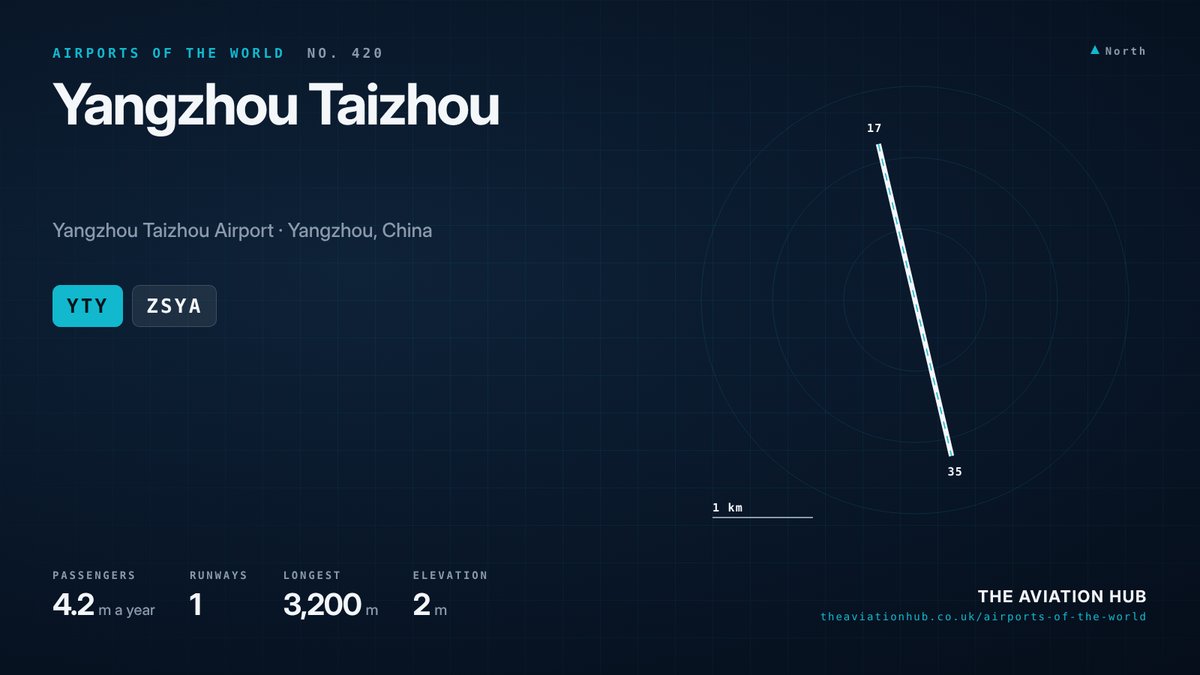
The IATA code is YTY and the ICAO code is ZSYA. The airport lies in Jiangdu district, about 19 miles (30 km) from central Yangzhou and 12 miles (20 km) from Taizhou, at an elevation of just 2 metres (7 feet). It has one runway and one passenger terminal. Yangzhou Taizhou Airport recorded around 4.16 million passengers, more than 47,000 aircraft movements and about 15,000 tonnes of cargo in its latest reported year.
No major airline uses the field as a hub, and flights come from a wide mix of Chinese carriers. The airport is jointly owned by the two cities, with Yangzhou holding 80 per cent and Taizhou 20 per cent. Flight schedules and transport details are on the airport’s official website.
How Yangzhou’s Airport Came to Be
Before 2012, travellers from Yangzhou and Taizhou usually drove to Nanjing or further afield to catch a flight. Local leaders pushed for an airport of their own as the region’s economy grew. During design and construction it was known as Suzhong Jiangdu Airport, after the central Jiangsu region and its home district.
In November 2011 the name changed to reflect both cities that funded it. The airport opened on 7 May 2012 after an investment of about 2.08 billion yuan (roughly £220 million). In March 2016, with approval from the Civil Aviation Administration of China, it added the word international to its title. The name plate is written in the calligraphy of former Chinese leader Jiang Zemin, a Yangzhou native.
Growth quickly outpaced the original plans. The airport was designed in 2012 for about 2 million passengers and 24,000 tonnes of cargo by 2020, and passenger numbers raced past that target. The first major expansion, approved in April 2017, extended the runway in 2018. A second phase followed, with main airfield works breaking ground on 18 April 2023 at Yangzhou Taizhou Airport.
Runways at Yangzhou Taizhou Airport
A single runway, 17/35, handles all traffic. It measures 3,200 metres (10,499 feet) long and 45 metres wide, with a concrete surface. The original strip was 2,400 metres long, and the extension to its current length was completed in December 2018.
That work raised the airport from class 4C to class 4E, allowing wide body aircraft such as the Boeing 747 and Airbus A340 to operate. On 30 October 2018, all flights were suspended so that a wide body Airbus A330 could complete a test flight on the longer runway. The flat, low lying terrain around the field gives open approaches from both north and south. Summer storms and winter fog are the main weather challenges at Yangzhou Taizhou Airport.
Terminals and Airlines
The passenger terminal covers about 31,000 square metres, with 13 aircraft stands on the apron. It handles both domestic and international flights, and the layout is compact and easy to navigate. The second phase of expansion aims to add capacity as traffic continues to climb.
A wide mix of Chinese airlines serve the airport, flying mainly Airbus A320 family and Boeing 737 jets. Spring Airlines, the Shanghai based low cost carrier, has been especially active on international routes. Signage and announcements are in Chinese and English, which helps foreign visitors find their way. Most airlines connect Yangzhou with their own bases elsewhere in China, giving travellers a broad spread of direct domestic links.
Routes and Destinations
The network is mainly domestic. Flights link central Jiangsu with major cities in the south, southwest and north of China, including popular business and leisure destinations. Holiday routes to warmer southern destinations such as Hainan tend to peak in winter, while business travellers fill flights to the big southern and western cities.
International flying is growing. Spring Airlines launched a route to Osaka in 2025 and added Bangkok in April 2026, both popular with Chinese tourists. Yangzhou’s own appeal, with its classical gardens, canals and food culture, draws inbound visitors too. Cargo, at around 15,000 tonnes a year, is modest but useful for local manufacturers. Seasonal peaks follow Chinese holidays, especially Spring Festival and the October Golden Week at Yangzhou Taizhou Airport.
Getting to and from Yangzhou Taizhou Airport
Road is the main option. Expressways link the airport with Yangzhou, Taizhou and the bridges across the Yangtze to Zhenjiang, including the Taizhou Yangtze River Bridge. That reach south of the river widens the catchment considerably. Taxis reach central Yangzhou in around 40 minutes and Taizhou in around 30 minutes, depending on traffic.
Airport shuttle buses run to both cities, the cheapest sensible option for most travellers. Ride hailing apps such as Didi are widely used. There is no direct rail link, but taxis and buses connect with high speed rail stations in Yangzhou and Taizhou. Parking at Yangzhou Taizhou Airport sits directly in front of the terminal.
Spotting and Photography
The flat countryside gives open views of approaches, with fish ponds, canals and farmland around the field. Public roads near the perimeter offer the best vantage points, though access can be limited. The terminal windows overlook the apron.
Chinese airports are sensitive about photography, so keep cameras discreet and avoid security installations. Stay on public land, keep away from fences and follow any instruction from police or airport staff. Hazy conditions are common, so clear days after rain give the best visibility. Morning and late afternoon light work best at Yangzhou Taizhou Airport.
What Comes Next
The phase two works, approved by Jiangsu’s provincial planners in June 2022, aim to expand capacity in line with rising demand. Early works began in July 2022, with main airfield construction under way from April 2023. More stands and terminal space should follow.
The airport faces competition from larger airports in Nanjing and Shanghai, both well connected by high speed rail. Even so, its convenience for two growing cities gives it a secure role. Expect steady growth and more international routes. Compare it with other Chinese airports on our Airports of the World map.
Continue to follow The Aviation Hub for more analysis and insight.
Advertise with us Your brand, in front of an aviation audience Home page and in-article placements, sold directly, one advertiser per slot. From £250 a year. See the rates

