
Yantai Airport Guide: Shandong’s Coastal Gateway at Penglai
Yantai Airport moved to a new site at Penglai in 2015 and now handles eight million passengers. Explore its runway, terminal, airlines, routes and access.
 By The Aviation Hub
5 min read
Updated October 20, 2026
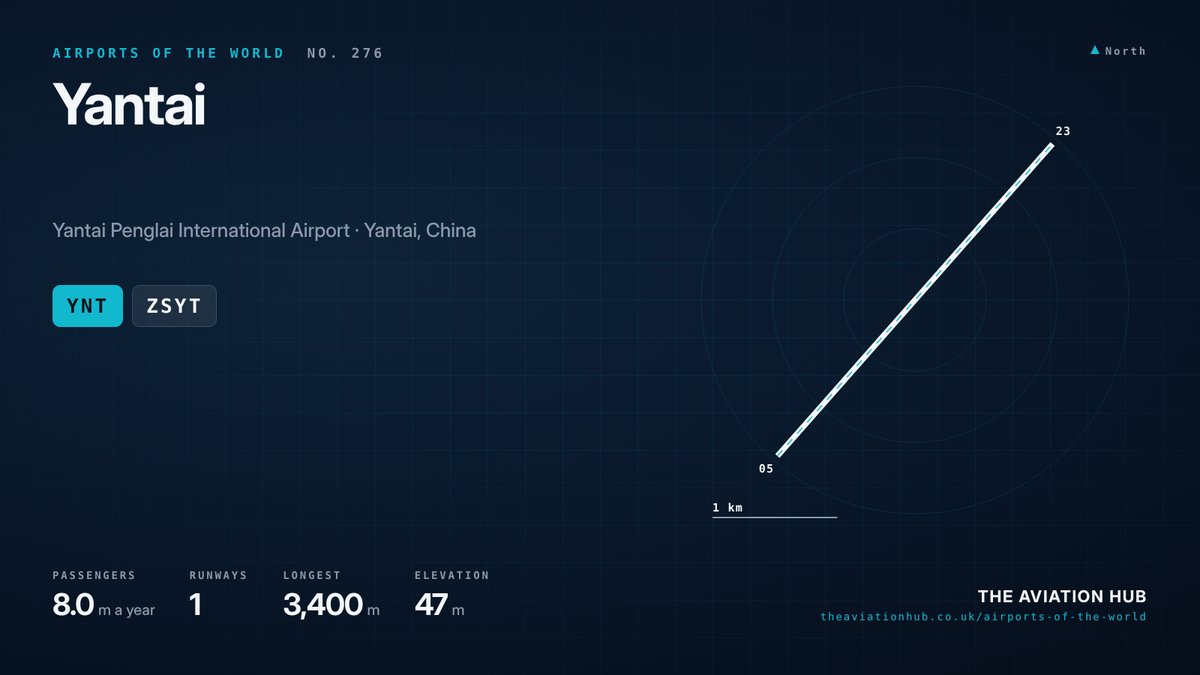
Yantai Airport serves the port city of Yantai on the northern coast of the Shandong peninsula, looking across the Bohai Strait towards Dalian and within easy reach of the Korean peninsula. The current field at Penglai opened in 2015, replacing a cramped site closer to the city, and it handled about eight million passengers in 2025. China Eastern Airlines and Shandong Airlines lead a busy domestic network, with a handful of links to South Korea and Japan.
Yantai Airport at a Glance
The codes are YNT for IATA and ZSYT for ICAO. The airport lies in Chaoshui town, Penglai District, about 27 miles (43 km) from Yantai city centre, at an elevation of 47 metres (154 feet). Its full name is Yantai Penglai International Airport. There is one runway and one terminal building of about 80,000 square metres.
Traffic reached roughly 8.04 million passengers in 2025, with some 68,600 aircraft movements and about 72,600 tonnes of cargo. China Eastern and Shandong Airlines treat Yantai Airport as a focus city, and most major Chinese carriers serve it. The airport holds a three star domestic rating from Skytrax. Flight information is on the airport’s official website.
How Yantai’s Airport Came to Be
For decades Yantai’s airline traffic used Laishan Airport, on the southern edge of the city. It was convenient for passengers but hemmed in by urban growth and shared with the military, which limited expansion. As traffic climbed in the 2000s, the city chose a new greenfield site to the west, near the coast at Penglai.
Construction began on 26 December 2009. The project was originally known as Yantai Chaoshui International Airport, after the town where it sits, and took its current name in April 2014. The move came on 28 May 2015, when every flight transferred overnight from Laishan to the new Yantai Airport. The first arrival, a China Eastern service from Beijing, landed just after midnight.
The new site was designed with growth in mind. Planners projected 12 million passengers and 90,000 tonnes of cargo by 2020, a target the airport has still not reached. Traffic has nevertheless recovered strongly since the pandemic.
Runways at Yantai Airport
Yantai Airport has a single concrete runway, 05/23, which measures 3,400 metres (11,155 feet) long and 45 metres wide. It is built to ICAO Code 4D standard, which suits the Airbus A320 and Boeing 737 families that dominate the schedule and allows wide bodies up to the size of the Boeing 767.
The runway runs south west to north east, on open land a few miles inland from the Bohai coast. Approaches cross farmland, orchards and small villages rather than dense suburbs. Sea fog rolling in from the Bohai Strait can reduce visibility, particularly in spring and early summer, and winter brings occasional snow.
A single runway has ample capacity for current traffic. Should demand reach the levels once forecast, a second runway would be the obvious next step on the large site.
Terminals and Airlines
All flights at Yantai Airport use the single terminal, which handles domestic and international passengers in separate areas. Jet bridges serve the main gates, with remote stands and buses for overflow at peak times. The building is modern, straightforward and rarely overcrowded outside holiday peaks.
China Eastern and Shandong Airlines run the largest operations. Shandong Airlines, based in Jinan, is controlled by Air China, while China Eastern belongs to SkyTeam. Air China, China Southern, Hainan Airlines, Sichuan Airlines and many smaller Chinese carriers also serve the field. Several cargo airlines operate freighters, reflecting the region’s export economy.
Routes and Destinations
Routes from Yantai Airport radiate to the big Chinese cities. Beijing, Shanghai, Guangzhou and Shenzhen form the core, with Chengdu, Hangzhou and many other provincial capitals close behind. Shorter hops reach north eastern cities such as Harbin and Shenyang, while flights to Dalian compete with the busy ferries across the Bohai Strait. Flights south to Hainan and Yunnan carry winter sun seekers, while summer brings tourists to Yantai’s beaches, wineries and the coastal scenery at Penglai.
The international network is small but strategic. Seoul Incheon is the key link, reflecting the close ties between Shandong and South Korea through trade, investment and family connections. Eastar Jet adds a Korean option, and Tokyo Narita, Nagoya and Osaka Kansai complete the regular international list, while Yakutia Airlines flies seasonal charters to Khabarovsk and Vladivostok. Cargo is significant, at around 72,600 tonnes in 2025, reflecting the region’s manufacturing and farming economy.
Getting to and from Yantai Airport
The distance from the city makes ground transport important. Airport shuttle buses run to Yantai’s main districts, including Zhifu and Laishan, and to Penglai and other nearby towns. They are the cheapest sensible option, and the journey to central Yantai takes around an hour depending on traffic.
Taxis and ride hailing services through apps such as DiDi are widely available and cost far less than in Europe. Expect around 45 minutes to an hour to central Yantai. Expressway links connect the airport with the city and the rest of the peninsula, and car parks serve the terminal. Check the latest options before travelling, as local transport links continue to develop.
Spotting and Photography
The countryside around Yantai Airport is open and largely flat, with farm roads and villages close to both ends of the runway. Because the runway runs south west to north east, the south eastern side keeps the sun behind the camera for much of the day. The terminal itself offers views of the apron from the departure gates.
Traffic is dominated by Airbus A320 family and Boeing 737 aircraft of China Eastern and Shandong Airlines, with occasional wide bodies and freighters adding interest. Chinese authorities are sensitive about photography near airports, so keep to public roads, stay well clear of fences and stop immediately if security staff or police ask.
What Comes Next
The site has space to grow, though traffic remains well below the original forecasts. Plans for a further phase, with more terminal capacity and potentially a second runway, have been discussed by local authorities, but timing depends on how quickly demand rises. The Weifang to Yantai high speed line, opened in October 2024, stops at Penglai but has no airport station, so a direct rail link would make the distant location easier to accept.
With a modern terminal, a long runway and a growing local economy, Yantai Airport looks set for steady growth as Shandong’s second tier gateway behind Qingdao and Jinan. See how it compares with other Chinese airports on our Airports of the World map.
Continue to follow The Aviation Hub for more analysis and insight.
Advertise with us Your brand, in front of an aviation audience Home page and in-article placements, sold directly, one advertiser per slot. From £250 a year. See the rates

