Yekaterinburg Airport, known to most Russians as Koltsovo, sits on the eastern side of the Ural Mountains where Europe gives way to Asia. It serves the fourth largest city in Russia and is the home of Ural Airlines, one of the country’s biggest carriers. Recent traffic has run at roughly seven to eight million passengers a year. The field mixes a rich wartime history with a modern terminal complex built through private investment in the 2000s.
Yekaterinburg Airport at a Glance
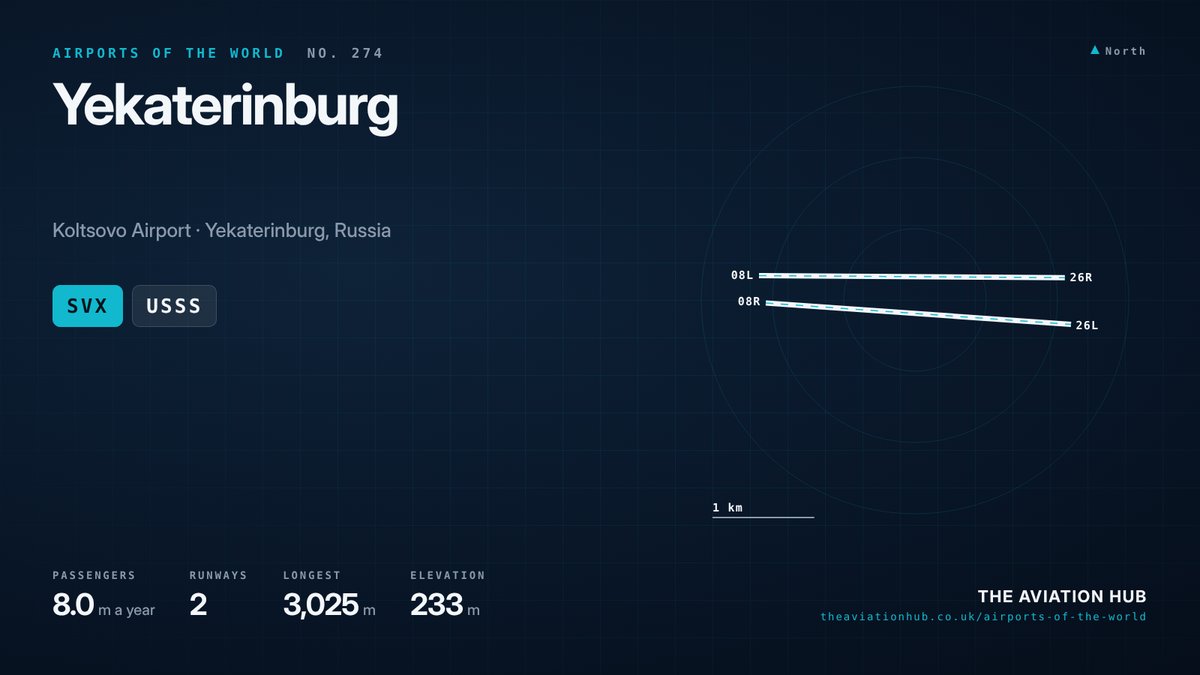
The codes are SVX for IATA and USSS for ICAO. The airport lies about 10 miles (16 km) south east of central Yekaterinburg, beside the village of Koltsovo that gives it its name. Elevation is 233 metres (764 feet). There are two parallel runways, a domestic Terminal A, an international Terminal B and a business aviation terminal in the original 1954 building.
Ural Airlines is the dominant carrier and has its headquarters in the city, while RusLine and the cargo operator Aviacon Zitotrans also use Yekaterinburg Airport as a base. A military transport regiment shares the field. Airports of Regions, a holding company that runs several Russian airports, manages the site through the owner, Koltsovo Invest. Live flight information is on the airport’s official website.
A Short History of Koltsovo
The aerodrome was built between 1928 and 1930 for a Soviet military aviation institute. It made history on 15 May 1942, when the BI-1 rocket powered interceptor made its maiden flight here. Its pilot, Grigory Bakhchivadzhi, was killed on the seventh test flight, and a full scale replica now stands outside the airport.
The field opened to civil traffic on 10 July 1943 while still serving the military. During the war it sat on a secret ferry route that brought American built aircraft from Fairbanks in Alaska to Moscow. In the early 1950s Moscow to Beijing services stopped here, giving Koltsovo its first international link, and the neoclassical terminal that now handles business aviation opened in 1954.
After the Soviet collapse, international status arrived in October 1993, and on 28 December that year the airport and Ural Airlines were split from the local aviation enterprise. A privately funded reconstruction ran from 2003 to 2009, delivering a new domestic terminal, a new international terminal, a control tower and a rebuilt runway in time for the 2009 summits held in the city.
Runways at Yekaterinburg Airport
Yekaterinburg Airport has two parallel runways. Runway 08R/26L is the main strip, a concrete runway measuring 3,025 metres (9,925 feet) long. Runway 08L/26R is asphalt and measures 3,004 metres (9,856 feet). Both run roughly east to west. The second runway dates from 1987, and the original strip was extended in 1956.
Both runways meet ICAO Category I standards. Winters are long and harsh, with temperatures often well below minus 20°C, so snow clearance and de icing shape the operation for months at a time.
An Air China Boeing 747 brought Chinese delegates to the summits in June 2009. Since then the runways have handled visiting wide bodies on charter and holiday routes, alongside the Ilyushin Il-76 freighters of Aviacon Zitotrans.
Terminals and Airlines
Terminal A handles domestic flights at Yekaterinburg Airport. Completed in 2007, it has five jet bridges and can process about 1,600 passengers an hour. Terminal B, the international building, opened on 15 June 2009 and covers about 45,000 square metres, with its own security, duty free and lounge. The two buildings are joined.
Ural Airlines flies Airbus A320 family jets across Russia and to Central Asia, the Caucasus and holiday destinations. Aeroflot, Pobeda, S7 Airlines and other Russian carriers add domestic capacity. Since 2022 Western airlines have not served Russia, so foreign carriers at the airport now come mainly from Central Asia, the Gulf, Turkey and China.
Routes and Destinations
Moscow is the busiest route by a wide margin, served from all three main Moscow airports. St Petersburg, Sochi, Novosibirsk and the oil and gas cities of western Siberia are other main routes. Yekaterinburg Airport also acts as a transfer point for Ural Airlines passengers travelling between the regions and Moscow.
Internationally the network has shifted east and south. Tashkent, Dushanbe, Bishkek and other Central Asian cities carry heavy migrant worker traffic, while Dubai, Antalya and resorts in Egypt, Thailand and Vietnam draw holidaymakers, especially in winter. Some flights to China have also been added. Cargo is significant, with Aviacon Zitotrans flying heavy freight on charter work.
Getting to and from Yekaterinburg Airport
Road transport does most of the work. City buses and minibuses run between the terminals, the main railway station and the city centre, taking around 40 to 60 minutes depending on traffic, and are the cheapest sensible option. A rail station opened at the airport in 2008 with an Aeroexpress style service, but trains have been sparse, so check the timetable before relying on them.
Taxis and ride hailing apps such as Yandex Go are cheap by Western standards. A trip to the centre typically takes 25 to 40 minutes and costs around 800 to 1,200 roubles (roughly £8 to £12). Car parks serve both terminals.
Spotting and Photography
Russian law and security culture make spotting at Yekaterinburg Airport a risky pursuit. Photographing airfields with a military presence can attract the attention of police and security services, and foreign visitors in particular should think carefully before raising a camera near the perimeter. Inside the terminals, views of the apron are limited.
The fleet mix is still varied. Ural Airlines A320s and A321s dominate, alongside Aeroflot and Pobeda Boeing 737s, regional jets and the occasional Il-76. With the runways running east to west, the southern side would keep the sun behind the camera. Anyone who does photograph should stay well away from fences and military areas, carry identification and stop immediately if asked.
What Comes Next
Sanctions have reshaped the airport’s prospects. Western built aircraft are harder to maintain, Western routes have gone, and growth now depends on domestic demand and links to Asia and the Middle East. The operator continues to market the field as a transfer hub between European Russia, Siberia and Central Asia.
The 2000s rebuild left the airport with modern terminals, so fleets matter more than buildings. Yekaterinburg Airport will remain the gateway to the Urals, but its future depends on airline fleets and politics as much as demand. See how it compares with other Russian hubs on our Airports of the World map.
Continue to follow The Aviation Hub for more analysis and insight.
Advertise with us Your brand, in front of an aviation audience Home page and in-article placements, sold directly, one advertiser per slot. From £250 a year. See the rates