
Yiwu Airport Guide: Where the Wholesale World Flies In
Yiwu Airport serves China's famous wholesale market city in Zhejiang. Its runway, terminals, airlines, routes, transport links and growth plans.
 By The Aviation Hub
5 min read
Updated October 20, 2026
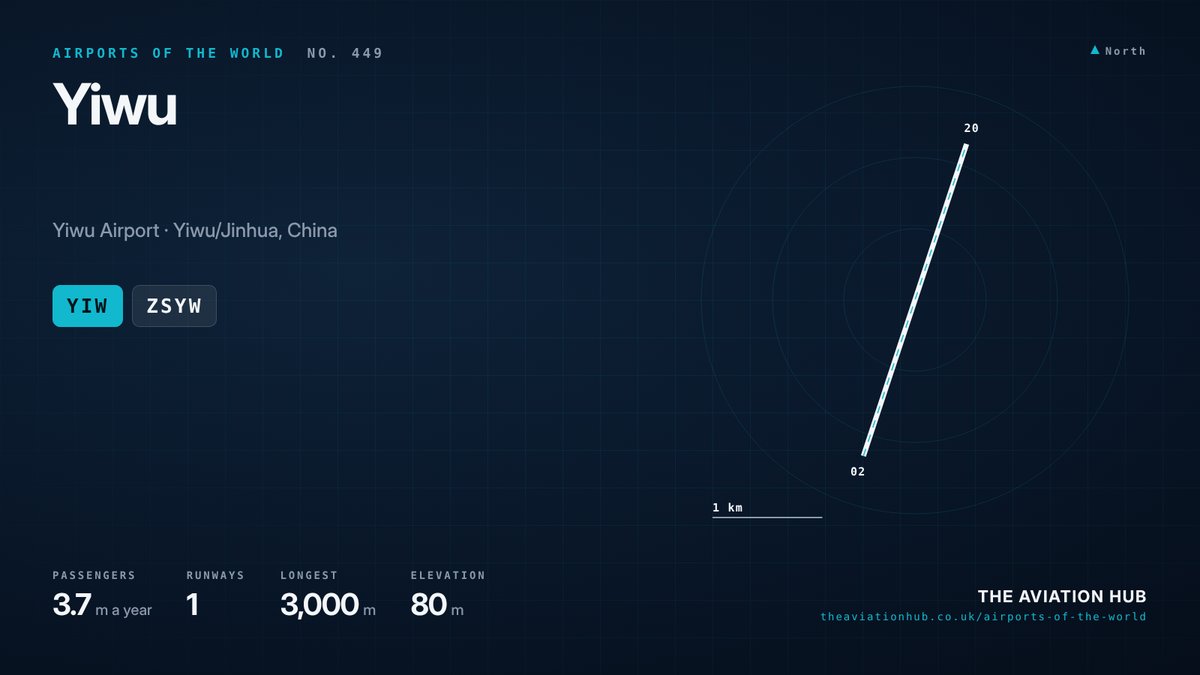
Yiwu Airport serves Yiwu, the Zhejiang city whose vast wholesale markets supply small goods to traders from every continent. It also serves nearby Jinhua and the surrounding inland region of central Zhejiang. Close to 3.7 million passengers used it in 2025, along with a growing flow of air cargo. For buyers heading to the markets, it offers a short hop from the big Chinese cities without the long transfer from Hangzhou or Shanghai.
Yiwu Airport at a Glance
The IATA code is YIW and the ICAO code is ZSYW. The airport lies about 3.4 miles (5.5 km) north west of central Yiwu and roughly 32 miles (51 km) from Jinhua. It sits 262 feet (80 m) above sea level, with one runway, a domestic terminal and a separate international terminal. Yiwu Airport recorded 3,684,507 passengers, 28,234 aircraft movements and about 24,400 tonnes of cargo in 2025.
The field is a joint military and civil airport. China Southern runs the largest list of routes, with Air China, China Eastern and several smaller Chinese airlines also present. Flight information is on the airport’s official website.
From Naval Airfield to Trade Gateway
Construction began in 1970, when the site was developed as a secondary naval training airfield. As Yiwu’s markets grew in the 1980s, local leaders pushed for passenger flights. In 1988 the State Council and the Central Military Commission approved conversion to joint military and civil use, and the airport opened to civil aviation on 1 April 1991.
Rapid growth followed the expansion of the Yiwu International Trade City. A 300 million yuan terminal project began on 22 October 2006, and the new passenger terminal and control tower entered service on 10 April 2009. Work on an international terminal of about 13,400 square metres started on 6 January 2012.
The State Council approved Yiwu Airport as an international port of entry on 6 August 2014, and the international terminal opened that year. A runway and airfield upgrade followed between 2015 and 2017, lifting the airport to the 4D category for larger aircraft. On 25 December 2025 the airport took over its own approach control within the Hangzhou approach area.
Runways at Yiwu Airport
There is one runway, 02/20, measuring 3,000 metres (9,843 feet) long and 45 metres wide. A 500 metre extension was commissioned on 13 November 2017. The upgrade allows wide body freighters and larger passenger jets, though Airbus A320 and Boeing 737 family aircraft fly almost every scheduled service.
The runway runs roughly north to south across the flat valley floor, with low hills on either side. Military movements share the airspace, which can affect scheduling at times. Summer brings heavy thunderstorms and the plum rain season in June, while winter fog occasionally delays early morning flights.
Terminals and Airlines
The 2009 domestic terminal handles the bulk of the traffic. The international terminal, opened in 2014, serves flights to Hong Kong and abroad and includes immigration and customs facilities. Both are compact and easy to navigate, a welcome contrast with the huge hubs of Shanghai and Hangzhou.
China Southern offers the widest network from Yiwu Airport, including Beijing Daxing, Guangzhou, Shenzhen and Chengdu Tianfu. Air China and China Eastern serve their own hubs, while China United adds Beijing Daxing and Shijiazhuang and Chongqing Airlines, Colorful Guizhou and Donghai add routes to the south west and Shenzhen. HK Express links Hong Kong, while Central Airlines and China Postal Airlines operate cargo flights to Manila and Osaka Kansai.
Routes and Destinations
The network is overwhelmingly domestic. Beijing, Guangzhou, Shenzhen, Chengdu and Chongqing are core routes, linking Yiwu’s traders with buyers and manufacturers across China. Flights to the west and south west also carry migrant workers who staff the city’s markets and factories. Hangzhou is absent from the map because high speed trains cover that trip in well under an hour, and Shanghai has only a China Eastern link to Pudong.
International traffic is small but strategic. Hong Kong is the only international passenger route, and foreign buyers from the Middle East, Africa and Russia often connect through Chinese hubs. Cargo is a growing business, with online retail parcels and small goods flown out alongside the freight trains that leave Yiwu for Europe and Central Asia. Yiwu Airport is part of a wider logistics web rather than a standalone gateway.
Getting to and from Yiwu Airport
The airport is close to the city, on its north western edge near the expressways to Hangzhou and Jinhua. Taxis and ride hailing cars reach the centre and the International Trade City in around 15 to 20 minutes, at a low fare. Local buses also serve the terminal and are the cheapest sensible option for light travellers. Many hotels near the markets offer pick ups, and some trading companies send drivers to meet visiting buyers.
There is no rail link to the terminal, but Yiwu railway station sits on the high speed line between Shanghai, Hangzhou and southern China. Trains reach Hangzhou in around half an hour and Shanghai in under two hours. Jinhua is about an hour away by road. Parking is available beside the terminals for drop offs and short stays.
Spotting and Photography
Yiwu Airport is a quiet field for enthusiasts, with mostly narrow body traffic from the big Chinese airlines. The flat ground around the runway offers views from nearby roads, and the terminal’s large windows show the apron. Freighter visits and the occasional military movement add interest.
Because the airport has a military role, photography demands extra care. Stay well away from fences, never photograph military aircraft or installations, and do not fly drones near the field. Carry identification and follow instructions from police or security staff without argument. Discretion is the rule at any Chinese airport.
What Comes Next
Traffic has outgrown the original plans, and the terminals are busy at peak times. Expanding passenger facilities and cargo handling will be the priority as the city’s trade continues to grow. More international routes, particularly to South East Asia, would suit the market’s buyers. The integration of approach control in December 2025 signals a field preparing for more movements.
Competition from Hangzhou’s international hub and fast rail links will always cap Yiwu’s long haul ambitions. The verdict: Yiwu Airport will thrive as a domestic and regional gateway for the world’s traders, with cargo its most promising growth area. Compare it with other Zhejiang airports on the Airports of the World map.
Continue to follow The Aviation Hub for more analysis and insight.
Advertise with us Your brand, in front of an aviation audience Home page and in-article placements, sold directly, one advertiser per slot. From £250 a year. See the rates

