
Yogyakarta Airport, officially Yogyakarta International Airport, is the main gateway to the cultural heart of Java and the temples of Borobudur and Prambanan. It sits on the south coast in Kulon Progo Regency, about 28 miles (45 km) west of Yogyakarta city. Opened in stages between 2019 and 2020, it replaced the cramped Adisutjipto Airport and was built to withstand major earthquakes and tsunamis. More than 4 million passengers a year now use it.
Yogyakarta Airport at a Glance
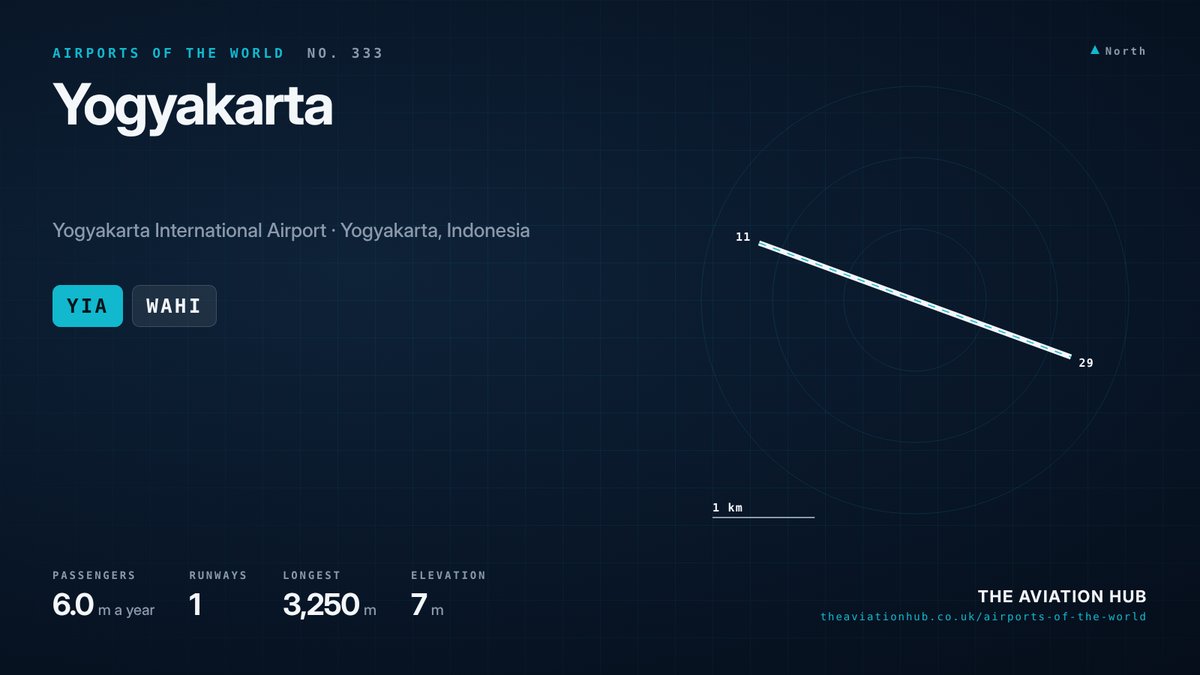
The airport uses the IATA code YIA and the ICAO code WAHI. It lies between Congot and Glagah beaches in Temon District, 7 m (24 ft) above sea level. A single runway and one large terminal serve the site. The terminal covers 219,000 square metres, with 96 check in counters, 10 jet bridges and 17 aircraft stands. InJourney Airports, formerly Angkasa Pura I, operates it for the state.
Yogyakarta Airport handled 4,275,848 passengers in 2024, just below the 2023 record of 4.31 million. Cargo jumped 34 per cent to around 15,700 tonnes. Garuda Indonesia treats it as a focus city, while Lion Air and Super Air Jet have bases here. Citilink, Batik Air, AirAsia, Scoot and Malaysia Airlines also fly in. Schedules and services are listed on the airport’s official website.
How Yogyakarta’s Airport Came to Be
For decades the city relied on Adisutjipto Airport, an active air force base on its eastern edge. Its terminal was built for about 1.2 million passengers a year, yet it handled more than 7.2 million in 2016 with only seven aircraft stands. Housing surrounded the site and the Indonesian Air Force owned the land, so expansion was impossible. A new coastal airport was the answer.
Land acquisition for around 587 hectares ran from 2012 to 2017 and met strong resistance. Residents feared losing farmland, and some raised tsunami and environmental concerns. The National Commission on Human Rights reported violations during clearances, and as of July 2018 some 86 families still refused to sell. About 40 per cent of the land belonged to the Paku Alam estate.
Partial operations began in May 2019 with a Citilink flight from Jakarta Halim. Full operations started on 29 March 2020, just as the pandemic struck, and President Joko Widodo inaugurated the airport on 28 August 2020. Traffic in 2021 was only around a million, roughly a tenth of expectations. The total investment was around Rp 11.3 trillion (roughly £550 million).
Runways at Yogyakarta Airport
A single runway serves Yogyakarta Airport. Runway 11/29 is 3,250 m (10,663 ft) long and 45 m wide with an asphalt surface and a pavement classification number of 93. It can take heavy aircraft up to the Boeing 777 and Airbus A380, a big step up from Adisutjipto. The runway runs parallel to the coast, close to the Indian Ocean shore.
The coastal position shaped the whole design. The airport is built to withstand earthquakes up to magnitude 8.8 and tsunamis up to 12 m high, and it has an early warning system for earthquakes, tsunamis and extreme weather. Flood mitigation works were completed in 2025. Sea breezes are a daily feature, and thunderstorms in the wet season from November to April can bring delays.
Terminals and Airlines
The single terminal at Yogyakarta Airport handles domestic and international flights under one roof. Its landside capacity is put at around 9 million passengers a year, roughly double today’s traffic. The halls are spacious and bright, with room to spare even at peak hours. A cargo terminal alongside can handle up to 500 tonnes a day.
Garuda Indonesia flies Boeing 737-800s on trunk routes and larger aircraft on its seasonal Saudi flights. Lion Air, Super Air Jet, Batik Air and Citilink provide much of the domestic capacity with Boeing 737 and Airbus A320 family aircraft. Pelita Air, TransNusa, Sriwijaya Air and Airfast Indonesia add further routes. AirAsia and Malaysia Airlines connect to Kuala Lumpur, and Scoot flies to Singapore.
Routes and Destinations
Jakarta is the busiest route by far, with flights to Soekarno Hatta through the day. Denpasar on Bali, Balikpapan and Makassar are among the other major domestic links. Other cities across Sumatra, Kalimantan and Sulawesi fill out a network that reflects Yogyakarta’s large student population and strong domestic tourism.
International flying is limited but growing. Kuala Lumpur and Singapore are the main foreign routes, popular with tourists heading for Borobudur. Garuda runs seasonal flights to Jeddah and Medina for pilgrims, the longest routes from Yogyakarta Airport at more than 5,000 miles (8,000 km). Demand peaks in school holidays and around Eid, when millions of Indonesians travel home.
Getting to and from Yogyakarta Airport
Rail is the best way into the city. The Yogyakarta International Airport Rail Link runs to Yogyakarta station in the city centre, taking 35 to 39 minutes. By 2025 around 50 trips ran each day. The Airport Train Xpress skips Wates station for a slightly quicker run. Fares are low by UK standards, making the train the cheapest sensible option for most visitors.
DAMRI shuttle buses link the airport with Adisutjipto, Magelang, Purworejo and Kebumen, and Magelang is the natural jumping off point for Borobudur. Satelqu buses serve Cilacap and Purwokerto. Taxis and app based rides take around an hour to central Yogyakarta, depending on traffic. A toll road to the city is planned but not yet complete.
Spotting and Photography
The coastal setting gives Yogyakarta Airport a different feel from most Indonesian fields. Glagah Beach, near the eastern end of the runway, and Congot Beach to the west offer open views of arrivals and departures with the Indian Ocean close by. The terminal glazing gives views of the apron, where Garuda, Lion Air and Citilink jets turn around.
Easterly winds dominate the dry season from May to October, which tends to favour runway 11. Early morning and late afternoon give the softest light before the tropical sun turns harsh. Keep to public beaches and roads, stay well away from the perimeter fence and follow any instruction from airport security or police at once.
What Comes Next
The terminal has room for roughly twice today’s traffic, so the focus is on filling it. More international routes to Malaysia, Singapore and the Gulf are the obvious next step. A planned toll road will cut journey times to the city and onward to Central Java. The rail link already does much of the heavy lifting.
Tourism around Borobudur, one of Indonesia’s designated super priority destinations, should drive demand. Yogyakarta Airport looks set for steady growth as domestic airline capacity recovers, with the space to absorb it. Compare it with other Indonesian gateways on the Airports of the World map.
Continue to follow The Aviation Hub for more analysis and insight.
Advertise with us Your brand, in front of an aviation audience Home page and in-article placements, sold directly, one advertiser per slot. From £250 a year. See the rates

