
Zhuhai Airport Guide: Home of China’s Biennial Airshow
Zhuhai Airport at Jinwan has a 4,120 metre runway, 13 million passengers and hosts the Airshow China exhibition. History, routes, access and spotting explained.
 By The Aviation Hub
6 min read
Updated October 20, 2026
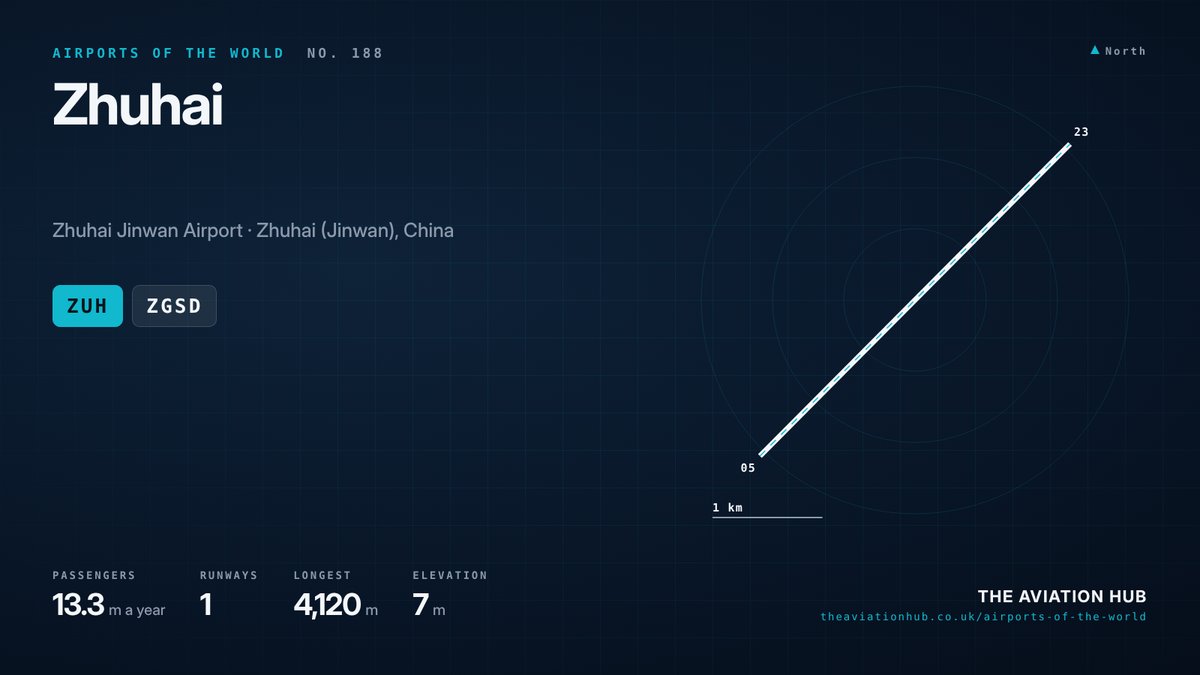
Zhuhai Airport, officially Zhuhai Jinwan Airport, serves the coastal city of Zhuhai in Guangdong province, across the border from Macau at the mouth of the Pearl River. It handled around 13.3 million passengers in 2025, all of them on domestic routes. The airport is best known to enthusiasts as the venue for Airshow China, the biennial exhibition where the Chinese aerospace industry unveils its latest aircraft. A 4,120 metre runway, built with wide body ambitions that took decades to justify, remains one of the longest in the country.
Zhuhai Airport at a Glance
The IATA code is ZUH and the ICAO code is ZGSD. The airport lies at Sanzao in the Jinwan district, about 31 miles (50 km) southwest of central Zhuhai and the Gongbei border crossing. Elevation is 7 metres (23 feet) on reclaimed coastal flats. There is one runway and one main terminal, with a second terminal being built alongside under the current expansion programme.
Traffic in 2025 reached roughly 13.3 million passengers, 92,000 aircraft movements and about 40,000 tonnes of cargo. China Southern Airlines treats Zhuhai Airport as a focus city, and Air China, China Eastern, Shandong Airlines, Hainan Airlines and Shenzhen Airlines all operate regular services. The China Coast Guard bases its 2nd Aviation Group at the field. Management has been in the hands of Hong Kong’s Airport Authority through a joint venture since 2006. Flight details appear on the airport’s official website.
From Wartime Airstrip to Pearl River Gateway
The site began as Sanzao Airport, built by Japanese forces in 1938 as a military base during the war in China. The Nationalist government destroyed the runway in 1948 and by 1949 local fishermen were using the concrete to dry fish and grain. The field lay abandoned for four decades until civil use was approved in 1989.
Zhuhai, one of the original special economic zones, rebuilt the site from 1992 with grand ambitions. When construction began in 1993 the airport was built to China’s highest 4E standard with a 4,120 metre runway. The airport opened in June 1995 as Zhuhai Sanzao Airport and the first Airshow China followed in 1996. The problem was traffic. Guangzhou, Shenzhen, Hong Kong and Macau all had airports within an hour or two, and Zhuhai’s remained largely empty.
From 1996 to 2006 the airport struggled with heavy debt and persistent bankruptcy rumours. The rescue came in 2006, when the Airport Authority Hong Kong took over management, making Zhuhai the first mainland airport run under the Hong Kong model. Traffic grew steadily from then on. The airport was renamed Zhuhai Jinwan Airport in 2013, and a terminal expansion in February 2018 added new floors and a VIP lounge.
Runways at Zhuhai Airport
Zhuhai Airport has one asphalt runway, 05/23, of 4,120 metres (13,517 feet) and 45 metres width. The length is extraordinary for an airport with no international flights, and it was chosen in the 1990s to attract wide body traffic that never came. Today it means any aircraft in the world can use the field, which matters during the airshow when heavy military transports, tankers and prototypes arrive.
The runway runs northeast to southwest on reclaimed land beside the coast. Typhoons from July to October are the main operational hazard and bring periodic closures. Low cloud and sea fog affect spring mornings.
A second runway of about 2,600 metres is planned. Zhuhai is also a centre of flight training and small aircraft manufacturing, so the mix on the single runway ranges from Airbus A330s to light aircraft and Coast Guard helicopters.
Terminals and Airlines
Terminal 1 is the original 1995 building, extended in 2018 with a longer eastern corridor and extra floors. It is a large, open hall with a departures level upstairs and arrivals below, and it was described at opening as one of the largest of its kind in China. The new terminal, under construction since November 2019, is designed to add substantial capacity.
China Southern Airlines is the dominant carrier at Zhuhai Airport and flies Airbus A320 family and Boeing 737 aircraft across the country, from Harbin and Changchun to Sanya and Urumqi. Air China, China Eastern, Shandong Airlines, Hainan Airlines, Shenzhen Airlines, Sichuan Airlines, Xiamen Airlines, Spring Airlines and Juneyao Air provide the rest of the network. The airport also hosts flight training organisations and general aviation operators.
Routes and Destinations
Every scheduled route is domestic. Beijing Daxing, Shanghai Pudong, Chengdu Tianfu, Hangzhou, Nanjing, Xi’an, Chongqing, Wuhan, Changsha and Kunming are served by several carriers. The northeast and northwest are well covered, with Harbin, Shenyang, Urumqi and Lanzhou on the board. Trunk routes to Beijing and Shanghai carry the heaviest traffic.
The longest sector is Urumqi at about 2,110 miles (3,400 km), with Harbin next at about 1,790 miles (2,875 km). International service is an obvious gap given the facilities, and the opening of the Hong Kong Zhuhai Macau Bridge in 2018 gave the airport a catchment that stretches into both special administrative regions. Traffic peaks around Chinese New Year and the October holiday, and the airshow in November of even years fills every seat into the city.
Getting to and from Zhuhai Airport
Rail arrived on 3 February 2024 when the Zhuhai to Zhuhai Airport intercity railway opened, with Zhuhai Airport railway station beside the terminal. Trains link the airport with Zhuhai station at Gongbei, next to the Macau border, and with the wider Guangzhou Zhuhai intercity network. The ride to Gongbei takes about half an hour.
Four airport express bus routes run to central Zhuhai, Gongbei, Jida and Tangjiawan, and some connect with the ferry and border terminals. Intercity coaches serve Macau, Zhongshan and Jiangmen. City buses 207, 504 and 701 are the cheapest option but slow. A dedicated taxi company serves arrivals, with the fare to Gongbei typically around ¥150 (roughly £16). The drive takes 45 minutes to an hour on the coastal expressway.
Spotting and Photography
Zhuhai Airport is a place of pilgrimage every second November. Airshow China brings the Chinese air force’s display team, prototype fighters, Comac airliners and foreign military visitors to the airport, and the public days offer unmatched access to Chinese hardware. Tickets sell out fast and the crowds are enormous.
Outside the show the field is quiet. The terminal windows cover the apron, and the roads around the field give occasional views of arrivals. The Coast Guard presence and the general sensitivity of Chinese authorities mean photography outside the terminal attracts attention. Keep away from fences, avoid pointing cameras at military or government aircraft, and be ready to show identification.
What Comes Next
The second terminal and the planned 2,600 metre runway are the headline projects. Together they are designed to carry the airport past 25 million passengers a year and give it a credible base for international flights for the first time. Linking the airport to the Hong Kong Zhuhai Macau Bridge catchment is the other strategic goal, with the new railway a first step.
The competitive position remains tough. Guangzhou, Shenzhen, Hong Kong and Macau all sit within easy reach and absorb most of the region’s long haul demand. Yet Zhuhai has grown from a punchline to a 13 million passenger airport, and the airshow keeps its name in front of the world. Zhuhai Airport is heading for steady growth and, eventually, an international timetable. Find its neighbours on the Airports of the World map.
Continue to follow The Aviation Hub for more analysis and insight.
Advertise with us Your brand, in front of an aviation audience Home page and in-article placements, sold directly, one advertiser per slot. From £250 a year. See the rates

