
Zurich Airport Guide: Three Runways and a Swiss Hub
Zurich Airport is the home of Swiss and Edelweiss. Discover how its three runways, three docks and German noise treaty shape Switzerland's main gateway.
 By The Aviation Hub
7 min read
Updated October 20, 2026
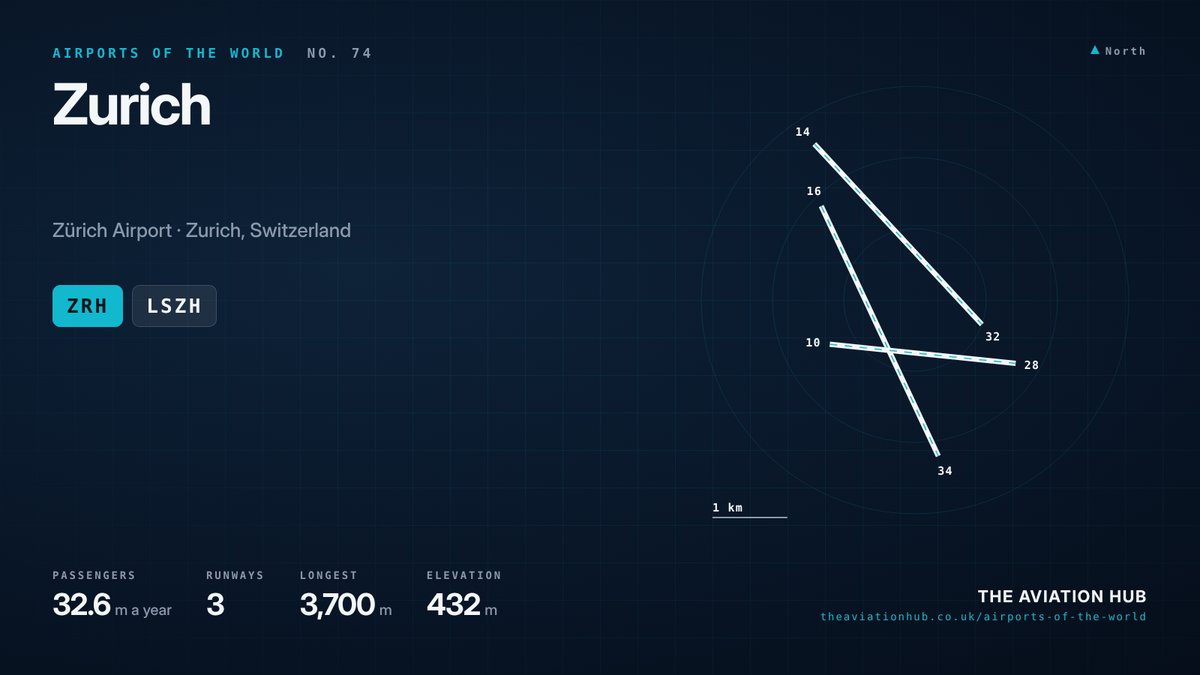
Zurich Airport lies at Kloten, about 5.5 miles (9 km) north of the city centre, on former moorland between the villages of Kloten, Rumlang and Oberglatt. It is Switzerland’s largest airport and the principal hub of Swiss International Air Lines, the Lufthansa Group carrier that replaced Swissair. Three runways in three different directions, a railway station under the terminal and a strict night curfew make it one of the more unusual major hubs in Europe. Around 32.6 million passengers used it in 2025, a record.
Zurich Airport at a Glance
The codes are ZRH and LSZH. The field stands 432 m (1,417 ft) above sea level, high enough that winter fog and snow are regular features. It has three concrete runways and a single terminal complex of three piers, called Docks A, B and E, joined by the Airside Centre. Flughafen Zurich AG operates it. The company is listed on the Swiss stock exchange, with the canton of Zurich holding a third of the shares plus one.
Zurich Airport handled about 32.6 million passengers in 2025, up 4.5 per cent on 2024 and above its 2019 peak of 31.5 million. Swiss is the dominant carrier, with Edelweiss Air, Helvetic Airways and Chair Airlines also based here, and Condor also keeps a base here. The field recorded about 270,000 aircraft movements and 441,000 tonnes of freight. Flight information and car park bookings are on the airport’s official website.
How Zurich’s Airport Came to Be
Civil flying in Zurich began at the military airfield of Dubendorf in 1909, and Swissair’s forerunner Ad Astra Aero flew from there from 1919. By the 1940s Dubendorf was too small and too military. A 1943 study picked the Kloten moor, and the federal parliament approved the site in 1945, selling the former artillery range to the canton. Construction began in 1946 after a cantonal vote.
The first runway opened on 14 June 1948, when a Swissair Douglas DC-4 took off for London. Civil traffic moved from Dubendorf later that year and the first terminal followed in 1953, complete with a 200 m spectator terrace. Runway 14/32 opened in 1976 and the railway station under the terminal in 1980. Dock A was extended in 1985 and the control tower followed a year later.
The Airport 2000 programme produced the midfield Dock E, the Skymetro people mover and the Airside Centre, all opened in 2003. The collapse of Swissair in October 2001 cut traffic sharply, and recovery came only after Lufthansa took control of the successor airline Swiss in 2005. The Circle, a huge complex of offices, hotels and shops opposite the terminal, opened in November 2020.
Runways at Zurich Airport
Zurich Airport has three runways, each 60 m wide and concrete. Runway 16/34 is the longest at 3,700 m (12,139 ft) and is used mainly for departures. Runway 14/32 at 3,300 m (10,827 ft) is the main landing runway. Runway 10/28, the original 1948 strip, is 2,500 m (8,202 ft) long and is used mostly for take offs towards the west. Runway 16/34 crosses 10/28 and the flight paths of 14 and 16 converge, so controllers juggle a complex pattern rather than running simple parallel operations.
For most of the day arrivals land on Runway 14 from the north while departures leave on 16 and 28. The 2001 treaty with Germany restricts approaches over German territory in the early morning and evening, so arrivals then switch to Runway 28 from the east or Runway 34 from the south. The eastern approach to 28 has no instrument landing system, and in November 2001 a Crossair Avro RJ100 crashed near Bassersdorf while flying it in poor weather, killing 24.
Voters in the canton approved extending Runway 28 by 400 m to the west and Runway 32 by 280 m to the north in March 2024. The aim is to improve safety margins and reduce noise. A night ban applies from 23:00 to 06:00, with limited delayed departures until 23:30.
Terminals and Airlines
All passengers check in at the landside Airport Centre and pass through the Airside Centre, from which three docks fan out. Dock A, opened in 1971 and extended in 1985, handles Schengen flights only, including the domestic hop to Geneva, and is reaching the end of its life. Dock B, rebuilt between 2008 and 2011, can handle Schengen and non Schengen flights through separate routes at each gate. Dock E is the midfield satellite between Runways 16/34 and 14/32, reached by the Skymetro, and serves non Schengen long haul flights.
Swiss and its Lufthansa Group partners, Austrian, Lufthansa, Brussels Airlines and Eurowings, dominate the schedule alongside Star Alliance partners such as United, Air Canada, Singapore Airlines, Thai and Turkish Airlines. Edelweiss flies leisure routes to the Mediterranean, the Canaries, the Caribbean and the Indian Ocean. Other visitors include British Airways, easyJet, Emirates, Qatar Airways, Delta and Etihad. The Swiss lounges in Dock E and the Senator lounge in Dock A are the standouts.
Routes and Destinations
London Heathrow is the busiest route from Zurich Airport with around 1.15 million passengers in 2024. Berlin follows at about 861,000, then Amsterdam, Madrid and Vienna, all between 740,000 and 815,000. Barcelona, Palma de Mallorca, Lisbon, Frankfurt and Hamburg complete the top ten. Swiss operates most of these with Airbus A220s, A320neos and A321neos.
Dubai leads the long haul list at about 661,000 passengers, ahead of Bangkok at 434,000 and New York JFK at 422,000. Swiss flies Boeing 777-300ERs and Airbus A330-300s and A340-300s to North America, Asia and Africa, with the Airbus A350-900 joining from 2025. Singapore at roughly 6,400 miles (10,300 km) is among the longest services. Edelweiss adds leisure long haul to the Maldives, Cancun and Cape Town with A340s and A350s.
Freight is substantial for an airport of this size, with pharmaceutical exports and watches making up high value cargo. Korean Air Cargo and Turkish Cargo run freighters alongside belly capacity on Swiss wide bodies.
Getting to and from Zurich Airport
The railway station beneath the Airport Centre is the cheapest and quickest way into town. About 13 trains an hour reach Zurich Hauptbahnhof in nine to 13 minutes, and a standard fare costs around CHF 7 (£6). Direct InterCity and InterRegio trains run on to Basel, Bern, Lucerne, St Gallen and Geneva, plus Munich and Konstanz in Germany. Trams 10 and 12 of the Glattalbahn stop outside, and tram 10 runs to the city centre in about 35 minutes.
A taxi to the city centre takes 20 to 30 minutes and costs CHF 60 to 70 (£55 to 65). The A51 motorway and the Nordring link Zurich Airport to the national network, and six car parks hold more than 14,000 spaces. Regional buses from VBG and PostAuto serve the surrounding towns.
Spotting and Photography
The observation deck on Dock B, reached through the Airside Centre, overlooks the apron and both runway systems and has a cafe. It is open to the public. The Dock E observation deck, inside the passenger zone, gives a closer look at the long haul fleet. Outside the fence, the spotter hill under the final approach to Runway 14 is a well known meeting point, and the viewing point in the west, by the crossing of Runways 16 and 28, looks out over departures.
Morning light suits the eastern side and the afternoon sun favours views from the west. Swiss 777-300ERs, A340s and A350s, Edelweiss A340s and the Emirates A380 are the highlights, with regular Swiss Air Force visitors adding interest. Stay on public paths, keep away from the fences and respect the signs at the runway ends.
What Comes Next
The replacement of Dock A, together with a new Skyguide control tower, is the big project. Construction is due to start in 2030 with completion in 2033 at the earliest, using timber and solar panels. The runway extensions approved in 2024 are the other major project. Work on a CHF 500 million baggage sorting hall began in 2018.
Growth is constrained by the night ban and the German treaty rather than by concrete, so the airport will stay a quality hub rather than a volume one. Zurich Airport has little room to add movements and will focus on bigger aircraft and better premium traffic. Place it alongside Europe’s other hubs on the Airports of the World map.
Continue to follow The Aviation Hub for more analysis and insight.
Advertise with us Your brand, in front of an aviation audience Home page and in-article placements, sold directly, one advertiser per slot. From £250 a year. See the rates

