
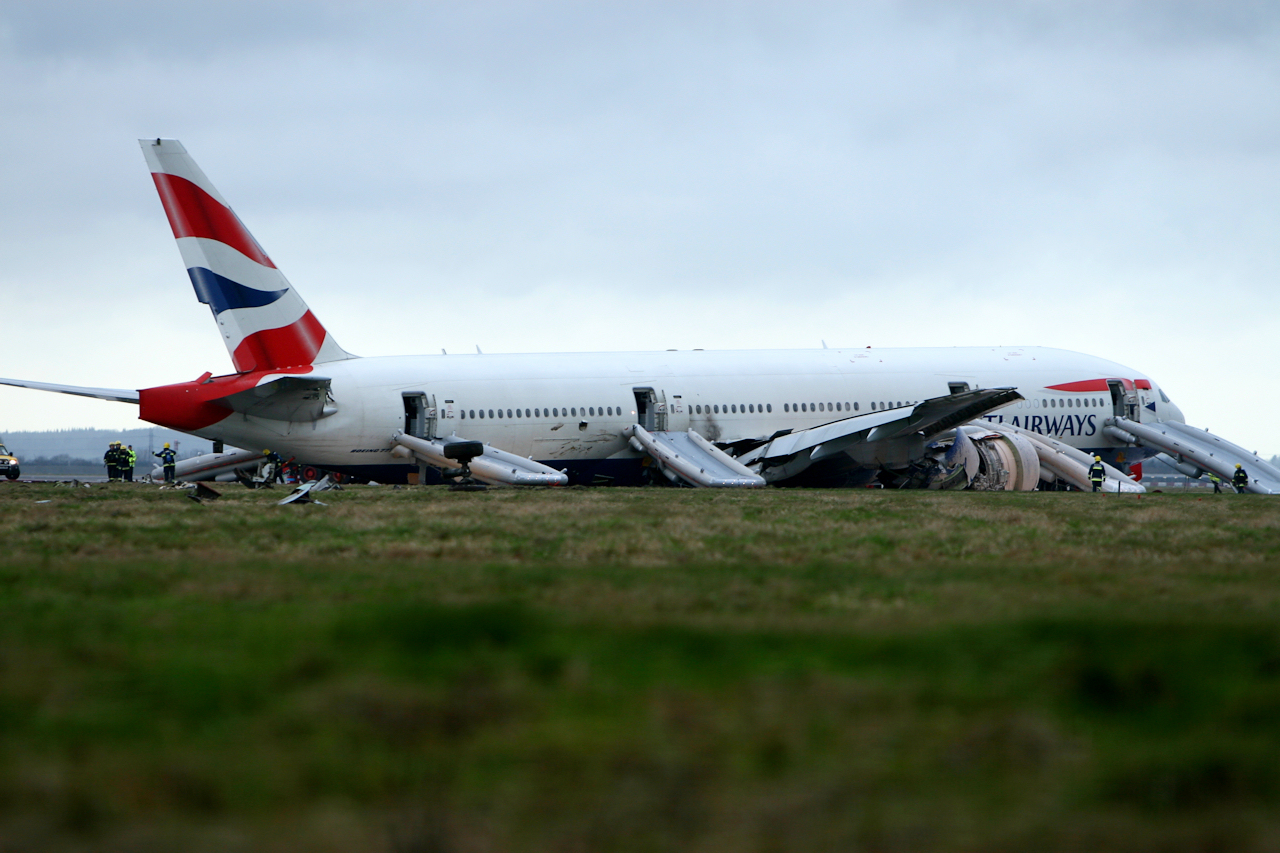
Eighteen years ago today, on 17 January 2008, British Airways Flight 38 made aviation history—not for tragedy, but for an extraordinary survival story that reshaped global understanding of fuel‑system behaviour in modern long‑haul aircraft.
As the Boeing 777‑236ER, registration G‑YMMM, descended toward London Heathrow after an 8,100‑kilometre journey from Beijing, a chain of events unfolded that no engineer, regulator, or airline had previously anticipated.
The aircraft lost thrust in both engines simultaneously, forcing a powerless glide to the ground. Yet all 152 people on board survived.
This anniversary offers a moment not only to revisit the accident itself, but to reflect on how it transformed engineering standards, operational procedures, and the broader culture of aviation safety.
British Airways Flight 38: A Routine Journey Across the World
British Airways Flight 38 departed Beijing Capital International Airport at 02:09 GMT, bound for Heathrow.
The aircraft—a Boeing 777 powered by Rolls‑Royce Trent 895 engines—was crewed by an experienced flight deck team: Captain Peter Burkill, Senior First Officer John Coward, and First Officer Conor Magenis.
The route took the aircraft across Mongolia, Siberia, and Scandinavia, cruising at altitudes between flight level 348 and 400.
Temperatures outside the aircraft ranged from −74°C to −65°C, well within the expected envelope for long‑haul polar‑route operations.
The crew monitored fuel temperature throughout, prepared to descend if freezing became a concern.
It never did: the fuel remained above its freezing point.
What the crew could not see, however, was the behaviour of microscopic water particles suspended within the fuel—particles that would ultimately trigger the first hull loss of a Boeing 777.
The Invisible Threat: Ice Accretion in the Fuel System
Jet fuel naturally contains trace amounts of water.
Under extremely cold conditions, this water can freeze into tiny crystals.
On British Airways Flight 38, these crystals accumulated inside the fuel lines during hours of low‑flow cruise flight.
The ice adhered to internal surfaces, particularly in the wing‑to‑engine feed lines.
This phenomenon was not considered dangerous at the time.
The Boeing 777’s fuel/oil heat exchangers (FOHEs) were designed to warm fuel before it reached the engines, preventing ice from reaching sensitive components.
But the system had a vulnerability no one had yet recognised.
As the aircraft descended toward Heathrow and the autothrottle demanded increased thrust, warmer fuel began to dislodge the accumulated ice.
The crystals flowed downstream as a slush, eventually reaching the FOHEs—where they refroze, blocking fuel flow to both engines simultaneously.
This was the first known instance of such a failure mode in the Trent 800 engine family.
The Final Approach for British Airways Flight 38: Seconds from Disaster
At 720 feet and just two miles from touchdown, the crew noticed that the engines were failing to respond to thrust commands.
The autopilot attempted to maintain the glide slope by sacrificing airspeed, which dropped to 108 knots by 200 feet.
The autopilot disconnected at 150 feet, and First Officer Coward took manual control.
Captain Burkill reduced the flap setting from 30° to 25° to reduce drag—an action that would later be credited with helping the aircraft clear the airport perimeter and avoid catastrophic structural damage.
At 12:42, the aircraft passed just above the houses of Myrtle Avenue, skimmed over the A30 road, and touched down on the grass 270 metres short of runway 27L.
The landing gear collapsed, the right main gear punctured the central fuel tank, and the aircraft slid to a halt on the runway threshold markings.
Despite the violent impact, there was no fire.
One passenger suffered serious injuries; 46 others sustained minor injuries.
Immediate Aftermath: A Model Evacuation
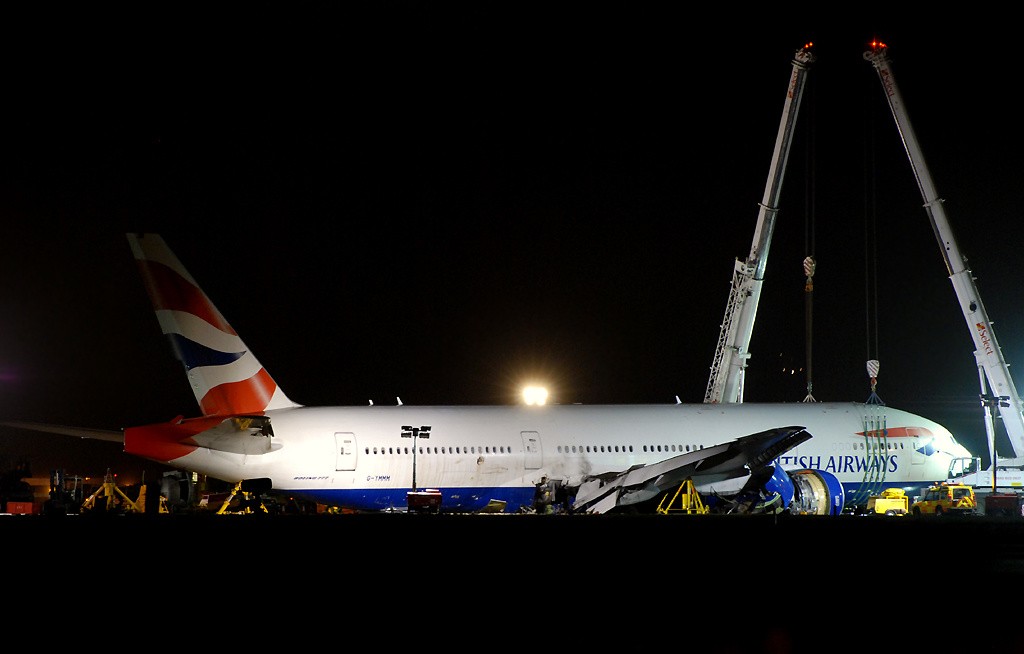
Emergency services responded rapidly, deploying ambulances, fire crews, and police units. All passengers and crew were evacuated safely.
British Airways praised the professionalism of the flight and cabin crew, who were later awarded the BA Safety Medal and the Royal Aeronautical Society’s President’s Award.
Heathrow operations were disrupted for the remainder of the day, with cancellations, diversions, and overnight dispensation for additional flights to restore schedules.
The aircraft, heavily damaged but largely intact, was later dismantled and scrapped—the first Boeing 777 ever written off.
The Investigation: A New Understanding of Fuel‑System Icing
The Air Accidents Investigation Branch (AAIB) led a two‑year inquiry, supported by Boeing, Rolls‑Royce, and the U.S. National Transportation Safety Board.
Early speculation ranged from software faults to electromagnetic interference, but investigators quickly focused on fuel delivery issues.
By February 2010, the AAIB concluded that:
- Ice had accumulated in the fuel system during long‑duration cruise in unusually cold conditions.
- The ice was released during descent and refroze at the FOHE face, restricting fuel flow.
- The FOHE design, though compliant with certification standards, was vulnerable to blockage by soft ice at high concentrations.
This discovery prompted a global redesign of FOHE units across the Rolls‑Royce Trent 500, 700, and 800 engine families.
Regulators mandated modifications, and Boeing revised operating procedures to reduce the risk of recurrence.
The accident also influenced certification standards, ensuring future aircraft designs accounted for this previously unknown hazard.
Wider Impact: Similar Incidents and Industry Change
The British Airways Flight 38 investigation uncovered parallels with other events, including Delta Air Lines Flight 18 in 2008, which experienced an “uncommanded rollback” of a Trent 800 engine under similar conditions.
Later, an Airbus A330 with Trent 700 engines experienced a related issue.
These cases reinforced the need for systemic redesign and validated the AAIB’s conclusions.
The survival of all 152 people on board is often cited as a testament to:
- The skill and composure of the flight crew
- The structural resilience of the Boeing 777
- The effectiveness of Heathrow’s emergency response
- The value of rigorous, transparent accident investigation
But the deeper legacy lies in how the accident reshaped engineering assumptions.
Before 2008, the idea that ice could accumulate harmlessly for hours and then suddenly mobilise to choke both engines was not part of any certification model.
Today, it is a standard consideration.
British Airways Flight 38 stands as a reminder that aviation safety evolves not only through innovation, but through learning—sometimes from the narrowest of escapes.
On this 18th anniversary, British Airways Flight 38 remains one of the most studied and consequential non‑fatal accidents in modern aviation.
It is remembered not for loss of life, but for the extraordinary chain of events that revealed a hidden vulnerability and ultimately made global aviation safer.
Continue to follow The Aviation Hub for more analysis and insight!