
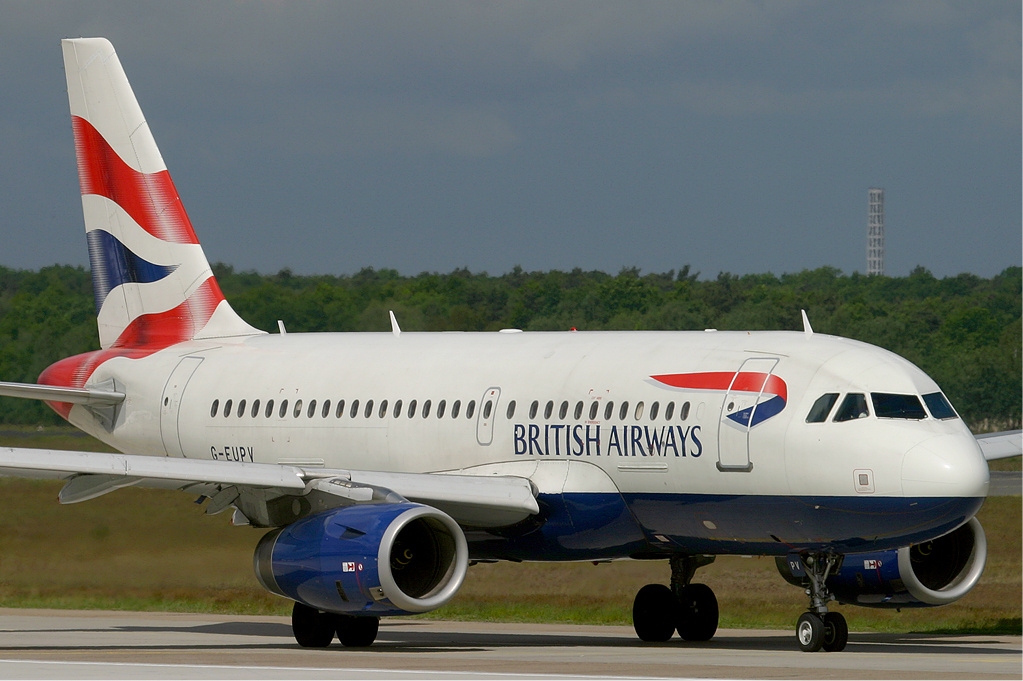
A British Airways Airbus A319 operating flight BA812 from London Heathrow to Copenhagen declared an emergency on final approach to the Danish capital on 1 February 2026, prompting a swift response from airport authorities and raising questions about the nature of the incident.
About The Aircraft Involved in Emergency
The aircraft involved, registered G-EUPU, is a 25-year-old airframe delivered to British Airways in December 2000 and currently configured in a CY143 layout.
According to Planespotters.net, the aircraft has undergone multiple configuration changes and periods of storage, most recently returning to service in March 2024 following a three-month grounding at Madrid.
G-EUPU has a long operational history with British Airways and has previously been leased out between 2016 and 2021.
It was stored at Bournemouth during the early stages of the COVID-19 pandemic and later at Madrid, before re-entering service in March 2024.
The aircraft’s age and maintenance history will be key factors in any investigation, though its active status and recent return to service suggest it was deemed airworthy prior to the incident.
British Airways BA812 – London to Copenhagen…
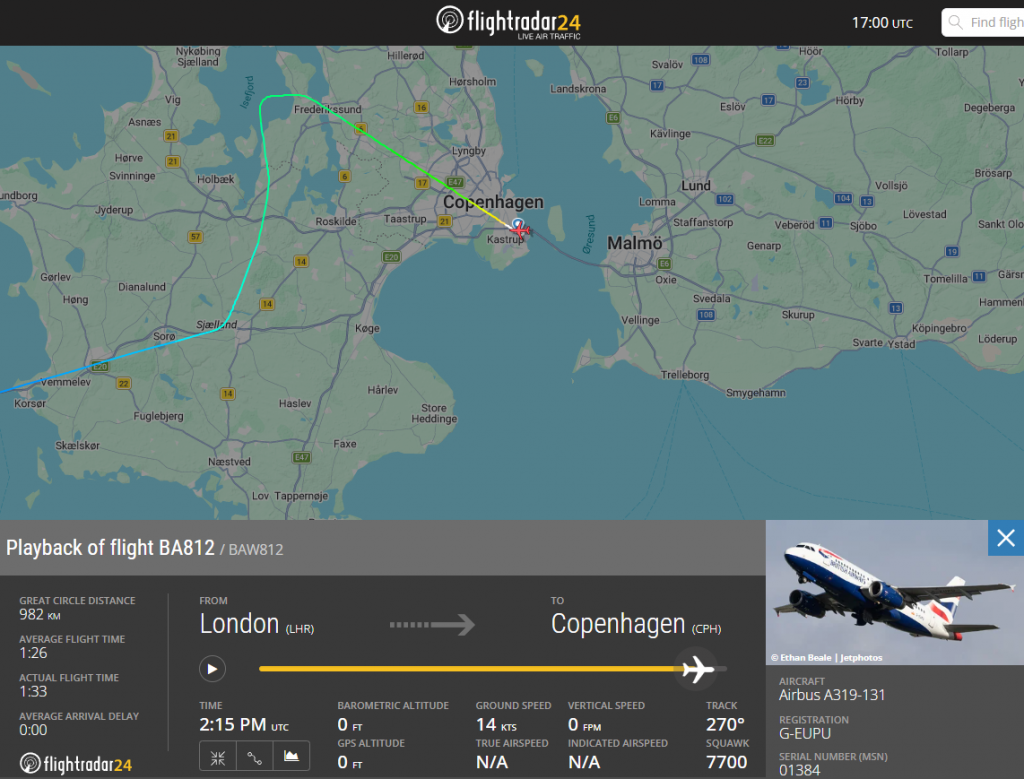
The emergency was first reported by AirLive and corroborated by Flightradar24, which tracked the aircraft’s descent into Copenhagen.
The flight had departed Heathrow as scheduled at 11:20 AM local time and was nearing its destination when the crew issued a general emergency call.
While the exact nature of the emergency remains unconfirmed, the aircraft landed safely and taxied to the gate without further incident.
No injuries were reported among passengers or crew.
Flight data from Flightradar24 shows a standard routing over the North Sea with no significant deviations until the final approach phase.
The aircraft maintained a steady descent profile before the emergency declaration, suggesting the issue may have arisen suddenly and close to touchdown.
The A319, powered by two IAE engines, did not exhibit any abnormal speed or altitude fluctuations prior to landing, further indicating that the emergency may have been precautionary or related to onboard systems rather than a structural or propulsion failure.
Technical Fault Onboard…
British Airways has not released an official statement detailing the cause of the emergency, though sources close to the airline suggest it may have involved a technical fault in the cockpit.
The aircraft was met by emergency services on arrival, a standard protocol for declared emergencies, but was not evacuated and continued to operate normally following inspection.
The incident is being reviewed internally by British Airways and will likely be subject to oversight by the UK Civil Aviation Authority and Danish transport authorities.
The emergency declaration underscores the importance of robust safety protocols and crew training, particularly on aging aircraft operating high-frequency European routes.
Copenhagen Airport handled the situation efficiently, with minimal disruption to other traffic.
BA812’s passengers were deplaned normally and rebooked as needed, with no reported delays to subsequent British Airways operations.
As of 1 February, G-EUPU remains in active service, pending further inspection.
Stay tuned for more updates.
Continue to follow The Aviation Hub for more analysis and insight!