How The US-Iran Conflict Is Affecting Emirates, Etihad Airways & Qatar Airways
 By The Aviation Hub
6 min read
By The Aviation Hub
6 min read
The latest escalation between the United States and Iran has delivered one of the most acute operational shocks the Middle East’s major carriers have faced since the pandemic.
Emirates, Qatar Airways and Etihad Airways have all been forced into large scale schedule disruption after Iranian retaliatory strikes triggered widespread airspace closures and damage at several regional hubs.
What initially appeared to be a short term operational inconvenience has rapidly evolved into a costly and complex financial burden for the ME3 whose business models rely on uninterrupted long haul connectivity and the stability of Gulf airspace.
Immediate Operational Disruption & Cost Of US-Iran Tensions…
The most visible impact has been the mass cancellation and diversion of flights across the region.
Thousands of Middle Eastern flights were cancelled after the US and Israel launched strikes on Iran prompting Iran to retaliate with drone and missile attacks that affected airports in the UAE Bahrain and Kuwait.
Dubai International Airport sustained minor damage with four staff injured while Abu Dhabi’s Zayed International Airport reported one fatality and seven injuries.
These events forced the ME3 to halt or reroute operations at unprecedented scale.
For carriers whose networks are built around high frequency long haul operations even a single day of disruption carries a heavy financial toll.
According to economist Shan Saeed via BernamaBiz, rerouted flights typically add one to two hours of flight time with each additional hour costing between USD 6000 and USD 10000 in fuel and crew expenses for long haul aircraft.
For the ME3 whose fleets are dominated by widebodies operating ultra long haul missions these incremental costs multiply rapidly.
A single rerouted Europe Asia rotation could add tens of thousands of dollars in unplanned expenditure. Multiply that across dozens of daily flights and the financial impact becomes severe.
The Burden of Airspace Closures For Emirates, Etihad & Qatar…
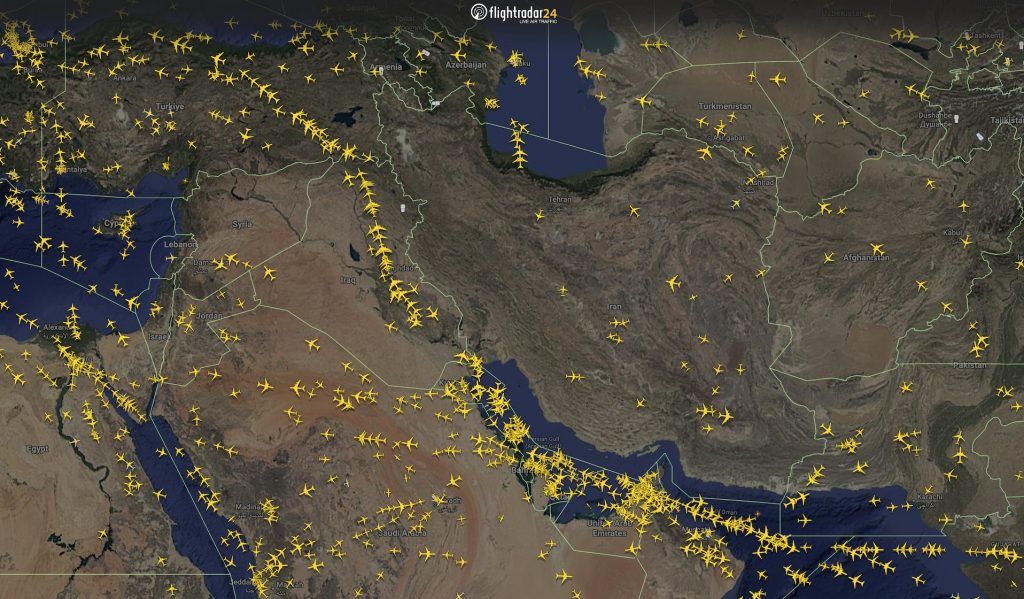
The closure of Iranian Iraqi and parts of Gulf airspace has forced airlines to adopt longer and less efficient routings.
For Emirates and Qatar Airways in particular whose networks depend on overflying Iran to connect Europe with South Asia and Australasia the loss of this corridor is strategically damaging.
Longer routings not only increase fuel burn but also reduce aircraft utilisation a critical metric for carriers operating high density hub and spoke models.
Lower utilisation means fewer daily rotations per aircraft and therefore reduced revenue generating potential.
For airlines that operate some of the world’s largest widebody fleets the opportunity cost alone is substantial.
Even if aircraft remain technically available the inability to operate optimised routings suppresses yield and erodes the efficiency advantages that underpin the ME3’s competitive position.
Rising Fuel Costs and the Risk Premium
Beyond operational inefficiencies the conflict has triggered a spike in oil prices driven by heightened geopolitical risk.
As noted by Universiti Kuala Lumpur Business School’s Mohd Harridon the increase in the risk premium directly affects jet fuel prices which remain the single largest cost item for most airlines.
For the ME3 the timing is particularly challenging.
All three carriers have been navigating a period of strong post pandemic recovery with record passenger demand and improving yields.
Higher fuel prices threaten to erode these gains especially when combined with the additional burn associated with rerouted flights.
Even a modest increase in fuel prices can translate into millions in additional monthly expenditure for airlines operating hundreds of long haul flights per day.
Airspace Fees and Diplomatic Complexity
Rerouting flights around conflict zones requires airlines to secure permission to use alternative airspace often at significant cost.
Harridon highlights that airspace fees are calculated based on aircraft weight and distance flown meaning that long haul widebody operations incur the highest charges.
For the ME3 this creates a dual financial burden.
Not only are flights longer and more fuel intensive but they also attract higher overflight fees from countries whose airspace is now being used more heavily.
This adds another layer of cost pressure at a time when operational flexibility is already constrained.
US-Iran Tensions: Impact on Hub Airports and the Wider Gulf Economy
The ME3’s financial exposure extends beyond airline operations.
Their home airports Dubai International Doha Hamad International and Abu Dhabi Zayed International are among the world’s most important transit hubs.
The conflict has disrupted hundreds of flights per day affecting hundreds of thousands of passengers and large volumes of cargo.
Cargo is a particularly important revenue stream for the ME3 especially Qatar Airways which operates one of the world’s largest dedicated freighter fleets.
Disruption to cargo flows affects not only airline revenue but also the broader logistics ecosystem that supports Gulf economies.
Economist Geoffrey Williams notes that attacks on major hubs will have a significant economic impact on both passenger and cargo businesses with losses compounding if the conflict persists.
Retail revenue at airports is also at risk.
Gulf hubs rely heavily on transit passengers whose spending supports duty free operators restaurants and service providers.
Reduced footfall translates into lower non aeronautical revenue which is a critical income source for airport operators and indirectly for the airlines that rely on strong hub performance.
The Domino Effect on Network Planning
The conflict has triggered a cascade of operational challenges that extend far beyond simple rerouting.
Airlines must redesign flight plans identify alternative diversion airports and renegotiate airspace access with multiple governments.
Each of these steps introduces cost complexity and uncertainty.
The ME3’s network planning teams now face the difficult task of maintaining global connectivity while navigating a patchwork of restricted airspace and volatile geopolitical conditions.
This reduces scheduling flexibility and increases the likelihood of delays and missed connections both of which carry financial penalties and damage customer confidence.
A Billion Dollar Global Impact and the ME3’s Share of the Burden
BernamaBiz reports that the global aviation industry could face costs exceeding USD 1 billion if the conflict intensifies.
Given the ME3’s geographic exposure operational scale and reliance on affected air corridors it is likely that Emirates, Qatar Airways and Etihad will shoulder a disproportionate share of this burden.
Their business models are uniquely vulnerable to Middle Eastern geopolitical instability.
Unlike European or Asian carriers that can reroute around the region entirely the ME3 sit at the centre of the conflict zone.
Their hubs are within range of missile and drone attacks and their most important air corridors run directly through contested airspace.
Strategic Implications for the ME3 Following US-Iran Tensions…
While the ME3 have demonstrated resilience through past crises including the Gulf blockade and the pandemic this conflict presents a different kind of challenge.
It strikes at the heart of their geographic advantage the ability to connect the world efficiently through the Gulf.
If airspace closures persist the ME3 may need to adjust capacity reduce frequencies or temporarily suspend certain routes.
These measures would protect operational integrity but at the cost of revenue and market share.
The longer the conflict continues the more difficult it becomes to sustain the high growth high utilisation model that has defined the ME3 for two decades.
Continue to follow The Aviation Hub for more analysis and insight!