

Solar powered fuel production could transform aviation’s path to net zero, offering a scalable alternative to cooking oil based SAF and reshaping future supply.
The aviation industry’s race to decarbonise has never been more urgent. With global passenger demand continuing to rise and airlines under mounting pressure to meet net zero commitments, the search for scalable, truly sustainable aviation fuel has become one of the sector’s defining challenges.
Now, new research led by the University of Sheffield suggests that solar energy could unlock a breakthrough pathway, potentially reshaping how the world produces sustainable aviation fuel and reducing the industry’s dependence on limited feedstocks such as used cooking oil.
A New Approach to SAF Production
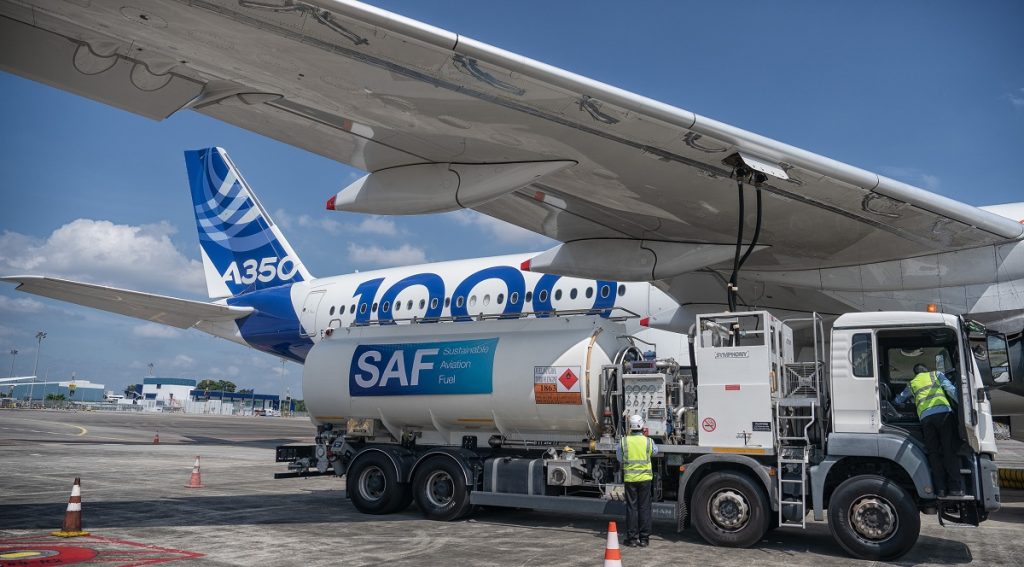
Sustainable aviation fuel has long been positioned as the most viable near term solution for reducing aviation emissions.
It is compatible with existing aircraft and infrastructure, requires no major mechanical changes and can deliver significant lifecycle carbon reductions.
Yet despite its promise, SAF production remains constrained by one critical issue: feedstock availability.
The majority of SAF used in the UK today is derived from used cooking oil, a resource that is both finite and increasingly contested.
As demand grows, the industry faces a bottleneck that threatens to slow progress toward net zero.
The University of Sheffield’s latest research directly targets this barrier by proposing a new solar powered method of producing SAF that bypasses traditional feedstocks entirely.
The technique captures carbon dioxide directly from the air, combines it with hydrogen and uses concentrated solar energy to drive the chemical reactions needed to create the fuel.
It is a process designed not only to reduce emissions but to eliminate reliance on fossil fuels within the production cycle itself.
Moving Beyond Cooking Oil
The research team’s findings, published in Nature Communications, highlight the limitations of current SAF pathways and the need for alternatives that can scale.
Professor Meihong Wang, who led the study, emphasised the urgency of the challenge.
“Decarbonising the aviation industry is key to slowing global warming and achieving net zero,” he said.
“SAF has emerged as a promising solution to meet energy needs while reducing greenhouse gas emissions, as it works in existing engines, potentially allowing for sustainable air travel without major mechanical changes to aeroplanes.”
“However, a major challenge in switching to SAF is ensuring that we have enough feedstock to produce the huge amount of fuel that the industry needs and also making the fuel in a way that doesn’t require fossil fuels.”
The proposed solar driven method aims to solve both problems at once.
By using atmospheric CO2 as the carbon source and solar energy as the heat source, the process removes the need for biomass based feedstocks and avoids the fossil fuel inputs that undermine the sustainability of some existing technologies.
Improving on DACCU
The Sheffield team’s work builds on an emerging concept known as Direct Air Capture and CO2 Utilisation. DACCU captures carbon dioxide from the atmosphere and combines it with hydrogen to create synthetic fuels.
However, current DACCU designs rely on natural gas to generate the high temperatures required for the chemical reactions.
This dependence on fossil fuel heat introduces emissions and limits the sustainability of the final product.
The new solar powered method replaces natural gas with concentrated solar energy, using a field of mirrors to focus sunlight and generate the intense heat needed for fuel synthesis.
According to the study, this shift not only eliminates fossil fuel combustion but also reduces production costs.
The researchers estimate that solar driven SAF could be produced for around US$4.62 per kilogram, compared with US$5.6 per kilogram for existing DACCU pathways.
The Hydrogen Fluidised Calciner
At the heart of the innovation is a specialised reactor known as a hydrogen fluidised calciner. Professor Wang described its dual purpose design.
“The innovation lies in a hydrogen fluidised calciner. This is a specialised reactor that uses a field of mirrors to focus sunlight, eliminating the need for onsite fossil fuel combustion.”
“By using hydrogen to circulate the carbon particles, the system also streamlines production as it serves as the medium to circulate the carbon particles while simultaneously providing the essential feedstock for fuel synthesis.”
This integrated approach removes several steps typically required in synthetic fuel production, including syngas generation and CO2 purification.
The result is a more efficient, more cost effective and potentially more scalable process.
As Professor Wang explained, “This dual purpose design allows us to bypass traditional, complex steps like syngas production and CO2 purification, resulting in a much more streamlined and cost effective production cycle.”
“By converting atmospheric carbon into SAF directly onsite, we transform CO2 from a waste product into a valuable resource, fostering a circular economy that eliminates the need for the expensive pipeline networks and geological reservoirs required by traditional carbon capture and storage.”
Identifying Global SAF Hubs
To understand where this technology could be deployed at scale, the research team conducted extensive modelling and simulation.
Their analysis identified five countries with the right combination of high solar intensity, low hydrogen costs and available land.
These potential SAF hubs span five continents: the United States, Chile, Spain, South Africa and China.
Each location offers conditions that could support industrial scale production, suggesting that solar driven SAF could become a globally distributed solution rather than one limited to specific regions or feedstock supplies.
The geographical diversity also highlights the potential for international collaboration and investment in next generation fuel infrastructure.
A Pathway to Industrial Scale
One of the most significant findings from the study is the technology’s scalability.
The researchers argue that the solar powered process can be deployed at industrial levels, offering a credible route to producing the volumes of SAF required by the aviation sector.
With airlines facing increasingly stringent mandates and sustainability targets, the ability to scale production rapidly and sustainably is essential.
The study also reinforces the importance of integrating renewable energy into fuel production.
By reducing electricity consumption and eliminating fossil fuel heat sources, the process aligns with broader efforts to build circular, low carbon energy systems.
A Collaborative Effort
The project brought together researchers from the University of Sheffield, the University of Manchester and the East China University of Science and Technology.
It was supported by the EU RISE project OPTIMAL and the National Natural Science Foundation of China.
Their combined expertise reflects the growing international momentum behind synthetic fuel research and the recognition that aviation’s decarbonisation requires global solutions.
A Step Toward a New SAF Landscape
While the technology remains in the development phase, its potential impact is significant.
If successfully commercialised, solar driven SAF could diversify the industry’s feedstock base, reduce production costs and eliminate fossil fuel inputs.
It could also help the sector move beyond the limitations of waste based fuels and toward a more sustainable, scalable and circular model.
The aviation industry has long known that no single solution will deliver net zero.
But innovations like this one offer a glimpse of what the next generation of sustainable fuel production could look like.
With continued research, investment and international cooperation, solar energy may yet become a cornerstone of aviation’s low carbon future.
Continue to follow The Aviation Hub for more analysis and insight!