The Complete Guide to Aircraft Emergency Procedures
 By The Aviation Hub
9 min read
Updated May 31, 2026
By The Aviation Hub
9 min read
Updated May 31, 2026

When an aircraft emergency happens, what procedures do pilots undertake to ensure safety to landing?
Aviation is, by almost every measurable standard, the safest form of mass transportation in the world.
Yet for many passengers, the idea of something going wrong at 35,000 feet remains one of the most persistent sources of anxiety when it comes to air travel.
The reality is that the aviation industry is built on layers upon layers of redundancy, training and protocol designed to handle virtually every conceivable situation that could arise in flight.
At the heart of this safety framework are aircraft emergency procedures.
These are not improvised responses to unexpected events.
They are carefully rehearsed, rigorously tested and internationally standardised protocols that pilots, co pilots and air traffic controllers follow the moment something deviates from the norm.
Understanding how these procedures work and what they mean can go a long way toward demystifying air travel and replacing fear with informed confidence.
This guide walks through the key components of aircraft emergency procedures, from the transponder squawk codes that communicate distress silently and instantly, to the systematic checklists pilots work through in an emergency, to the broader statistical picture of just how safe modern aviation truly is.
Aircraft Emergency Squawk Codes: What 7500, 7600 and 7700 Mean
When you board an aircraft, you are stepping into an environment where communication is everything.
Pilots are in constant contact with air traffic control, sharing position, altitude, speed and intentions.
But there are situations where verbal communication is impossible, compromised or simply too slow. That is where transponder squawk codes come in.
A transponder is a device onboard every commercial aircraft that broadcasts a four digit code to air traffic control radar systems.
In normal operations, aircraft are assigned a routine squawk code by controllers.
But three codes are universally reserved for an aircraft emergency, and every pilot in the world knows exactly what each one means.
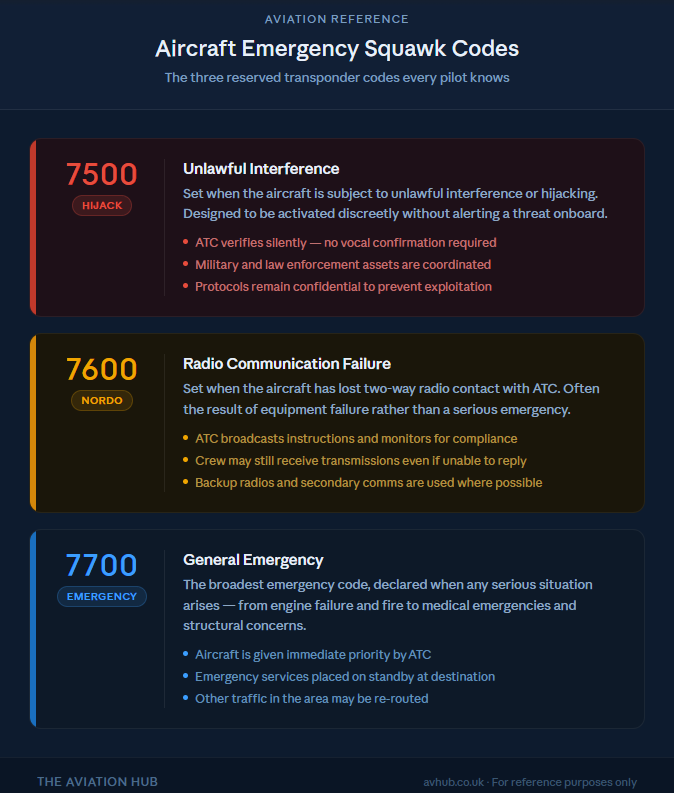
Squawk 7700: General Emergency
Squawk 7700 is the broadest of the three aircraft emergency codes and the one most likely to be used when something has gone seriously wrong onboard.
Setting the transponder to 7700 immediately alerts air traffic control that the aircraft is declaring a general emergency.
This code covers an enormous range of scenarios: a medical emergency onboard, an engine issue, a pressurisation problem, a fire warning, severe structural concerns or any other situation the crew determines requires immediate priority handling.
When 7700 appears on a radar screen, controllers are trained to respond immediately.
Other aircraft in the area may be re routed, the crew will be given priority for approach and landing, and emergency services on the ground will be placed on standby.
Declaring a 7700 does not necessarily mean a crash is imminent.
In fact, the vast majority of 7700 aircraft emergency declarations are resolved safely.
The code exists precisely so that pilots can rapidly communicate the seriousness of a situation without needing to first explain it in detail.
Squawk 7600: Radio Communication Failure
Squawk 7600 is set when an aircraft has lost radio communication with air traffic control.
This is known in aviation as NORDO, short for No Radio.
It sounds alarming, but communication failures are a known and manageable scenario that pilots are thoroughly trained to handle during an aircraft emergency.
When an aircraft squawks 7600, controllers immediately know that the crew can likely still hear transmissions even if they cannot respond.
Controllers will often broadcast instructions on the open frequency and watch for the aircraft to comply, using movement and altitude changes as a form of silent confirmation.
Protocols vary depending on whether the aircraft is in controlled airspace, on approach or in the cruise phase, but the procedures are well established.
In many cases, a communication failure is the result of a faulty radio, a blown fuse or an incorrect frequency setting rather than anything more serious.
Pilots carry backup radios and have access to secondary communication systems. Squawk 7600 is a precautionary code as much as it is an emergency one.
Squawk 7500: Unlawful Interference or Hijacking
Of the three emergency codes, 7500 is the one with the most serious and specific connotation.
Setting the transponder to 7500 communicates to air traffic control that the aircraft is being subjected to unlawful interference, most commonly understood to mean a hijacking.
What makes 7500 particularly significant is the way it is designed to be used discreetly.
A pilot being coerced by someone onboard can set this code without making an audible announcement.
Air traffic controllers who see 7500 on their screens are trained to verify it carefully before acting, typically by asking the crew to confirm via squawk code changes or other indirect methods.
The response to a 7500 squawk involves coordination between aviation authorities, military assets and law enforcement.
Airlines and national aviation bodies have detailed protocols for exactly this scenario, and these protocols are kept deliberately confidential to prevent exploitation.
The code itself, however, is publicly known because its purpose is for pilots to be able to signal danger without alerting a threat onboard.
Aircraft Emergency Procedures Pilots Have in Place

Squawk codes are just one layer of the emergency response framework.
What happens in the cockpit during an emergency is governed by procedures that are among the most thoroughly tested and refined in any professional discipline.
Standard Operating Procedures and Emergency Checklists
Every commercial aircraft type has a set of Emergency and Abnormal Procedures, commonly referred to as QRH procedures, where QRH stands for Quick Reference Handbook.
These are not guidelines.
They are step by step checklists that pilots follow in sequence to address any abnormal situation, from a single indicator light to a full engine failure.
The checklist based approach exists for a very important reason: under stress, memory degrades.
Even the most experienced pilots can miss steps in a high pressure situation.
Checklists remove the reliance on recall and ensure that every action is taken in the correct order.
Pilots train with these checklists repeatedly in simulators so that accessing them in a real emergency is second nature.
Crew Resource Management
Modern commercial aviation operates on the principle of Crew Resource Management, known as CRM.
This is the practice of ensuring that all information and decision making within the cockpit is managed as a team effort between the captain and the first officer, rather than being concentrated in a single pilot.
CRM training teaches pilots to communicate clearly, challenge each other’s decisions when appropriate and avoid the kind of hierarchical pressure that historically contributed to accidents.
In an emergency, one pilot typically handles the aircraft while the other works through the relevant checklist. Roles are clearly defined and well rehearsed.
Mayday and Pan Pan Calls
When a crew needs to declare an emergency verbally over the radio, they use one of two standard distress calls.
A Mayday call, repeated three times, signals a grave and immediate danger requiring immediate assistance.
It is the highest level of distress.
A Pan Pan call, also repeated three times, signals an urgent situation that does not yet require immediate assistance but where priority handling is needed.
Both calls are internationally recognised under International Civil Aviation Organisation standards.
Upon hearing either, air traffic controllers clear the frequency, give the distressed aircraft absolute priority and begin coordinating whatever resources may be needed on the ground.
Diversions and Emergency Landings
In many emergency scenarios, the appropriate response is to divert to the nearest suitable airport.
Pilots are trained to identify suitable diversion airports based on runway length, available emergency services and proximity.
Air traffic control actively assists with this process, providing weather information, runway availability and direct routing to expedite the aircraft’s arrival.
Emergency landings are practiced extensively in simulators.
Pilots train for engine failures at every phase of flight, hydraulic failures affecting control surfaces, landing gear malfunctions, brake failures and dozens of other scenarios.
The goal is always the same: get the aircraft on the ground safely, with as much preparation time as the situation allows.
Automation and Redundancy
Modern commercial aircraft are equipped with extraordinary levels of built in redundancy.
Systems including hydraulics, electrics, fuel supply and flight control computers typically exist in duplicate or triplicate configurations.
If a primary system fails, backups activate automatically or can be selected manually.
Fly by wire aircraft, which includes most modern Airbus and many Boeing types, have flight envelope protection systems that prevent pilots from inadvertently exceeding the structural limits of the aircraft.
These systems do not remove pilot authority, but they do provide an additional layer of protection during high workload situations.
The Safety of Air Travel

Context matters enormously when discussing aviation safety.
The emotional weight of a plane crash, amplified by media coverage, can make air travel feel far more dangerous than the statistics support.
Commercial aviation consistently records fatality rates that are a fraction of those associated with road travel.
The International Air Transport Association regularly reports that flying on a commercial jet is statistically among the safest activities a person can engage in.
In many years, the number of fatal accidents involving commercial passenger aircraft in scheduled service is measured in single figures globally, out of tens of millions of flights operated.
Several factors underpin this record.
Aircraft are designed and certified to standards far exceeding those required for other forms of transport.
Pilots undergo rigorous initial training followed by recurrent training every six to twelve months throughout their careers.
Aircraft maintenance is conducted to extraordinarily detailed schedules by licensed engineers.
Air traffic management systems provide continuous oversight of aircraft movements across the globe.
There is also the culture of safety reporting that pervades aviation.
Pilots, engineers and controllers are actively encouraged and in many jurisdictions legally protected to report safety concerns, near misses and minor incidents without fear of punitive action.
This creates a continuous feedback loop of improvement, where near misses are studied and learned from rather than concealed.
The accident rate in commercial aviation has declined markedly over the past several decades.
Aircraft that were considered state of the art in the 1970s and 1980s have been replaced with types that are fundamentally more reliable, more automated and better understood.
Training has become more sophisticated with the advent of full flight simulators capable of replicating virtually any emergency scenario. Investigation of accidents and incidents has become more thorough and more transparent.
None of this means that aviation is without risk.
It is not. But it does mean that the risk is managed with a seriousness and sophistication that is unmatched in almost any other industry.
Overall…
Aircraft emergency procedures represent one of the most comprehensive safety systems ever developed.
From the silent signal of a transponder squawk code to the methodical steps of a cockpit checklist, from the coordinated response of air traffic control to the redundant engineering built into every major aircraft system, every element is designed with a single purpose: to bring an aircraft and its occupants home safely, no matter what challenges arise.
For passengers, understanding even the basics of how these systems work can be genuinely reassuring.
The next time you hear an announcement about a minor technical issue, or read about an aircraft diverting to a different airport, you will know that what you are seeing is not chaos.
It is a carefully designed system performing exactly as intended.
Aviation has earned its reputation as the world’s safest form of mass transport, not through luck, but through decades of rigorous work, honest self examination and an unwillingness to accept anything less than the highest possible standard. Emergency procedures are not a footnote to that story.
They are a central part of it.
Continue to follow The Aviation Hub for more analysis and insight!



1 comment