
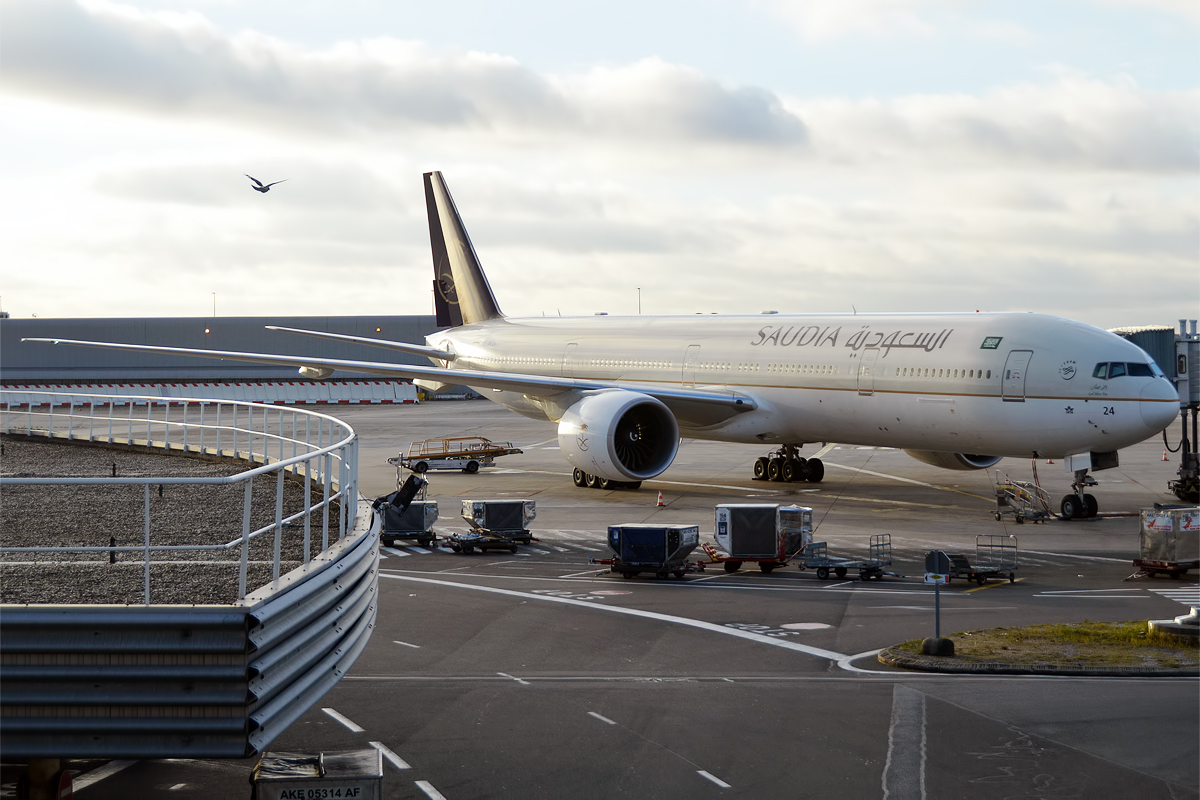
A Saudi Arabian Airlines Boeing 777‑300 operating flight SV724 from Riyadh to Islamabad committed a significant runway misidentification error on 14 October 2024, touching down on Islamabad International Airport’s runway 10L despite being cleared to land on runway 10R.
The incident, which involved 399 passengers and 18 crew, resulted in no injuries or aircraft damage, but Pakistan’s Bureau of Aircraft Safety Investigation (BASI) has now released a detailed final report outlining a complex web of human factors, communication breakdowns, and procedural lapses that allowed the wrong‑runway landing to occur.
The findings paint a picture of an event that was not the result of a single mistake, but rather a gradual erosion of situational awareness across both cockpit and control tower—an erosion that went uncorrected until the aircraft was already on the ground.
A Routine Flight from Riyadh to Islamabad That Drifted Off Course
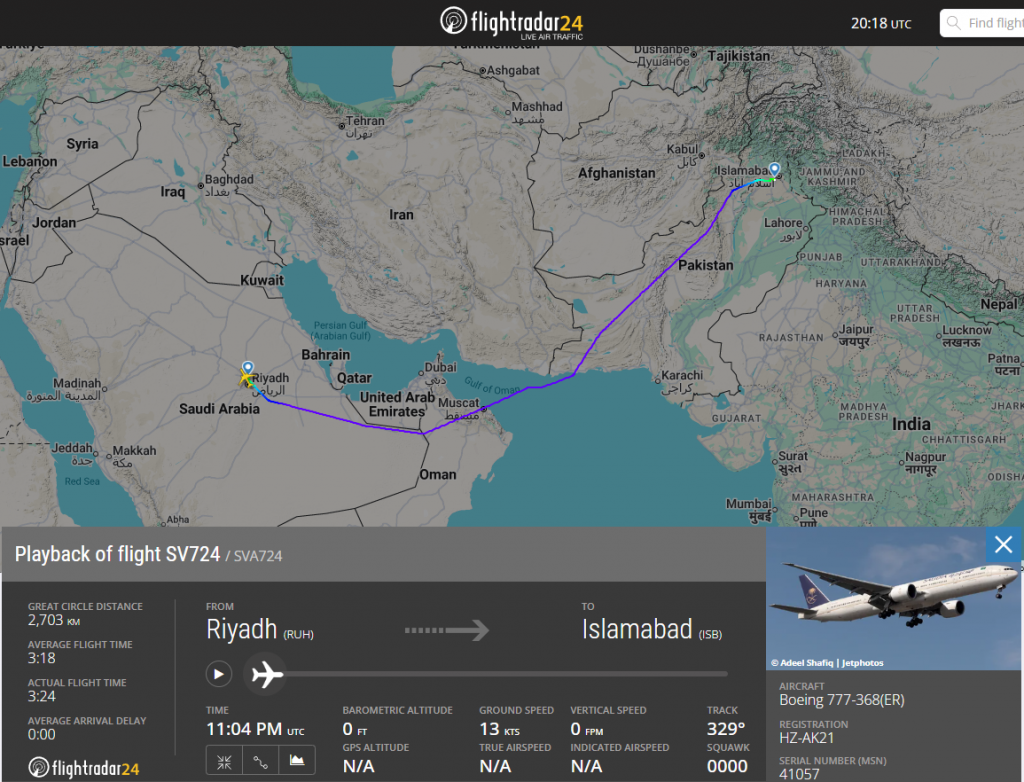
Flight SV724 departed Riyadh’s King Khalid International Airport at 23:27Z, beginning what should have been a straightforward overnight service to Pakistan’s capital.
Weather conditions in Islamabad were benign: light winds, good visibility, no cloud cover, and no meteorological factors that might complicate an approach.
In other words, the environment was not a contributing factor.
The problems began during the descent phase, when the crew first contacted Islamabad Area Control. Controllers issued instructions for an ILS Z approach to runway 10R—a standard precision approach to the airport’s right‑hand runway.
However, the crew repeatedly failed to read back the full clearance.
Instead of confirming both the approach type and runway assignment, they responded only with the routing elements, such as waypoints SUMEB and IS416.
Despite controllers prompting for complete readbacks, the omissions continued. BASI’s analysis suggests the pilots were so focused on the sequence of fixes that they effectively filtered out the runway and approach information, a classic example of expectation bias.
The crew appeared to assume they were being vectored for a particular runway and approach, and their mental model became increasingly detached from the clearances they were actually receiving.
CRM Breakdown in the Cockpit of the SAUDIA Flight…
The report highlights a significant Crew Resource Management (CRM) failure. Neither pilot challenged the other’s incomplete readbacks, nor did they cross‑verify the runway assignment during the approach.
This mutual inattentiveness removed a critical safety barrier: the second pair of eyes that should catch and correct errors before they escalate.
One particularly telling moment occurred when the tower issued the final landing clearance for runway 10R.
The pilot responded with “Runway 10…” followed by a brief hesitation, omitting the left/right designator entirely. BASI notes that this pause may indicate the crew sensed a discrepancy between their alignment and the assigned runway—but chose not to question it.
Under standard CRM principles, any ambiguity about runway alignment should trigger an immediate go‑around.
Instead, the crew continued the approach, descending toward the runway they were already lined up with: 10L.
ATC Lapses: Missed Opportunities to Intervene
While the cockpit errors were central to the incident, BASI’s report also identifies several shortcomings on the air traffic control side.
Area Control
Controllers did not insist on complete readbacks after the second incomplete response.
Although they repeated the clearance once, they did not challenge the crew’s continued omission of the runway and approach type.
Their focus remained on waypoint sequencing rather than the critical elements of the approach.
Approach Control
Approach controllers reissued the ILS 10R clearance but again accepted incomplete readbacks.
They also used ambiguous phrasing such as “report established” without reinforcing the runway or approach type. When passing the altimeter setting, they did not clarify an unclear readback.
Crucially, the final transmission from Approach referenced “runway 10” without specifying left or right—an omission that removed an important cue at a critical moment.
Tower Control
The tower controller issued a correct landing clearance for runway 10R, but accepted the pilot’s ambiguous readback of “Runway 10” without challenge.
When the aircraft was observed aligning with the wrong runway, the controller hesitated to issue a go‑around, despite clear guidance in Pakistan’s Air Safety Circular requiring controllers to advise a missed approach whenever an aircraft’s position or identification is in doubt.
This hesitation allowed the aircraft to continue unchecked toward runway 10L.
Organisational Factors: A System Under Strain
BASI also identified structural issues within Pakistan’s air traffic management system.
At the time of the incident onboard SV724 Riyadh-Islamabad, the same individual was performing both supervisory and approach control duties—a dual role that increased workload and reduced oversight.
With no separate supervisor available to cross‑monitor clearances or intervene, critical omissions went unnoticed.
This organisational setup, combined with the controllers’ reluctance to challenge incomplete readbacks or issue a go‑around, created an environment where errors could propagate unchecked.
A Safe Landing, but a Serious Incident
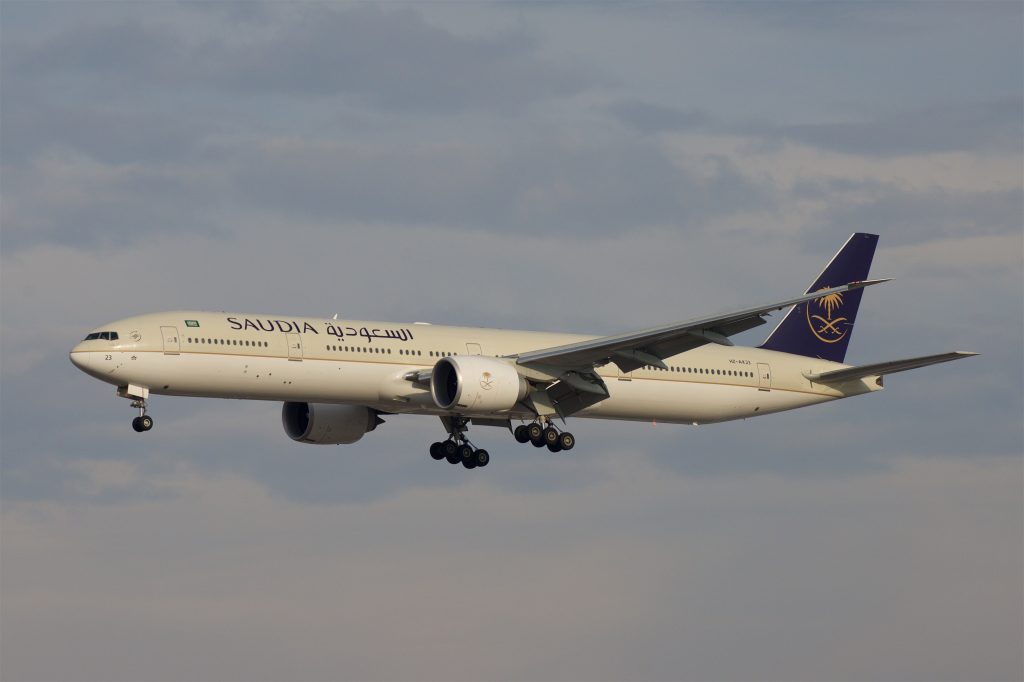
Despite the misalignment, the Boeing 777 touched down safely on runway 10L and rolled out without further incident.
Only after landing did the crew inform the tower that they believed they had been cleared for an RNP approach to runway 10L—an assertion contradicted by the recorded ATC instructions.
The safe outcome does not diminish the seriousness of the event.
Wrong‑runway landings are considered high‑risk because they can lead to runway incursions, collisions with other aircraft, or conflicts with ground vehicles.
Islamabad’s parallel runways are separated by a significant distance, but the potential consequences remain severe.
Probable Cause and Contributing Factors For the Flight from Riyadh…
BASI concluded that the primary cause of the incident was the flight crew’s incorrect interpretation of ATC instructions and insufficient adherence to those instructions. Contributing factors included:
- Inadequate cross‑verification within the cockpit
- Expectation bias leading to filtered perception of clearances
- Controllers’ failure to enforce complete readbacks
- Missed opportunities to detect misalignment
- Hesitation to issue a go‑around
- Organisational workload issues within ATC
Each factor alone might not have caused the incident. Together, they formed a chain of errors that culminated in the wrong‑runway landing.
Lessons for the Industry Following Islamabad Incident…
The incident involving SV724 from Islamabad to Riyadh underscores several enduring lessons for aviation safety:
- Complete readbacks are essential, not optional.
- CRM must remain active, especially during high‑workload phases.
- Controllers must challenge ambiguity, even when traffic is light.
- Go‑arounds are a safety tool, not a sign of failure.
- Organisational structures matter, particularly in high‑stakes environments like ATC.
In an industry built on layers of redundancy, this event demonstrates how quickly those layers can erode when vigilance slips on both sides of the radio.
Continue to follow The Aviation Hub for more analysis and insight!