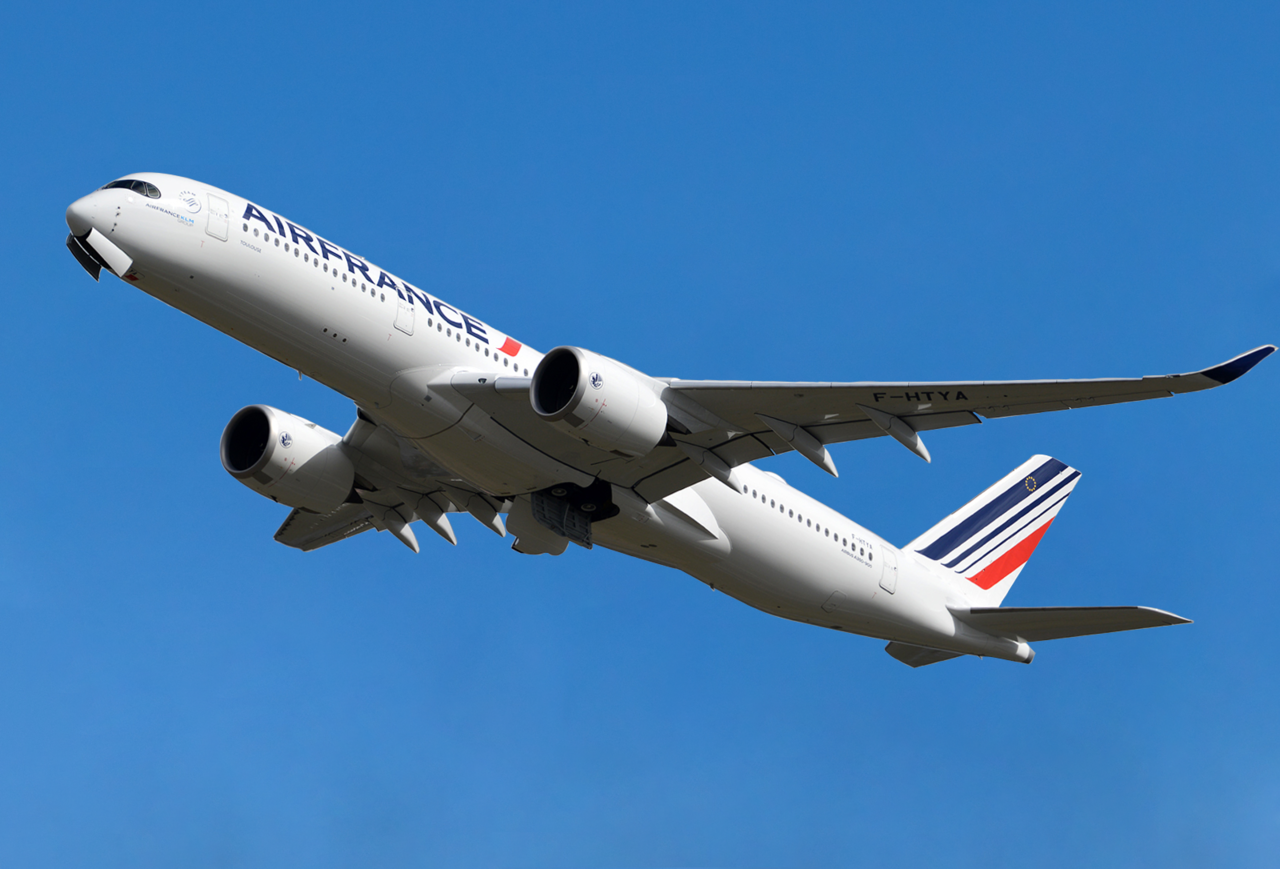
A BEA report reveals how undetected radome damage on Air France AF291 triggered radar failures, unreliable airspeed and an overweight A350 return to Osaka.
On 28 May 2023, an Air France Airbus A350‑900 operating flight AF291 from Osaka Kansai to Paris Charles de Gaulle experienced a rare and serious in‑flight failure that forced the crew to abandon the transcontinental crossing and return to Japan.
The BEA’s final report reconstructs the sequence of events in detail, showing how undetected radome damage, cascading weather radar faults, and unstable air data indications combined to create a complex and high‑workload emergency for the four‑pilot crew.
The incident ultimately ended in a safe—though significantly overweight—landing back at Kansai.
This article breaks down the investigation’s findings and the operational lessons now influencing Airbus and Air France procedures.
Early Radar Failures in the Climb Onboard AF291

AF291 departed Osaka at 02:14 UTC with 14 crew members and 309 passengers. The augmented crew included a captain and three first officers, with the captain acting as PF for the departure.
Before the flight, the inbound crew had informally mentioned intermittent weather radar faults.
Maintenance personnel in Osaka reported that both radar systems had been tested and were functioning normally.
Eight minutes after takeoff, climbing through 11,600 ft, the first fault appeared: SURV WXR 2 FAULT.
Over the next several minutes, both radar channels produced intermittent failures, triggering repeated MASTER CAUTION alerts.
The crew attempted resets, mode changes, and switching between radar 1 and 2, but neither system stabilised.
By the time the aircraft levelled at FL350, the ECAM displayed SURV WXR 1+2 FAULT, prompting the crew to apply the TOTAL LOSS OF WXR procedure.
With cumulonimbus forecast along the Siberian route and more than six hours of flight ahead, the crew conducted a FORDEC assessment and elected to return to Osaka.
A Sudden Structural Failure at FL300 Onboard AF291
At 03:17, descending through FL300 at 320 kt, the crew heard a loud thud followed by intense aerodynamic noise.
Engine N1 values fluctuated, prompting the PF to disconnect autothrust. Initially suspecting a pressurisation issue, the crew quickly ruled it out.
A 300‑ft discrepancy between PFD 1 and PFD 2 altitudes suggested a structural failure affecting air data sources.
The crew suspected the radome had detached or been severely damaged.
Within a minute, the A350’s PRIMs rejected one air data source and triggered NAV AIR DATA REDUNDANCY LOST, followed by MULTIPLE AIR DATA REJECTED BY PRIMs.
The aircraft briefly reverted to ALTERNATE law.
The BEA later confirmed that the radome had collapsed inward, severely deforming the nose structure and disrupting airflow to the pitot probes, AOA vanes, and static ports.
Managing Unreliable Airspeed in Descent
From FL150 downward, the crew began experiencing fluctuating airspeed indications—particularly on PFD 1—with variations around the GREEN DOT speed.
At 03:40, they declared MAYDAY and applied the UNRELIABLE AIRSPEED procedure.
The A350’s NAIADS system, which automatically switches between air data sources, was rejecting and re‑selecting probes based on the disturbed airflow.
This created intermittent stability in the displayed speeds, followed by sudden divergences.
The crew kept AP, FD, and A/THR engaged as recommended, but the aircraft continued to oscillate between NORMAL and ALTERNATE law.
At this stage, the aircraft weighed approximately 253 tonnes, well above the A350’s 207‑tonne maximum landing weight.
With no fuel‑jettison capability, the crew descended early to burn fuel while maintaining a conservative speed margin.
Approach Configuration Triggers Severe Speed Divergence
The most dramatic airspeed anomalies occurred during the approach.
At 05:01, the crew selected CONF 1. Slat deployment altered the airflow around the damaged radome, causing the first major divergence in indicated airspeeds.
At 05:02, as the flaps extended, the PFDs displayed sudden, sharp drops and large discrepancies between the captain’s and first officer’s airspeed indications.
The crew believed the radome had detached entirely.
Recognising the situation as a full UAS event, the crew selected F/O on BKUP SPD, disconnected AP, A/THR, and FD, and transitioned to manual flight using the HUD.
They cross‑checked pitch and thrust against the FCOM tables, though these only extend to 210 tonnes—forcing the pilots to extrapolate values for their 248‑tonne landing weight.
Despite the degraded aerodynamics and vibration, the aircraft stabilised in CONF 3 and later CONF FULL.
A Safe but Overweight Landing
At 05:24 UTC, after a long downwind leg and a carefully managed manual approach, F‑HTYO landed safely on runway 24R at Osaka Kansai.
Post‑flight inspection revealed that the radome remained attached but was severely crushed inward, and the weather radar antenna was damaged.
The airflow disruption had affected all forward air data sensors.
The BEA concluded that the radome had likely been structurally compromised before departure, and the collapse occurred due to aerodynamic loads during descent.
Maintenance Oversight and System Behaviour
The BEA found that the radome’s composite structure had likely suffered internal damage that went undetected during maintenance.
The inspection procedures did not sufficiently highlight the vulnerability of composite radomes, and technicians may not have fully appreciated the risk of internal delamination.
The weather radar faults were early indicators of this structural degradation, as the antenna’s movement and signal path were being affected.
The inward deformation created turbulent, asymmetric airflow over the pitot probes, AOA sensors, and static ports, leading to intermittent rejection of air data sources by the PRIMs and NAIADS.
Despite this, the BEA highlighted the crew’s effective CRM, disciplined use of FORDEC, and correct application of UAS procedures.
Safety Actions and Industry Impact Following AF291
Airbus has updated radome inspection tasks, revised troubleshooting procedures for WXR faults, and amended A350 FCOM and FCTM guidance on UAS and NAIADS behaviour.
Air France has issued guidance to pilots on NAIADS logic, reinforced maintenance training on composite radome inspection, and emphasised strict adherence to AMM procedures.
The AF291 incident demonstrates how a seemingly minor, undetected structural defect can cascade into a complex, multi‑system in‑flight emergency.
The crew’s disciplined management of unreliable airspeed, combined with a methodical overweight landing strategy, prevented a potentially catastrophic outcome.
For operators, the event reinforces the importance of composite structure awareness, robust troubleshooting of repeated WXR faults, and deep familiarity with the A350’s air data architecture.
Continue to follow The Aviation Hub for more analysis and insight!