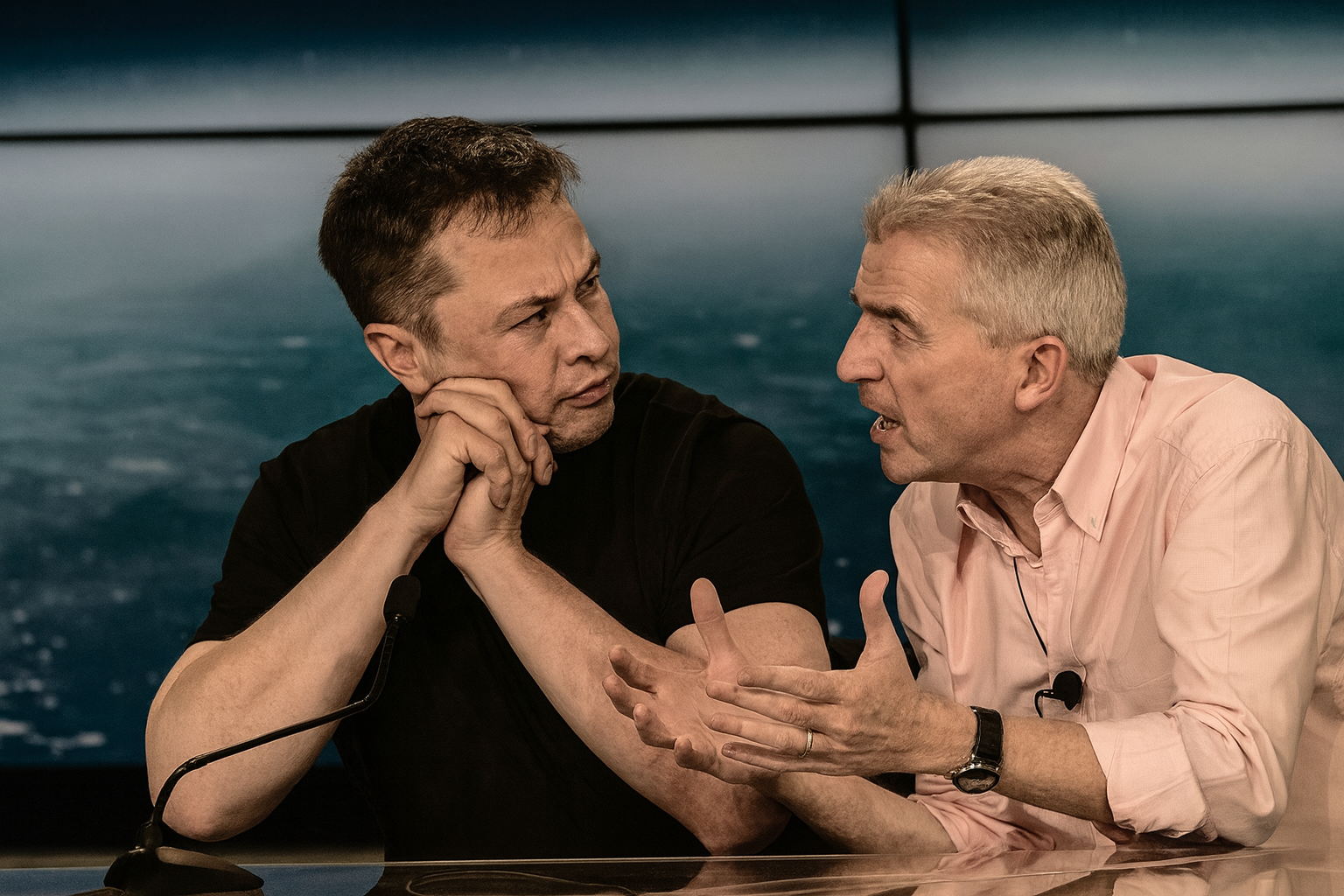
The aviation and tech worlds are no strangers to bold personalities, but few clashes have erupted as spectacularly as the recent feud between Ryanair CEO Michael O’Leary and tech billionaire Elon Musk.
What began as a technical disagreement over in‑flight Wi‑Fi has spiralled into a full‑blown public brawl—complete with insults, corporate mockery, and even half‑serious threats of a hostile airline takeover.
At the centre of the dispute is Ryanair’s decision to reject Starlink, the satellite‑based internet service developed by Musk’s SpaceX.
While dozens of airlines worldwide have embraced Starlink for its high‑speed connectivity, O’Leary has dismissed the system as economically unworkable for an ultra‑low‑cost carrier.
His comments triggered a chain reaction that quickly turned personal, exposing a cultural and strategic divide between Silicon Valley ambition and Ryanair’s famously ruthless cost discipline.
Why Ryanair Said “No” to Starlink & Elon Musk
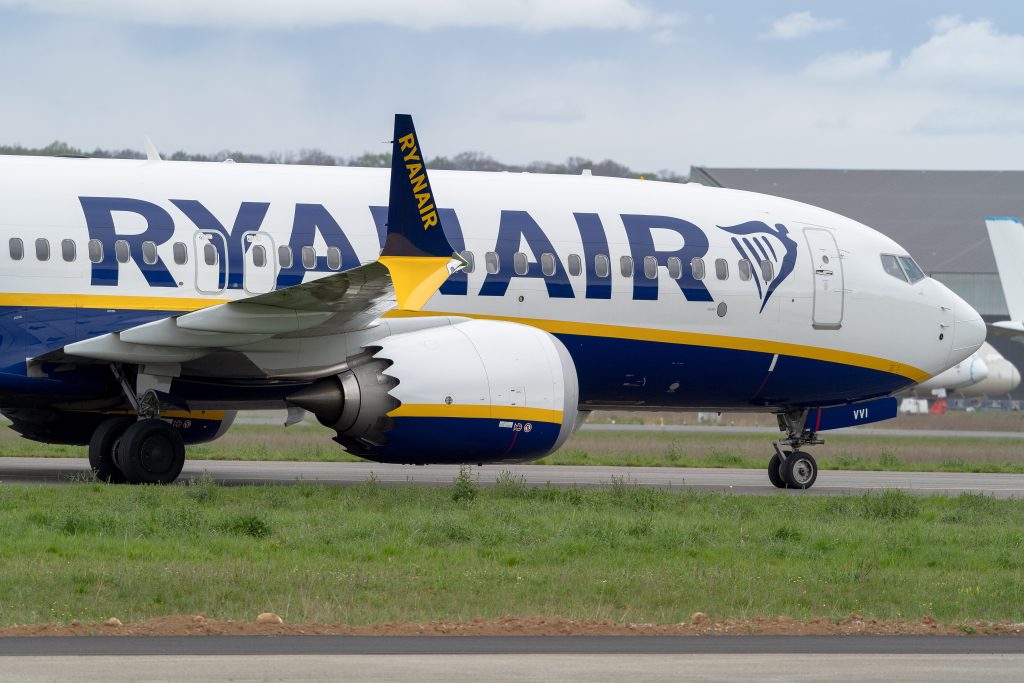
Ryanair operates more than 600 Boeing 737 aircraft, flying short‑haul routes where every kilogram of weight and every fraction of a percent of fuel burn matters.
O’Leary argued that installing Starlink’s external antennas would impose a 2% fuel penalty, costing the airline hundreds of millions of dollars annually—a figure he said would never be recouped on short flights where passengers “won’t pay one euro” for Wi‑Fi.
For O’Leary, the maths simply didn’t add up.
Ryanair’s business model thrives on razor‑thin margins, ancillary revenue, and operational efficiency.
Adding weight and drag for a service he believes passengers won’t pay for was, in his view, a non‑starter.
Starlink’s engineering team pushed back hard.
Michael Nicolls, the company’s vice president of engineering, said Ryanair’s estimates were wildly inflated.
According to Starlink’s internal analysis, the fuel penalty would be no more than 0.3%, thanks to a newer, thinner antenna design that dramatically reduces aerodynamic drag.
Nicolls conceded that O’Leary’s 2% figure might apply to older Wi‑Fi systems—but insisted Starlink’s hardware was in a different league.
The War of Words Erupts Between Elon Musk & Michael O’Leary…
The disagreement might have remained a technical debate—until O’Leary went on Ireland’s Newstalk radio and delivered a characteristically blunt assessment of Musk.
“He’s an idiot—very wealthy, but still an idiot,” O’Leary said, adding that he would “pay no attention whatsoever to Elon Musk”.
Elon Musk, never one to let an insult pass quietly, fired back on X (formerly Twitter), calling O’Leary an “utter idiot” and urging Ryanair to fire him.
He accused the airline of misunderstanding Starlink’s fuel impact “by a factor of 10,” and later joked about buying Ryanair outright and replacing its CEO with someone “whose actual name is Ryan”.
Ryanair’s social media team—well‑known for its cheeky online persona—joined the fray.
When X suffered a major outage across the United States, the airline posted:
“Perhaps you need Wi‑Fi, @elonmusk?”
The jab went viral, further inflaming tensions.
A Bigger Battle: Tech Optimism vs. Airline Pragmatism
Beyond the insults, the feud highlights a deeper philosophical divide.
Elon Musk’s worldview is rooted in technological maximalism: if something can be improved with engineering, it should be.
Starlink’s rapid adoption across global carriers—including Lufthansa, Qatar Airways, Alaska Airlines, airBaltic, and United Airlines—supports his belief that high‑speed in‑flight connectivity is becoming a baseline expectation for travellers.
O’Leary’s worldview, by contrast, is grounded in cost discipline. Ryanair’s success comes from stripping away anything that doesn’t directly support low fares.
For him, Wi‑Fi is a luxury—one that passengers may enjoy if free, but won’t pay for. And if they won’t pay, Ryanair won’t install it.
This tension between innovation and frugality is not new in aviation, but rarely has it been expressed so publicly or so personally.
The Stakes for Starlink
Starlink’s aviation ambitions are significant.
A 2025 Cornell University study found that Starlink delivers far superior speeds and reliability compared to legacy systems, often exceeding 200 Mbps—fast enough for streaming and video conferencing in the sky.
For long‑haul carriers, this is a game‑changer.
But Ryanair is Europe’s largest airline by passenger numbers.
Securing a deal with such a giant would have been a symbolic victory for Starlink’s expansion into the low‑cost market.
Losing that deal—especially amid a public spat—risks signalling to other budget carriers that the economics may not work.
What Happens Next?
Neither side shows signs of backing down.
Elon Musk continues to insist that Starlink’s hardware is efficient and cost‑effective.
O’Leary remains adamant that the numbers don’t add up. And both men seem to relish the attention that comes with a high‑profile feud.
In practical terms, Ryanair passengers shouldn’t expect Starlink—or any Wi‑Fi—on their flights anytime soon.
O’Leary has made it clear that unless the economics shift dramatically, connectivity won’t be part of the Ryanair experience.
For Elon Musk, the fallout is more reputational than operational.
Starlink’s airline partnerships continue to grow, and the company remains a leader in satellite connectivity.
But the clash between these two outspoken executives has become a case study in how corporate disagreements can escalate in the age of social media—especially when both parties are known for speaking their minds.
If nothing else, the feud has provided a rare moment of entertainment in the often‑dry world of aviation technology.
And given the personalities involved, the turbulence may not be over yet.
Continue to follow The Aviation Hub for more analysis and insight!