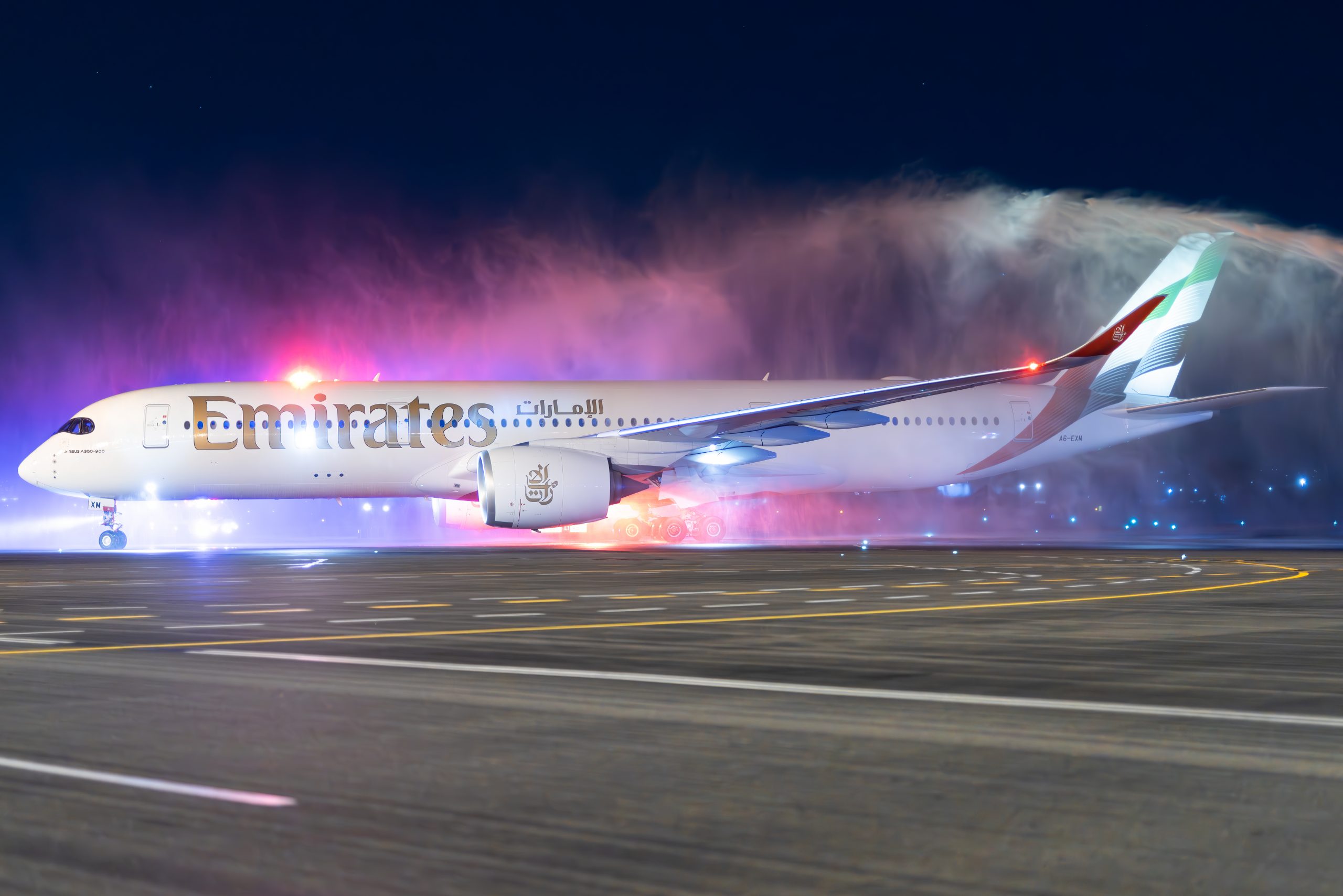
Emirates has this week deployed it’s Airbus A350-900ULR (Ultra-Long Range) variant aircraft to Adelaide, Australia – with this in mind, where else is next for the aircraft in the airline’s network?
This comes following the last couple of months of fleet and route development that has occurred within the Dubai-based carrier.
Services between Dubai and Adelaide with this new variant of aircraft began on December 1st, with this now operating on a daily basis, replacing the Boeing 777-200LR aircraft that would normally operate the flight.
Commenting on the launch of these flights was Barry Brown, Divisional Vice President Australasia at Emirates:
“This is a landmark moment for Emirates, highlighting Adelaide and South Australia’s vital role in our global operations.”
“Adelaide proudly becomes the first Australian city to welcome the Emirates A350.”
“With this, our new and highly acclaimed Premium Economy cabin debuts in Adelaide, completing the cabin’s rollout across all five of Emirates’ Australian gateways.”
“While Emirates has been accepting the delivery of A350s for the past year, this is the first delivery of our long-range variant with the range and capability to fly from Dubai to Adelaide.”

“Adelaide has been earmarked to receive this new aircraft for some time, underscoring our commitment to the South Australian capital.”
“These milestones are a powerful statement of our ongoing investment and commitment to bringing our latest generation product to Australia and will provide South Australians with direct access to our most advanced, comfortable seats and an elevated flying experience, offering seamless connections to Europe and beyond for both business and leisure.”
“Premium Economy has proven incredibly popular, consistently achieving strong load factors to and from Australia, and we anticipate a similar strong demand in Adelaide for the cabin’s quiet luxury and customised experience.”
The Two Airbus A350-900ULRs for Emirates So Far…
The two Emirates Airbus A350-900ULRs that have been operating on the Dubai-Adelaide route has been A6-EXM and A6-EXK.
A6-EXK was delivered to the UAE carrier on October 9, and entered into service four days afterwards.
A6-EXM was delivered on Halloween this year, and entered into commercial service on November 3rd.
These seem to be the aircraft operating this ultra-long-haul route at present, with no variation expected at the time of writing.
Emirates has opted to have their A350-900ULRs deployed with a standard configuration, which is as follows:
- 32 seats in Business Class
- 28 seats in Premium Economy
- 238 seats in Economy
This means that given with the number of seats on offer, the aircraft can fly non-stop for around 15 hours, which is roughly how long the Emirates flight between Dubai and Adelaide takes.
Of course, Singapore Airlines’ A350-900ULRs can fly longer than that, but that is down to having less seats and a more premium focus placed on the flights to the likes of New York, Los Angeles and other destinations from Changi Airport.
For example, their ULRs have 67 seats in Business Class and 94 in Economy.
So, realistically, for Emirates A350-900ULRs to be able to fly just 15 hours carrying near enough 300 passengers, is an impressive feat in itself.
Such an expansion in it’s Airbus fleet has been impressive in just over 12 months, having received 13 at present, so a little over one per month at the moment.
Where Else Could The Airline Deploy These Aircraft?

For Emirates, it seems that 15 hour flight times seem to be the sweet spot, and has worked to their benefit when it comes to the Airbus A350-900ULR, and also it’s choice of Adelaide as well.
Within Australia, it is unclear what the plan is next following Adelaide in terms of where this aircraft will be deployed to next.
You do have to remember that the carrier operates the Boeing 777 on it’s Melbourne flights, so it would make sense that this destination becomes the next in the country to receive the aircraft.
What this does also represent for Australia is that all five Australian cities in their network offers next-generation aircraft.
But outside of Australia, the sky is the limit (pardon the pun) is there for Emirates to deploy the Airbus A350-900ULR as more units of that variant are delivered in the months and years to come.
From it’s hub in Dubai, a lot of flights to the West Coast U.S would be in that 12-15 hour mark, so there could be scope there, as well as into Southern Africa and even South America as well.
All eyes will be on what Emirates will do with the Airbus A350-900ULR and what the operation will look like outside of Adelaide.
Overall Thoughts…
It remains clear that the Adelaide operation utilising Emirates’ Airbus A350-900ULR aircraft is a big step for the carrier but also for the airport as well.
On a daily basis, the region will benefit significantly from this movement, as well as Australia as a whole too due to the continued interconnected links to Dubai as well.
What will be interesting is to determine where else the airline will deploy this special variant of what will be an important aircraft type for the carrier as we get closer to the end of the decade and beyond.
As well as the A350, Emirates is still to receive Boeing 777X and 787 aircraft, and will no doubt form part of a complemented strategy of connectivity all around the world for tourism, business and more.
One thing is for sure though with Emirates. They will continue to grow capacity whenever the opportunity presents itself, and don’t have any indicators of slowing down.
They are one of those airlines that have now established themselves to a point that it is impossible for them to fail due to their sheer size.
And that provides a great combination for a carrier that will be wanting to keep these successes up going into the long-term. And they definitely see Adelaide and the rest of Australia as part of that continued success strategy, that’s for sure.
Be sure to continue following The Aviation Hub for more analytical insight into the commercial aviation industry!