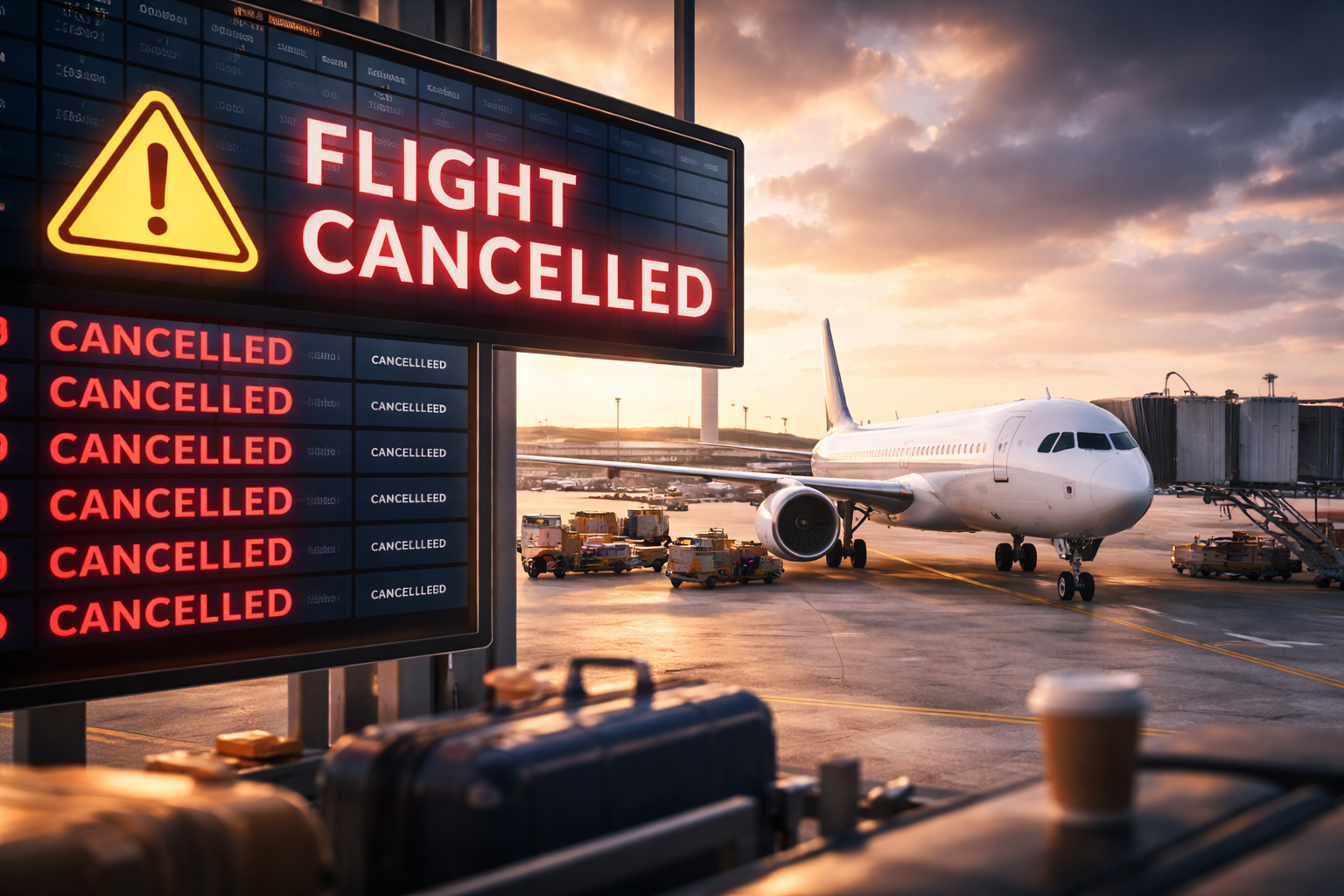

Cancellation of flights can feel random, but in Europe, those pressure points have been getting worse.
In reality, cancellations are usually a deliberate operational decision—made to stop a problem in one part of the system from snowballing across the entire network.
And in Europe, those pressure points have been getting worse: higher demand, tighter airspace and ATC constraints, and thinner operational buffers mean airlines are more likely to cancel rather than “try and recover later.”
EUROCONTROL has repeatedly highlighted how seasonal peaks strain the network, with traffic rising and delay pressure intensifying in summer.
The simple truth: airlines cancel to protect the network
Airlines don’t cancel flights because they “feel like it.” They cancel because the airline’s operation is a chain—aircraft rotations, crews, gates, slots, maintenance windows—and once key links break, the cheapest way to stop the damage is to remove flights from the schedule.
A cancellation can be the least-bad option when:
- the aircraft is out of position (stuck at another airport),
- the crew can’t legally operate the next sector,
- the flight would miss its slot and create bigger downstream disruption,
- capacity restrictions (ATC/airport) make the flight infeasible.
This is why, in big disruption events, you’ll see airlines cancel early—because early cancellations reduce passenger misconnects and prevent late-night knock-on chaos.
The main causes of cancellations in Europe
1) ATC capacity and staffing constraints are a structural bottleneck
Europe’s airspace is fragmented across many national air navigation service providers (ANSPs). When capacity is constrained—especially in peak summer—delays rise and airlines often cancel flights to keep aircraft and crew rotations viable.
Multiple industry sources point to ATC capacity and staffing issues as a major driver of delays and disruption across Europe, particularly in peak months.
For example, IATA has highlighted a long-term worsening trend in European ATC delay minutes and attributed a large share of ANSP delay to staffing/capacity issues.
EUROCONTROL’s network performance reporting and annual delay reporting also document how ATC-related issues contribute to disruption and can lead to cancellations.
Why this leads to cancellations (not just delays):
- If a flight is delayed enough, the crew may “time out” (legal duty limits).
- If the aircraft misses its next slot at a constrained airport, the rotation collapses.
- Airlines may cancel a later flight to free the aircraft/crew to operate a higher-priority service.
2) Summer peaks are harsher in Europe than many people expect
Europe’s summer schedule is intense: leisure demand spikes, airports run closer to maximum capacity, and there’s less room to “absorb” disruption.
EUROCONTROL’s summer network reporting shows how traffic increases in summer and how performance challenges scale with demand.
What feels like “one delayed flight” is often:
- a saturated airport system,
- constrained en-route sectors,
- and an airline trying to keep the rest of its timetable intact.
3) Weather is still real—but its impact is often indirect
Weather doesn’t need to be extreme at your departure airport to cancel your flight.
Thunderstorms in one region can force reroutes, reduce sector capacity, and trigger air traffic flow restrictions.
EUROCONTROL’s monthly and annual reporting routinely breaks down delay drivers across the network, including weather and ATC factors.
In Europe, the key point is: weather interacts with constrained capacity. A network that’s already stretched is far more vulnerable to any “shock.”
4) Airline resourcing and operational buffers are thinner
Post-pandemic, airlines have had to rebuild staffing and resilience while demand returned strongly. Many schedules are built for utilisation—aircraft flying more hours per day—because that’s how airlines make money. But high utilisation means:
- fewer spare aircraft
- fewer recovery options
- tighter turnarounds
When the operation slips, cancellations become a tool to “reset” the plan.
Why it’s getting worse in Europe specifically
Europe’s airspace complexity is a disadvantage during disruption
Europe isn’t one unified ATC system; it’s many.
That fragmentation makes it harder to flex capacity when demand surges.
When a few key control centres or corridors become constrained, the effects ripple across borders.
Industry and network-level reporting has repeatedly pointed to capacity constraints as a central factor behind recent European disruption patterns.
“Delay minutes” are a warning signal for cancellations
Even if you’re writing about cancellations, it’s worth tracking delay metrics—because heavy delays are the precursor conditions that force airlines into cancellation decisions.
IATA’s numbers on European ATC delay minutes (and their concentration in peak summer months) illustrate why airlines struggle to keep schedules intact during the busiest periods.
New operational friction points can also pile on
Beyond ATC and weather, Europe periodically introduces new sources of friction—border processes, airport staffing pressures, ground handling constraints.
Even when these don’t directly “cause” cancellations, they reduce recovery capacity. (For example, recent reporting around border processing changes shows how non-flight factors can create major airport congestion.)
What passenger rights do—and don’t—do about cancellations
In the UK and EU, passenger protections are strong on paper.
The UK CAA explains that passenger rights cover cancellations and delays, including assistance and (in many cases) compensation depending on notice, circumstances, and cause.
EU rules (commonly referred to via Regulation (EC) No 261/2004) set out key obligations such as care, re-routing, reimbursement, and compensation conditions.
The UK government also provides a summary guide to passenger rights and airline obligations.
But rights don’t prevent cancellations because:
- they don’t create ATC capacity,
- they don’t conjure spare aircraft or crews,
- they don’t eliminate weather constraints,
- and they don’t change the physics of network recovery.
They do change airline incentives at the margin—especially around notice periods and duty of care—but they can’t remove the underlying operational constraints.
What actually reduces cancellations in Europe
If Europe wants fewer cancellations, the solutions are mostly unglamorous:
- ATC capacity and staffing resilience
- recruitment and training pipelines
- better rostering and peak planning
- faster recovery when sectors degrade
- Network-level planning and coordination
- pragmatic capacity declarations for peaks
- better cross-border flow management
- realistic schedules that match available capacity
- Airline operational buffers
- more standby crews during peak periods
- spare aircraft in strategic locations
- slightly longer turnarounds where feasible
None of this is easy or cheap—but it’s the difference between a system that absorbs disruption and one that collapses into mass cancellations.
Bottom line
Flights get cancelled when the airline’s operation can’t be recovered safely and legally within the constraints of airspace, airports, crew rules, and aircraft availability.
And Europe’s cancellations problem is getting worse because the network is running hotter: higher peak demand meets constrained airspace capacity and limited operational slack.
If you’re a passenger, the most useful mindset shift is this:
A cancellation is often the airline protecting the rest of the schedule—and in a stretched European system, that decision is happening more often than it used to.
Continue to follow The Aviation Hub for more analysis & insight!