Disruptive Passenger Onboard United Airlines 777 to San Francisco
 By The Aviation Hub
4 min read
By The Aviation Hub
4 min read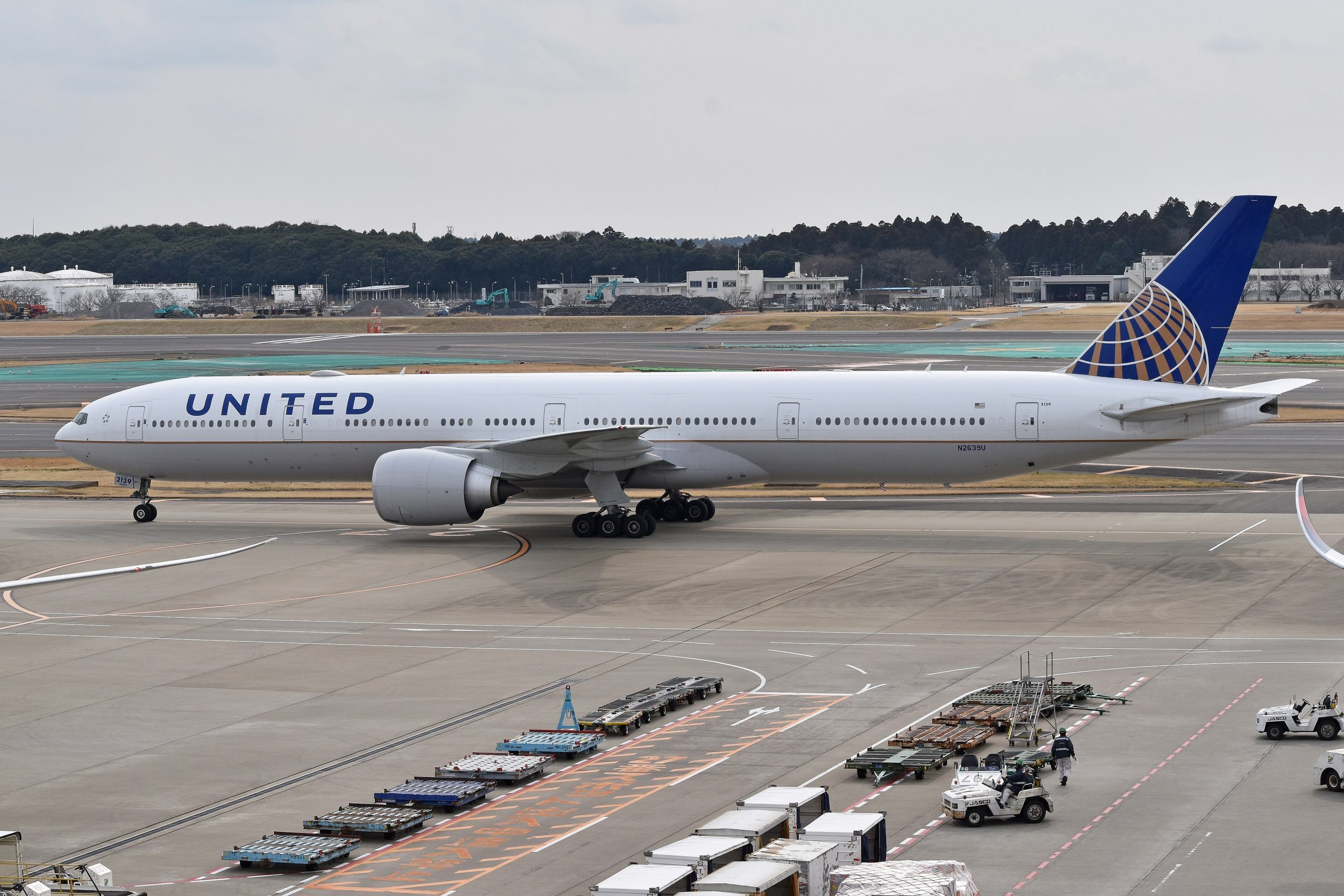
A disruptive passenger onboard a United Airlines Boeing 777 bound for San Francisco prompted a diversion to Tokyo.
A United Airlines Boeing 777-300ER bound for San Francisco was forced to turn back to Japan on 24 June after a passenger became disruptive in the cabin, delaying hundreds of travellers and triggering an unscheduled landing at Tokyo Narita Airport.
The widebody, registered N2138U and operating flight UA858, had already departed Shanghai Pudong International Airport when the atmosphere onboard deteriorated to the point where the crew judged that continuing the long journey across the Pacific was no longer advisable.
What Happened Onboard The San Francisco-bound Flight…
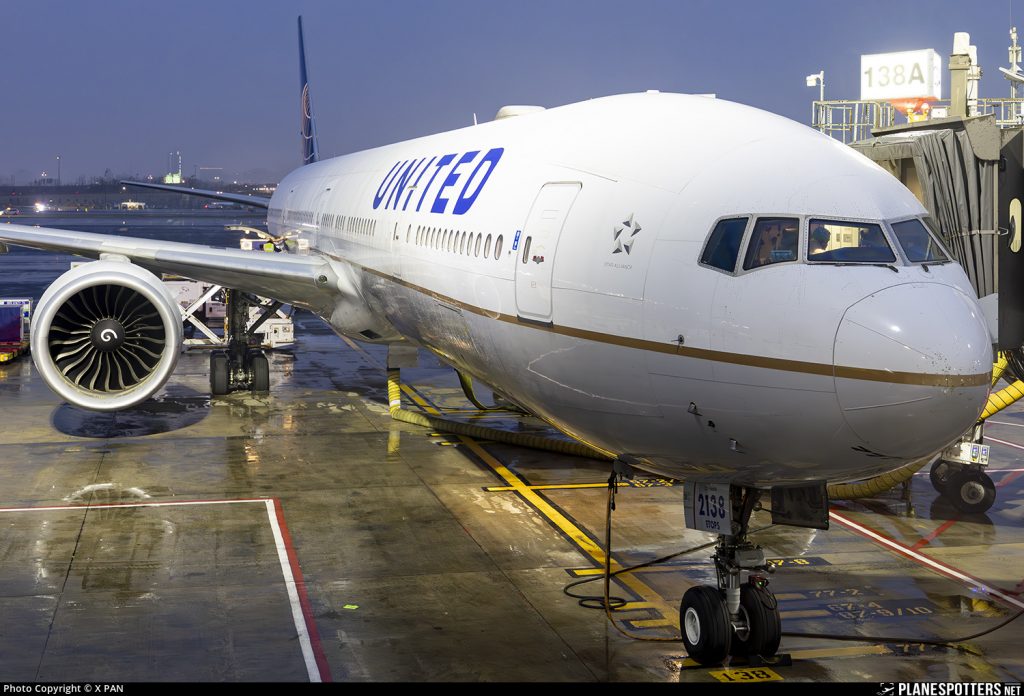
According to airline and passenger accounts, the individual grew increasingly agitated during the early part of the flight.
Witnesses described the passenger arguing with cabin crew, throwing items around her seating area and behaving erratically as tensions rose.
The confrontation escalated until the captain stepped in personally, and when the disturbance failed to settle, the flight deck made the decision to divert in the interest of safety.
The aircraft was carrying 285 passengers and 16 crew members at the time.
Diverting a fully loaded 777 is never a simple matter.
Because the aircraft had departed with enough fuel for a Pacific crossing, it was well above its maximum landing weight, and crews in this situation must either burn off or dump fuel before touching down.
Passengers reported that fuel was offloaded to bring the jet within safe landing limits at Narita.
Police Meet the Flight in Tokyo
United Airlines confirmed that law enforcement boarded the aircraft once it arrived in Japan and removed the passenger from the cabin.
With the individual no longer onboard, engineers carried out maintenance checks before the aircraft was cleared to continue.
The airline emphasised that the safety of passengers and crew remained the priority throughout the episode.
United Airlines Flight UA858 – Shanghai to San Francisco…
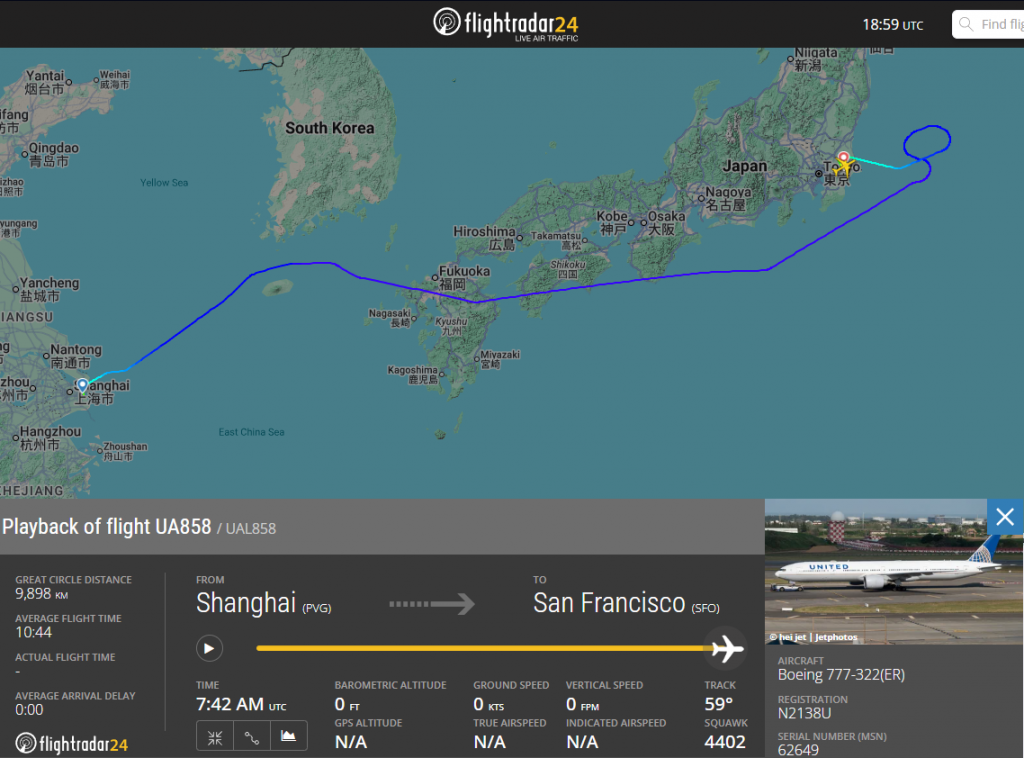
Flight UA858 is a scheduled service linking Shanghai Pudong with San Francisco International Airport.
On the day of the incident the aircraft pushed back from Shanghai at around 04:43 UTC before the diversion unfolded a few hours later.
Passengers noted that the turn toward Tokyo came roughly four hours after departure, with the jet eventually landing at Narita to resolve the situation.
Once the passenger had been removed and the necessary checks completed, the same aircraft resumed the journey as UA858 out of Narita.
The repositioned leg departed at approximately 09:14 UTC and went on to complete a flight of around eight hours and twenty five minutes, touching down in San Francisco at 17:40 local time.
Despite the lengthy interruption, every remaining passenger reached their destination later the same day.
About the Aircraft
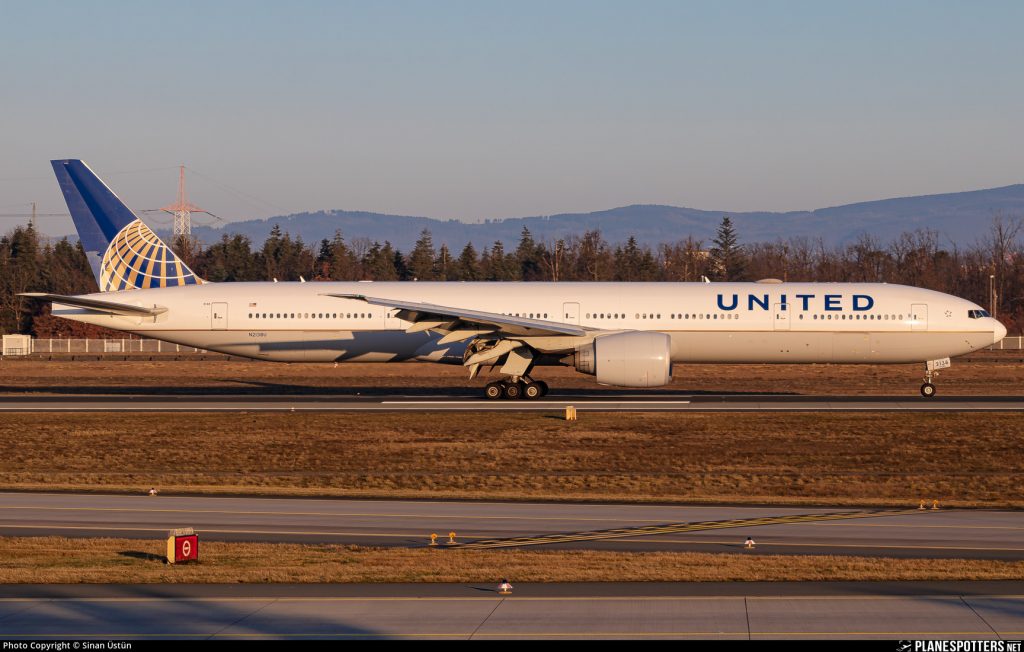
The aircraft involved was a Boeing 777-300ER carrying the manufacturer serial number 62649 and line number 1483.
It first took to the skies on 22 March 2017 from Boeing’s Everett facility in Washington State and was delivered to United Airlines on 31 March 2017.
Furthermore, the jet was ferried from Everett to San Francisco on 25 July 2017 and entered revenue service on 9 August 2017.
Now around nine years old, the airframe wears United’s fleet number 2138 and the hex code A1C82A.
It is powered by two General Electric GE90-115B engines, among the most powerful commercial turbofans ever built, and is arranged in a three class cabin offering 60 Polaris business seats, 24 Premium Plus seats and 266 economy seats.
The aircraft remains active in United’s long haul fleet and was back flying international rotations within days of the incident.
A Familiar Problem for Airlines
The diversion adds to a growing list of onboard disruptions affecting long haul commercial flights around the world.
Carriers continue to grapple with unruly passenger behaviour, which can place crews under pressure, unsettle fellow travellers and generate significant operational cost whenever a diversion becomes unavoidable.
Furthermore, each unscheduled landing carries knock on effects for crew duty limits, aircraft scheduling and connecting passengers.
For United, the swift response brought the situation under control with no reported injuries, and the aircraft returned to normal service shortly afterwards.
Overall, the episode is nonetheless a reminder of how a single individual can disrupt the plans of hundreds and force a flight crew to make difficult decisions thousands of feet above the ocean.
Continue to follow The Aviation Hub for more analysis and insight!
Advertise with us Your brand, in front of an aviation audience Home page and in-article placements, sold directly, one advertiser per slot. From £250 a year. See the rates