Dubai International Airport’s Departure Strain Deepens Amid Iran War
 By The Aviation Hub
4 min read
By The Aviation Hub
4 min read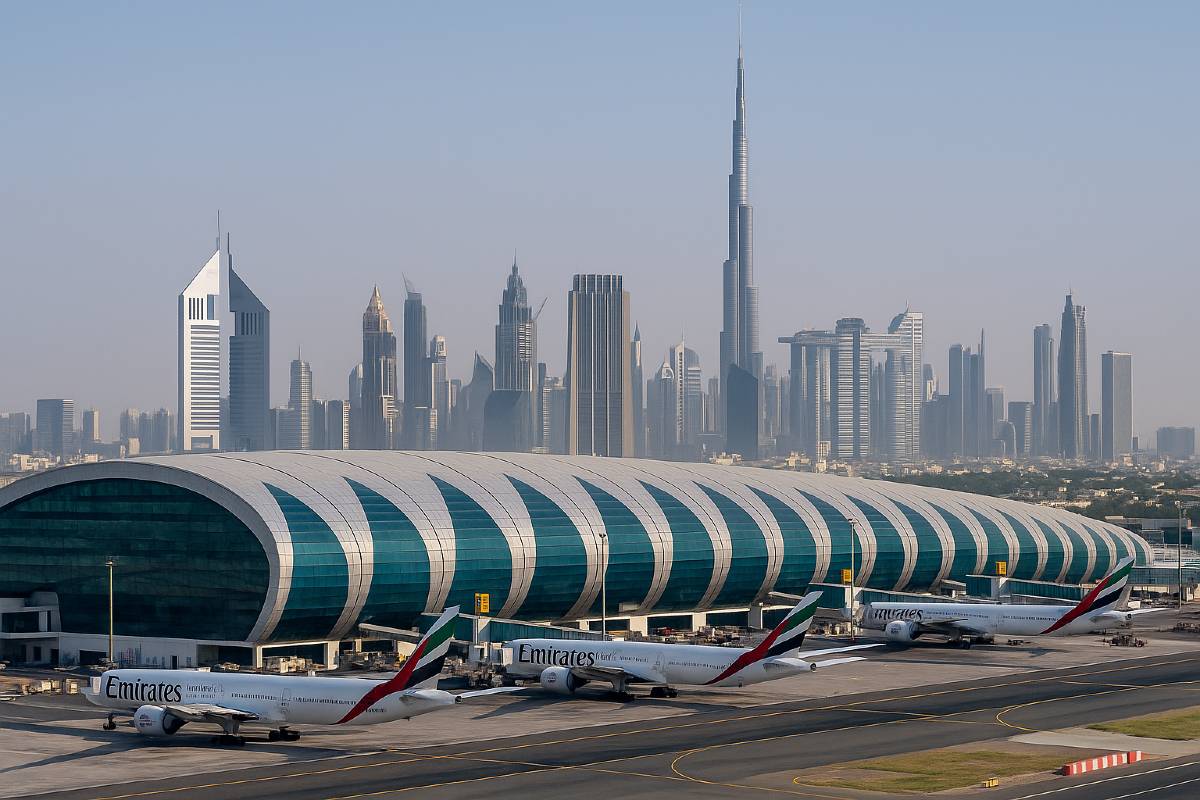
Dubai International Airport has spent the past 30 days navigating one of the most turbulent operational periods in its recent history due to the Iran War.
The escalation of the Iran War has reshaped airspace availability, airline scheduling confidence, and day‑to‑day operational resilience across the region.
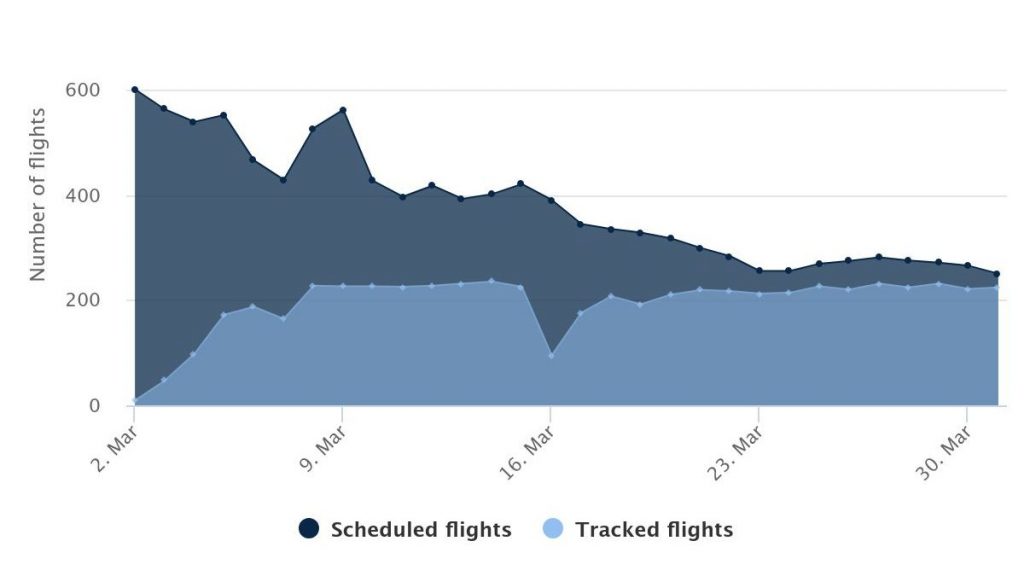
Nowhere is this more visible than in the airport’s scheduled versus tracked departures, which show a steady erosion of planned activity and a widening gap between what airlines intended to operate and what ultimately took off.
The data paints a clear trajectory.
On 2 March, Dubai International had 600 scheduled departures, yet only 9 tracked flights were recorded.
By the end of the month, scheduled departures had fallen to 250, while tracked flights had risen to 224.
This inversion of volume and reliability reflects a system under pressure, adjusting in real time to geopolitical volatility.
The Early Shock For Dubai International Airport
The first week of March reveals the sharpest contrast between expectation and reality.
Scheduled flights fall from 600 to 428 between 2 and 7 March, a drop of nearly one‑third. Tracked flights, meanwhile, climb from 9 to 164.
The widening gap suggests airlines initially attempted to maintain ambitious schedules despite the conflict’s early disruptions, only to cancel or reroute heavily as the operational picture deteriorated.
The figures from the document underscore this mismatch.
On 4 March, for example, the airport listed 538 scheduled flights but tracked only 98.
By 6 March, the schedule had dropped to 465, yet tracked flights had climbed to 187.
This pattern indicates a system recalibrating: airlines were still filing schedules based on pre‑conflict assumptions while the airport was contending with rapidly shifting realities.
Stabilisation Under Stress
From 8 March onward, the data shows a more consistent relationship between scheduled and tracked flights.
Scheduled departures continue to decline, but tracked flights stabilise in the 200–230 range for most of the month.
On 9 March, the airport recorded 561 scheduled flights and 226 tracked flights.
By 14 March, scheduled flights had fallen to 401, while tracked flights reached 235, one of the highest figures in the dataset.
This stabilisation suggests that airlines and airport operators had begun to adapt to the constraints imposed by the conflict.
Rerouting through safer corridors, consolidating frequencies, and adjusting crew and fleet allocations appear to have helped maintain a relatively steady level of actual operations, even as the published schedules became increasingly conservative.
The outlier on 16 March, where tracked flights drop to 95 against 390 scheduled, hints at a temporary disruption, possibly a sudden airspace closure or a surge in regional military activity.
But the rebound the following day, with 176 tracked flights, shows the airport’s ability to recover quickly.
The Slow Squeeze on Capacity in Dubai
The most striking trend is the sustained decline in scheduled departures.
From 600 at the start of the month to 250 by 31 March, the airport’s planned capacity has more than halved.
This is not a short‑term shock but a structural response to prolonged instability.
The data from the final week illustrates this clearly. Scheduled flights hover between 255 and 281, while tracked flights remain remarkably steady between 214 and 231.
The narrowing gap between scheduled and tracked flights suggests that airlines have finally aligned their schedules with operational reality.
What is planned is now much closer to what can actually be flown.
This alignment is a sign of maturity in crisis management, but it also reflects the depth of the challenge.
Dubai International is operating with a significantly reduced schedule, and even though tracked flights remain relatively stable, the airport’s overall throughput is far below normal levels.
A System Adapting, Not Collapsing
Despite the pressures of the Iran War, the data shows resilience rather than breakdown.
Tracked flights remain consistently above 200 for most of the month, demonstrating that Dubai International continues to function as a major regional hub even under constrained conditions.
What has changed is the scale and predictability of operations.
Airlines have trimmed schedules aggressively, and the airport has shifted from a high‑volume, high‑frequency model to one focused on reliability and operational certainty.
The month‑long trend, from 600 scheduled flights and 9 tracked flights on 2 March to 250 scheduled and 224 tracked on 31 March—captures this transformation.
Dubai International has not been overwhelmed by the conflict, but it has been reshaped by it, operating with a leaner schedule and a more cautious approach as the regional situation continues to evolve.
Continue to follow The Aviation Hub for more analysis and insight!
Advertise with us Your brand, in front of an aviation audience Home page and in-article placements, sold directly, one advertiser per slot. From £250 a year. See the rates